
Ask questions which are clear, concise and easy to understand.
Ask QuestionPosted by Nishant Pal 7 years, 4 months ago
- 1 answers
Posted by Tanveer Arhaan 6 years, 6 months ago
- 1 answers
Sia ? 6 years, 6 months ago
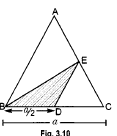
Let the side of triangle = a
{tex}\therefore{/tex} BC = a {tex}\Rightarrow{/tex} BD = {tex}\frac{a}{2}{/tex}
Now area({tex}\triangle{/tex}BDE) = {tex}\frac{\sqrt{3}}{4}{/tex}({tex}\frac{a}{2}{/tex})2 = {tex}\frac{\sqrt{3}}{4}{/tex}{tex}\frac{a^2}{4}{/tex} = {tex}\frac{1}{4}{/tex}({tex}\frac{\sqrt{3}}{4}{/tex}a2) = {tex}\frac{1}{4}{/tex}area ({tex}\triangle{/tex}ABC).
or area({tex}\triangle{/tex}BDE) = {tex}\frac{1}{4}{/tex}area ({tex}\triangle{/tex}ABC).
Hence proved.
Posted by Diksha Dabas 6 years, 6 months ago
- 1 answers
Sia ? 6 years, 6 months ago
PA = PB (Given)
{tex}\therefore {/tex} PA2 = PB2
{tex} \Rightarrow {/tex} (5 - x)2 + (1 - y)2 = (1 - x)2 + (5 - y)2
{tex} \Rightarrow {/tex} 25 + x2 - 10x + 1 + y2 - 2y = 1 + x2 - 2x + 25 + y2 - 10y
{tex} \Rightarrow {/tex} -8x = -10y + 2y
{tex} \Rightarrow {/tex} -8x = -8y
{tex} \Rightarrow {/tex} x = y
Posted by Tanya Tomar 7 years, 4 months ago
- 5 answers
Sanjivani Gawade 7 years, 4 months ago
Posted by Akash Rai 7 years, 4 months ago
- 0 answers
Posted by Ankush Kumar 7 years, 4 months ago
- 1 answers
Posted by Anshul Anshul 7 years, 4 months ago
- 1 answers
Omraje Deore 7 years, 4 months ago
Posted by Praveen Singh Rathore 7 years, 4 months ago
- 0 answers
Posted by Akansha Mourya 6 years, 6 months ago
- 1 answers
Sia ? 6 years, 6 months ago
Let AB be the vertical stick and AC be its shadow. Also, let DE be the vertical tower and DF be its shadow. Join BC and EF. Let DE = x metres.
We have,
AB = 12 m, AC = 8m, and DF = 40m.
In {tex}\Delta{/tex} ABC and {tex}\Delta{/tex}DEF, we have,
{tex}\angle{/tex}A = {tex}\angle{/tex}D = 90° and {tex}\angle{/tex}C = {tex}\angle{/tex}F [Angular elevation of the sun]
Therefore, by AA- criterion of similarity, we obtain {tex}\Delta A B C \sim \Delta D E F{/tex}
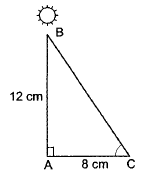
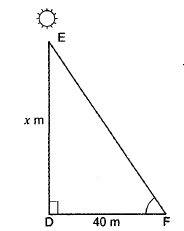
{tex}\Rightarrow \quad \frac { A B } { D E } = \frac { A C } { D F }{/tex}
{tex}\Rightarrow \quad \frac { 12 } { x } = \frac { 8 } { 40 } \Rightarrow \frac { 12 } { x } = \frac { 1 } { 5 } \Rightarrow x {/tex} = 60 metres
Posted by Karan Preet 6 years, 6 months ago
- 1 answers
Sia ? 6 years, 6 months ago
Let perimeter of first square = x metres
Let perimeter of second square = (x +24) metres
Length of side of first square = {tex}\frac { x } { 4 }{/tex}metres {Perimeter of square = 4 × length of side}
Length of side of second square = {tex}\left( \frac { x + 24 } { 4 } \right){/tex}metres
Area of first square = side × side = {tex}\frac { x } { 4 } \times \frac { x } { 4 } = \frac { x ^ { 2 } } { 16 } m ^ { 2 }{/tex}
Area of second square = {tex}\left( \frac { x + 24 } { 4 } \right) ^ { 2 } m ^ { 2 }{/tex}
According to given condition:
{tex}\frac { x^{ 2 } } { 16 } + \left( \frac { x + 24 } { 4 } \right) ^ { 2 } = 468{/tex} {tex}\Rightarrow \frac { x ^ { 2 } } { 16 } + \frac { x ^ { 2 } + 576 + 48 x } { 16 } = 468{/tex}
{tex}\Rightarrow \frac { x ^ { 2 } + x ^ { 2 } + 576 + 48 x } { 16 } = 468{/tex} {tex}\Rightarrow{/tex} 2x2 + 576 + 48x = 468 × 16
{tex}\Rightarrow{/tex} 2x2 +48x + 576 = 7488 {tex}\Rightarrow{/tex} 2x2 + 48x - 6912 = 0
{tex}\Rightarrow{/tex} x2 + 24x - 3456 = 0
Comparing equation x2 + 24x - 3456 = 0 with standard form ax2 + bx + c = 0,
We get a = 1, b = 24 and c = -3456
Applying Quadratic Formula {tex}x = {-b \pm \sqrt{b^2-4ac} \over 2a}{/tex}
{tex}x = \frac { - 24 \pm \sqrt { ( 24 ) ^ { 2 } - 4 ( 1 ) ( - 3456 ) } } { 2 \times 1 }{/tex}
{tex}\Rightarrow x = \frac { - 24 \pm \sqrt { 576 + 13824 } } { 2 }{/tex}
{tex}\Rightarrow x = \frac { - 24 \pm \sqrt { 14400 } } { 2 } = \frac { - 24 \pm 120 } { 2 }{/tex}
{tex}\Rightarrow x = \frac { - 24 + 120 } { 2 } , \frac { - 24 - 120 } { 2 }{/tex}
{tex}\Rightarrow{/tex} x = 48, -72
Perimeter of square cannot be in negative. Therefore, we discard x = -72
Therefore, perimeter of first square = 48 metres
And, Perimeter of second square = x + 24 = 48 + 24 = 72 metres
{tex}\Rightarrow{/tex} Side of First square {tex}= \frac { \text { Perimeter } } { 4 } = \frac { 48 } { 4 } = 12 \mathrm { m }{/tex}
And, Side of second Square {tex}= \frac { \text { Permeter } } { 4 } = \frac { 72 } { 4 } = 18 \mathrm { m }{/tex}
Posted by Manshi Heda 7 years, 4 months ago
- 1 answers
Posted by Hameed Uddin 7 years, 4 months ago
- 1 answers
Posted by Kiran Yadav 7 years, 4 months ago
- 1 answers
Posted by Bablu Garg 7 years, 4 months ago
- 1 answers
Posted by Ujwal Sai Dommati 7 years, 4 months ago
- 0 answers
Posted by Ajmat Ali 7 years, 4 months ago
- 1 answers
Archit Raj 7 years, 4 months ago
Posted by Ajmat Ali 7 years, 4 months ago
- 1 answers
Posted by Ajmat Ali 7 years, 4 months ago
- 1 answers
Monisha Ishu 7 years, 4 months ago
Posted by Asif Ali 7 years, 4 months ago
- 2 answers
Shushant Kumar Sinha 7 years, 4 months ago
Posted by Sourav Panwar 7 years, 4 months ago
- 1 answers
Subham Subhrajit Samal 7 years, 4 months ago
Posted by Boyar Jamatia 7 years, 4 months ago
- 1 answers
Posted by Rishu Singh 7 years, 4 months ago
- 3 answers
Sakshi Mohan 7 years, 4 months ago
Manas Shrivastava 7 years, 4 months ago
Posted by Ishan Bisla 7 years, 4 months ago
- 0 answers
Posted by Harsh Dev Sarwa 7 years, 4 months ago
- 1 answers
Posted by Priyanshu Atal 7 years, 4 months ago
- 1 answers
Posted by Ankita Das 7 years, 4 months ago
- 1 answers
Posted by Muskan Shekhawat 6 years, 6 months ago
- 1 answers
Sia ? 6 years, 6 months ago
Thales' theorem states that if A, B, and C are distinct points on a circle where the line AC is a diameter, then the angle ∠ABC is a right angle.
Posted by Anas Ahamd 6 years, 6 months ago
- 1 answers
Sia ? 6 years, 6 months ago
213 = 120 x 1 + 93
120 = 93 x 1 + 27
93 = 27 x 3 + 12
27 = 12 x 2 + 3
12 = 3 x 4 + 0
The HCF(213,120) = 3

myCBSEguide
Trusted by 1 Crore+ Students

Test Generator
Create papers online. It's FREE.

CUET Mock Tests
75,000+ questions to practice only on myCBSEguide app

Sunil Kumar 7 years, 4 months ago
0Thank You