
Ask questions which are clear, concise and easy to understand.
Ask QuestionPosted by Ayush Sinha 6 years, 6 months ago
- 1 answers
Posted by Sai Chandana 7 years, 4 months ago
- 1 answers
Janani Srinivasan 7 years, 4 months ago
Posted by Samya Singh 7 years, 4 months ago
- 0 answers
Posted by Sanjivani Gawade 7 years, 4 months ago
- 1 answers
Posted by Ambar Kumar 7 years, 4 months ago
- 1 answers
Shubham Achary 7 years, 4 months ago
Posted by Hitesh Choudhary 7 years, 4 months ago
- 1 answers
Japsimar Bedi 7 years, 4 months ago
Posted by Sushant Singh 7 years, 4 months ago
- 0 answers
Posted by Anurag Bhushan 7 years, 4 months ago
- 2 answers
Posted by Subrata Panda 7 years, 4 months ago
- 0 answers
Posted by Nachiket Patil 7 years, 4 months ago
- 1 answers
Angel ☺☺☺ Manu 7 years, 4 months ago
Posted by Sumit Kumar 7 years, 4 months ago
- 1 answers
Posted by Rishabh Jain 7 years, 4 months ago
- 3 answers
Aniket Mittal 7 years, 4 months ago
Shivam Patel 7 years, 4 months ago
Posted by Anshul Anshul 7 years, 4 months ago
- 1 answers
Posted by Chirag P Kumar 7 years, 4 months ago
- 0 answers
Posted by Anshul Maurya 7 years, 4 months ago
- 1 answers
Anshul Maurya 7 years, 4 months ago
Posted by Anshul Maurya 7 years, 4 months ago
- 3 answers
Posted by Tohid Khan 6 years, 5 months ago
- 1 answers
Sia ? 6 years, 5 months ago
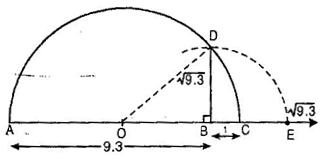
Mark the distance 9.3 units from a fixed point A on a given line to obtain a point B such that AB = 9.3 units. From B mark a distance of 1 unit and call the new point as C. Find the mid-point of AC and call that point as O. Draw a semi-circle with centre O and radius OC = 5.15 units. Draw a line perpendicular to AC passing through B cutting the semi-circle at D. Then BD = {tex}\sqrt {9.3} .{/tex}
Posted by Ujjwal Verma 7 years, 4 months ago
- 0 answers
Posted by Ayush Singh 7 years, 4 months ago
- 1 answers
Sanjivani Gawade 7 years, 4 months ago
Posted by Wizard Coc 7 years, 4 months ago
- 1 answers
Posted by Ujjwal Thakur 7 years, 4 months ago
- 1 answers
Posted by Ayan Majumder 7 years, 4 months ago
- 1 answers
Japsimar Bedi 7 years, 4 months ago
Posted by Hitesh Chandnani 7 years, 4 months ago
- 1 answers
Posted by Aakansha Mittal 7 years, 4 months ago
- 0 answers
Posted by Shyamanand Yadav 7 years, 4 months ago
- 1 answers
Posted by Amanpreet Singh 7 years, 4 months ago
- 0 answers
Posted by Partheepan Partheepan 6 years, 6 months ago
- 1 answers
Sia ? 6 years, 6 months ago
{tex}D = [2(k -12)]^2 - 4(k - 12)\times 2{/tex}
= 4(k -12)2 - 8(k - 12)
For equal and real roots, D = 0
{tex}\Rightarrow{/tex}{tex}4(k - 12)^2 - 8(k - 12) = 0{/tex}
{tex}\Rightarrow{/tex}{tex}4(k - 12) (k - 12 - 2) = 0{/tex}
{tex}\Rightarrow{/tex}{tex}4(k - 12) (k - 14) = 0{/tex}
{tex}\Rightarrow{/tex}k =12 or k = 14
{tex}\because{/tex}a {tex}\ne{/tex} 0 {tex}\Rightarrow{/tex} k {tex}\ne{/tex}12; {tex}\therefore{/tex} k = 14.

myCBSEguide
Trusted by 1 Crore+ Students

Test Generator
Create papers online. It's FREE.

CUET Mock Tests
75,000+ questions to practice only on myCBSEguide app

Sia ? 6 years, 6 months ago
The given pair of equation is
6x + 3y = 6xy
{tex}\Rightarrow \quad \frac { 6 x } { x y } + \frac { 3 y } { x y } = \frac { 6 x y } { x y }{/tex}..............Dividing throughout by xy
{tex}\Rightarrow \quad \frac { 6 } { y } + \frac { 3 } { x } = 6{/tex}.........................(1)
2x + 4y = 5xy
{tex}\Rightarrow \quad \frac { 2 x } { x y } + \frac { 4 y } { x y } = \frac { 5 x y } { x y }{/tex} ..................Dividing throughout by xy
{tex}\Rightarrow \quad \frac { 2 } { y } + \frac { 4 } { x } = 5{/tex}..........................(2)
Put {tex}\frac { 1 } { x } = u{/tex} .....................(3)
And {tex}\frac { 1 } { y } = v{/tex}..........................(4)
Then, the equation (1) and (2) can be written as:
{tex}6 v + 3 u = 6{/tex}..................(5)
2 v + 4 u = 5 ..................(6)
Multiplying equation (6) by 3, we get
6 v + 12 u = 15 ..........................(7)
Subtracting equation (5) from equation(7), we get 9u = 9
{tex}\Rightarrow \quad u = \frac { 9 } { 9 } = 1{/tex}
{tex}\Rightarrow \quad \frac { 1 } { x } = 1{/tex}.......................using (3)
{tex}\Rightarrow \quad x = 1{/tex}
Substituting this value of u in equation (5), we get 6v + 3 X 1 = 6
{tex}\Rightarrow \quad 6 v + 3 = 6{/tex}
{tex}\Rightarrow 6 v = 6 - 3 = 3{/tex}
{tex}\Rightarrow \quad v = \frac { 3 } { 6 } = \frac { 1 } { 2 }{/tex}
{tex}\Rightarrow \quad \frac { 1 } { y } = \frac { 1 } { 2 }{/tex}......................using (4)
{tex}\Rightarrow y =2{/tex}
Hence, the solution of the given pair of the equation is x =1, y =2
Verification: Substituting x =1, y =2
We find that both the equation (1) and (2) are satisfied as shown below:
{tex}\frac { 6 } { y } + \frac { 3 } { x } - \frac { 6 } { 2 } + \frac { 3 } { 1 } - 3 + 3 - 6{/tex}
{tex}\frac { 2 } { y } + \frac { 4 } { x } - \frac { 2 } { 2 } + \frac { 4 } { 1 } = 1 + 4 = 5{/tex}
Hence, the solution is correct.
0Thank You