
Ask questions which are clear, concise and easy to understand.
Ask QuestionPosted by Kashish Chaudhary 5 years, 8 months ago
- 1 answers
Posted by Pardeep Singh Pardeep Singh 6 years, 5 months ago
- 1 answers
Sia ? 6 years, 5 months ago
To Prove: 2+{tex}\sqrt3{/tex} is an irratinal number.
Given: {tex}\sqrt3{/tex} is irrational number.
Proof: Let 2 + {tex}\sqrt{3}{/tex} be a rational number.
{tex}\Rightarrow{/tex} 2 + {tex}\sqrt{3}{/tex} = {tex}\frac{p}{q}{/tex}, p, q {tex}\in{/tex} I, q {tex}\ne{/tex} 0
{tex}\Rightarrow{/tex} {tex}\sqrt{3}{/tex} = {tex}\frac{p}{q}{/tex} - 2
= {tex}\frac{p - 2q}{q}{/tex}
= {tex}\frac{integer}{integer}{/tex}
{tex}\implies{/tex}{tex}\sqrt{3}{/tex} is rational number
{tex}\Rightarrow{/tex} which is a contradiction to the fact that {tex}\sqrt{3}{/tex} is a rational
hence 2 + {tex}\sqrt{3}{/tex} is irrational number.
Posted by Abhishek Mishra 6 years, 6 months ago
- 1 answers
Sia ? 6 years, 6 months ago
Given,
{tex}\frac { 1 } { ( a + b + x ) } = \frac { 1 } { a } + \frac { 1 } { b } + \frac { 1 } { x }{/tex}
{tex}\Rightarrow \quad \frac { 1 } { ( a + b + x ) } - \frac { 1 } { x } = \frac { 1 } { a } + \frac { 1 } { b } \Rightarrow \frac { x - ( a + b + x ) } { x ( a + b + x ) } = \frac { b + a } { a b }{/tex}
{tex}\Rightarrow \quad \frac { - ( a + b ) } { x ( a + b + x ) } = \frac { ( a + b ) } { a b }{/tex}
On dividing both sides by (a+b)
{tex}\Rightarrow \quad \frac { - 1 } { x ( a + b + x ) } = \frac { 1 } { a b }{/tex}
Now cross multiply
{tex}\Rightarrow{/tex} x(a + b + x) = -ab
{tex}\Rightarrow{/tex} x2 + ax + bx + ab = 0
{tex}\Rightarrow{/tex} x(x +a) + b(x +a) = 0
{tex}\Rightarrow{/tex} (x + a) (x + b) = 0
{tex}\Rightarrow{/tex} x + a = 0 or x + b = 0
{tex}\Rightarrow{/tex} x = -a or x = -b.
Therefore, -a and -b are the roots of the equation.
Posted by Usha Yadav 7 years, 4 months ago
- 1 answers
Posted by Sunita K Negi 6 years, 4 months ago
- 1 answers
Sia ? 6 years, 4 months ago
Number 50 p coins in the piggy bank = 100
Number of Re. 1 coins in the piggy bank = 50
Number of Rs. 2 coins in the piggy bank = 20
Number of Rs. 5 coins in the piggy bank = 10
∴ Total number of coins in the piggy bank = 100 + 50 + 20 -10 = 180
∴ Number of all possible outcomes = 180
- Number of favourable outcomes to the event that the coin will be a 50 p coin = 100
∴ Probability that the coin will be a 50 p coin
{tex}\frac{Number\;of\;favourable\;outcomes\;to\;the\;event\;that\;the\;coin\;will\;be\;a\;50\;p\;coin}{\;Number\;of\;all\;possible\;outcomes}{/tex} {tex}\frac{100}{180}=\frac59{/tex} - Number of favourable outcomes to the event that the coin will not be a Rs. 5 coin
= 100 + 50 + 20 = 170
∴ Probability that the coin will not be Rs. 5 coin
{tex}\frac{Total \ no.\;of\;favourable\;outcomes}{Total\;number\;of\;possible\;outcomes}{/tex} {tex}\frac{170}{180}=\frac{17}{18}{/tex}
Posted by Saheb Dutta 6 years, 6 months ago
- 1 answers
Sia ? 6 years, 6 months ago
As x = 2 and -5 are the zeroes of x4 + 6x3 + x2- 24x - 20.
{tex}\Rightarrow{/tex} (x - 2) and (x + 5) are two factors of x4 + 6x3 + x2 -24x - 20
{tex}\Rightarrow{/tex} product of factors is (x - 2) (x + 5) = x2 + 3x - 10
Dividing x{tex}^4{/tex} + 6{tex}x^3{/tex}+ {tex}x^2{/tex} - 24x - 20 by {tex}x^2{/tex} + 3x - 10
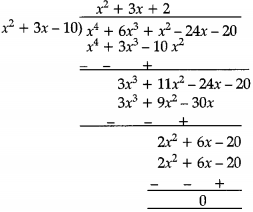
Dividend = divisor {tex}\times{/tex} quotient + remainder
{tex}\Rightarrow{/tex} x4 + 6x3 + x2 - 24x - 20 = (x2 + 3x -10) (x2 + 3x + 2)
= (x - 2) (x + 5) (x + 2) (x + 1)
Hence, other two zeroes are -2 and -1.
Posted by Ankit Yadav Yadav 7 years, 4 months ago
- 1 answers
Sia ? 6 years, 6 months ago
Check NCERT solutions here : <a href="https://mycbseguide.com/ncert-solutions.html">https://mycbseguide.com/ncert-solutions.html</a>
Posted by Aniket Srivastava 7 years, 4 months ago
- 1 answers
Sargam Raina 7 years, 4 months ago
Posted by Kaushal Kumar 7 years, 4 months ago
- 1 answers
Posted by Amrita Maurya 7 years, 4 months ago
- 2 answers
Sajal Singh Chauhan 7 years, 4 months ago
Posted by Suraj Krishna Tripathi 7 years, 4 months ago
- 0 answers
Posted by Harini Varathan 7 years, 4 months ago
- 0 answers
Posted by Abhijith S 7 years, 4 months ago
- 0 answers
Posted by Yash Soni 7 years, 4 months ago
- 4 answers
Abhijith S 7 years, 4 months ago
Posted by Nisha Ahamed 6 years, 5 months ago
- 1 answers
Sia ? 6 years, 5 months ago
The given series is:
9,15,21,27,....
a1 = 9 ,a2 = 15,a3 = 21
Here a2-a1=15-9=6
and a3-a2= 21-15=6
We found that {tex}{\mathrm a}_3-{\mathrm a}_2={\mathrm a}_2-{\mathrm a}_1=6{/tex}
Therefore the given series is an AP where a=9 and d=6
The term next to 27 = 27+ d
=27 + 6
= 33
Posted by Ram Ashish 7 years, 4 months ago
- 1 answers
Posted by Ravinder Singh 7 years, 4 months ago
- 1 answers
Ujjwal Sharma 7 years, 4 months ago
Posted by Pratibha Gusain 7 years, 4 months ago
- 1 answers
Posted by Abhishek Gaming 7 years, 4 months ago
- 1 answers
Posted by Gill Saab 7 years, 4 months ago
- 0 answers
Posted by Sudhir Jaiswal 7 years, 4 months ago
- 0 answers
Posted by Suraj Tanwar 7 years, 4 months ago
- 2 answers
Posted by Hariom Dalal 7 years, 4 months ago
- 1 answers
Janani Srinivasan 7 years, 4 months ago
Posted by Kiran Yadav 6 years, 6 months ago
- 1 answers
Sia ? 6 years, 6 months ago
Let digit at unit's place be x and digit at ten's place be y
Therefore, Number = 10y + x
According to given situation we have,
10y + x = 7(x + y)
{tex}\Rightarrow{/tex}10y + x = 7x + 7y
{tex}\Rightarrow{/tex}6x = 3y
{tex}\Rightarrow{/tex}y =2x .......................(i)
Also 10y + x = 3xy - 12
{tex}\Rightarrow{/tex}10 {tex}\times{/tex} 2x + x = 3x{tex}\cdot{/tex} 2x - 12
{tex}\Rightarrow{/tex}6x2 - 21x -12 = 0 {tex}\Rightarrow{/tex} 2x2 - 7x - 4 = 0
{tex}\Rightarrow{/tex}2x2 - 8x + x - 4 = 0
Factorize above quadratic equation we get,
2x(x - 4) + 1(x - 4) = 0
{tex}\Rightarrow{/tex}(x - 4)(2x + 1) = 0
{tex}\Rightarrow{/tex}x =4 or x = -{tex}\frac{1}{2}{/tex}(rejected)
When x = 4, y = 2 {tex}\times{/tex}4 = 8
{tex}\therefore{/tex}Number is 10{tex}\times{/tex}8 + 4 = 84.

myCBSEguide
Trusted by 1 Crore+ Students

Test Generator
Create papers online. It's FREE.

CUET Mock Tests
75,000+ questions to practice only on myCBSEguide app
