
Ask questions which are clear, concise and easy to understand.
Ask QuestionPosted by K N 7 years, 4 months ago
- 0 answers
Posted by Suplex City ?? 7 years, 4 months ago
- 2 answers
Sudhanshu Yadav 7 years, 4 months ago
Posted by Aashi Kori 7 years, 4 months ago
- 1 answers
Posted by Yashika Saboo 7 years, 4 months ago
- 1 answers
Archit Dutta 7 years, 4 months ago
Posted by Komalpreet Kaur Khattra 5 years, 8 months ago
- 1 answers
Sia ? 6 years, 5 months ago
The given quadratic equation is
2x2 - 6x + 3= 0
Here, a = 2, b = -6, c = 3
Therefore, discriminant = b2 - 4ac
{tex}= ( - 6 ) ^ { 2 } - 4 ( 2 ) ( 3 ) = 36 - 24{/tex}
= 12 > 0
So, the given quadratic equation has two distinct real roots
Solving the quadratic equation {tex}2 x ^ { 2 } - 6 x + 3 = 0{/tex} , by the quadratic formula, {tex}x = \frac { - b \pm \sqrt { b ^ { 2 } - 4 a c } } { 2 a }{/tex}
we get {tex}= \frac { - ( - 6 ) \pm \sqrt { 12 } } { 2 ( 2 ) } = \frac { 6 \pm 2 \sqrt { 3 } } { 4 } = \frac { 3 \pm \sqrt { 3 } } { 2 }{/tex}
Therefore, the roots are {tex}\frac { 3 \pm \sqrt { 3 } } { 2 } , \text { i.e. } \frac { 3 + \sqrt { 3 } } { 2 } \text { and } \frac { 3 - \sqrt { 3 } } { 2 }{/tex}
Posted by Ashish Kumar 7 years, 4 months ago
- 0 answers
Posted by Ram Kumar 7 years, 4 months ago
- 1 answers
Posted by Siksha Thapa 7 years, 4 months ago
- 2 answers
Posted by Bhavik Shah 7 years, 4 months ago
- 1 answers
Hansika Verma 7 years, 4 months ago
Posted by Priyanshu Sinha 7 years, 4 months ago
- 1 answers
Devanshu Agrawal 7 years, 4 months ago
Posted by Dipesh Mishra 7 years, 4 months ago
- 1 answers
Pankaj Prajapati 7 years, 4 months ago
Posted by Shivam Singh 7 years, 4 months ago
- 4 answers
Posted by Shivani Pal 7 years, 4 months ago
- 5 answers
Posted by Saikat Dey 7 years, 4 months ago
- 2 answers
Posted by Avni Asati 7 years, 4 months ago
- 1 answers
Posted by Kishlay Kumar 5 years, 8 months ago
- 1 answers
Sia ? 6 years, 4 months ago
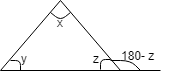
Let the triangle's of angle is x, y and z
we have to prove
x + y + z = 180 ..........(i)
we know that sum of two interior opposite angle is equal to exterior angle.
so, x + y = 180 - z ....... (ii)
By linear pair exterior angle is 180 - z when triangle's angle is z.
By (i) also we get
x + y = 180 - z ..........(iii)
Hence proved
(ii) and (iii) are the same, so we can say that the sum of the three angles triangle is 180o.
Posted by Narasimha Narasimha 7 years, 4 months ago
- 0 answers
Posted by Harish Anand 5 years, 8 months ago
- 0 answers
Posted by Abhishek Kumar 6 years, 4 months ago
- 1 answers
Sia ? 6 years, 4 months ago
You can check NCERT Solutions here : https://mycbseguide.com/ncert-solutions.html
Posted by Chandan Shukla 6 years, 4 months ago
- 1 answers
Sia ? 6 years, 4 months ago
You can check last year papers here : https://mycbseguide.com/cbse-question-papers.html
Posted by Yogendra Patel 6 years, 4 months ago
- 1 answers
Sia ? 6 years, 4 months ago
We will prove this by contradiction.
Let us suppose that (3+2 {tex}\sqrt { 5 }{/tex}) is rational.
It means that we have co-prime integers a and b such that
{tex}\frac { a } { b } = 3 + 2 \sqrt { 5 } \quad \frac { a } { b } - 3 = 2 \sqrt { 5 }{/tex}
{tex}\Rightarrow \frac{{a - 3b}}{b} = 2{\sqrt 5 \,{ \Rightarrow }}\frac{{a - 3b}}{{2b}} = \sqrt 5 {/tex} ....(1)
a and b are integers.
It means L.H.S of (1) is rational but we know that {tex}\sqrt { 5 }{/tex} is irrational. It is not possible. Therefore, our supposition is wrong. (3+2 {tex}\sqrt { 5 }{/tex}) cannot be rational.
Hence, (3+2 {tex}\sqrt { 5 }{/tex}) is irrational.
Posted by Chanchal Jangid 7 years, 4 months ago
- 1 answers
Posted by Pankaj Prajapati 7 years, 4 months ago
- 2 answers
Posted by Sujit Gore 7 years, 4 months ago
- 2 answers
Posted by Hemanth Hemanth 7 years, 4 months ago
- 1 answers
Devanshu Agrawal 7 years, 4 months ago
Posted by Manmohan Singh Lodhi 7 years, 4 months ago
- 1 answers
Sia ? 6 years, 4 months ago
Co-ordinates of point R = (4,0)
{tex}\therefore{/tex} QR = 8 units
Let the coordinates of point P be (0,y)
Since, PQ = QR
or, (-4 - 0)2 + (0 - y)2 = {tex}8^2{/tex}
or, 16 + y2 = 64
{tex}y^2=48{/tex}
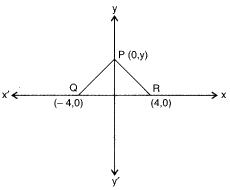
or, y = {tex}\pm 4\sqrt 3{/tex}
Coordinates of P are (0,{tex}4\sqrt3{/tex}) or (0,{tex}-4\sqrt3{/tex})
Posted by Yogesh Lodha 7 years, 4 months ago
- 1 answers
Posted by Shubhangam Pati 7 years, 4 months ago
- 5 answers
Vidhansu Pal 7 years, 4 months ago
Posted by Ganesh Pd Swarnkar 6 years, 4 months ago
- 1 answers
Sia ? 6 years, 4 months ago
Given: {tex}\Delta ABC \sim \Delta PQR{/tex}
Since we know that ,the ratio of area of two similar triangles is equal to the square of ratio of their corresponding sides. Thus,
{tex}\frac{\text { ar } \triangle \mathrm{ABC}}{\text { ar } \triangle \mathrm{PQR}}{/tex} = {tex}\frac{\mathrm{AB}^{2}}{\mathrm{PQ}^{2}}{/tex} = {tex}\left(\frac{1}{3}\right)^{2}{/tex} = {tex}\frac{1}{9}{/tex}

myCBSEguide
Trusted by 1 Crore+ Students

Test Generator
Create papers online. It's FREE.

CUET Mock Tests
75,000+ questions to practice only on myCBSEguide app
