
Ask questions which are clear, concise and easy to understand.
Ask QuestionPosted by Jaspreet Singh 7 years, 4 months ago
- 1 answers
Posted by Ayush Kumar 6 years, 5 months ago
- 1 answers
Sia ? 6 years, 5 months ago
Distance between the points P(x, 2) and Q(3, - 6) is 10.
Using distance formula PQ = 10
{tex}\Rightarrow{/tex} {tex}\sqrt { ( x - 3 ) ^ { 2 } + \{ 2 - ( - 6 ) \} ^ { 2 } }{/tex} = 10
{tex}\Rightarrow{/tex} {tex}\sqrt { x ^ { 2 } + 3 ^ { 2 } - 2 \times 3 \times x + ( 2 + 6 ) ^ { 2 } }{/tex} = 10
{tex}\Rightarrow{/tex} {tex}\sqrt { x ^ { 2 } + 9 - 6 x + 8 ^ { 2 } }{/tex} = 10
{tex}\Rightarrow{/tex} {tex}\sqrt { x ^ { 2 } + 9 - 6 x + 64 }{/tex} = 10
{tex}\Rightarrow{/tex} {tex}\sqrt { x ^ { 2 } - 6 x + 73 }{/tex} = 10
Squaring both sides, we get
x2 - 6x + 73 = 100
{tex}\Rightarrow{/tex} x2 - 6x + 73 - 100 = 0
{tex}\Rightarrow{/tex} x2- 6x -27 = 0
{tex}\Rightarrow{/tex} x2- 9x + 3x-2 7 = 0
{tex}\Rightarrow{/tex} x(x - 9) + 3(x - 9) = 0
{tex}\Rightarrow{/tex} (x - 9) (x + 3) = 0
{tex}\Rightarrow{/tex} either x-9 = 0 or x + 3 = 0
{tex}\Rightarrow{/tex} x = 9 or x = - 3
Ignoring x = - 3 as it is given that x is a positive integer.
Thus, only solution is x = 9.
Posted by Jatin Chawla 7 years, 4 months ago
- 2 answers
Anureet Kaur Saroaye 7 years, 4 months ago
Posted by Aayush Raj 7 years, 4 months ago
- 1 answers
Posted by R Singh 7 years, 4 months ago
- 1 answers
Posted by Tanu Tanu 7 years, 4 months ago
- 1 answers
Ashwani Mishra 7 years, 4 months ago
Posted by Poorva Parmar Poorvi Parmsr 7 years, 4 months ago
- 0 answers
Posted by Nikhil Gupta 5 years, 8 months ago
- 1 answers
Posted by Priyansh Goyal 7 years, 4 months ago
- 1 answers
Ashwani Mishra 7 years, 4 months ago
Posted by Aditya Raj 7 years, 4 months ago
- 3 answers
Posted by Apoorva Tiwari 7 years, 4 months ago
- 0 answers
Posted by Vineet Kumar 7 years, 4 months ago
- 1 answers
Posted by Mitul Samadder 7 years, 4 months ago
- 1 answers
Yogita Ingle 7 years, 4 months ago
Mixed surds can be expressed in the form of pure surds. Because if we make rational co-efficient under radical sign, it will become a pure surd.
2 √7 = √22 × 7 = √4 × 7 = √28
Posted by Vimal Kannan 6 years, 4 months ago
- 1 answers
Sia ? 6 years, 4 months ago
Given equations are
{tex}\frac{8}{2x - 3y}{/tex} + {tex}\frac{21}{2x + 3y}{/tex} = 11...(i)
{tex}\frac{5}{2x - 3y}{/tex} + {tex}\frac{7}{2x + 3y}{/tex} = 6 ....(ii)
Putting {tex}\frac{1}{2x - 3y}{/tex} = A and {tex}\frac{1}{2x + 3y}{/tex} = B in equation (i) & (ii) so that we may get the pair of linear equations in variables A & B as following :-
8A + 21B = 11 ...(iii). and 5A + 7B = 6...(iv)
Multiplying eq. (iv) by 3 & then subtracting eq. (iii) from it , we get ;
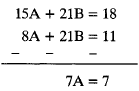
{tex}\Rightarrow{/tex} A = 1
Substituting A = 1 in eq. (iii) ,
8 {tex}{/tex}× 1 + 21B = 11
{tex}\Rightarrow{/tex} 21B = 3
{tex}\Rightarrow{/tex} B = {tex}\frac{1}{7}{/tex}
Since, A = 1
{tex}\Rightarrow{/tex} {tex}\frac{1}{2x - 3y}{/tex} = 1
{tex}\Rightarrow{/tex} 2x - 3y = 1...(vi)
Where B = {tex}\frac{1}{7}{/tex}
{tex}\Rightarrow{/tex}{tex}\frac{1}{2x + 3y}{/tex} = {tex}\frac{1}{7}{/tex}
{tex}\Rightarrow{/tex}2x + 3y = 7...(vii)
Adding (vi) and (vii), we get
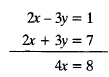
{tex}\Rightarrow{/tex}x = 2
Substituting x = 2 in eq.(vi),
2{tex}{/tex}× 2 - 3y = 1
{tex}\Rightarrow{/tex} -3y = -3
{tex}\Rightarrow{/tex} y = 1
{tex}\therefore{/tex} x = 2, y = 1.
Posted by Muskaan Thakur 7 years, 4 months ago
- 2 answers
Kannu Kranti Yadav 7 years, 4 months ago
Posted by Salman Khan 7 years, 4 months ago
- 2 answers
Posted by Harshita Awashthi 6 years, 5 months ago
- 2 answers
Sia ? 6 years, 5 months ago
The given system of equations is
11x + 15y + 23 = 0 ....(1)
7x - 2y - 20 = 0 ....(2)
To solve the equations (1) and (2) by cross multiplication method,
we draw the diagram below:
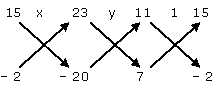
Then,
{tex}\Rightarrow \;\frac{x}{{(15)( - 20) - ( - 2)(23)}} = \frac{y}{{(23)(7) - ( - 20)(11)}}{/tex}{tex}= \frac{1}{{(11)( - 2) - (7)(15)}}{/tex}
{tex}\Rightarrow \;\frac{x}{{ - 300 + 46}} = \frac{y}{{161 + 220}} = \frac{1}{{ - 22 - 105}}{/tex}
{tex}\Rightarrow \;\frac{x}{{ - 254}} = \frac{y}{{381}} = \frac{1}{{ - 127}}{/tex}
{tex}\Rightarrow \;x=\frac{{ - 254}}{{ - 127}} = 2{/tex} and {tex}y = \frac{{381}}{{ - 127}} = - 3{/tex}
Hence, the required solution of the given pair of equations is
x = 2, y = -3
Verification : substituting x = 2, y = -3,
We find that both the equations (1) and (2) are satisfied as shown below:
11x + 15y + 23 = 11(2) + 15(-3) + 23
= 22 - 45 + 23 = 0
7x - 2y - 20 = 7(2) - 2(-3) - 20
= 14 + 6 - 20 = 0
Hence, the solution we have got is correct.
Posted by Guri_Kaur Brar 7 years, 4 months ago
- 1 answers
Ashu Sharma 7 years, 4 months ago
Posted by Renuka Mali 6 years, 5 months ago
- 1 answers
Sia ? 6 years, 5 months ago
In {tex}\triangle{/tex}PAO and {tex}\triangle{/tex}QBO
{tex}\angle{/tex}A = {tex}\angle{/tex}B = 90o
{tex}\angle{/tex}POA = {tex}\angle{/tex}QOB (Vertically Opposite Angle)
{tex}\triangle{/tex}PAO ~ {tex}\triangle{/tex}QBO,(by AA criteria)
{tex}\frac { O A } { O B } = \frac { P A } { Q B }{/tex}
or, {tex}\frac { 6 } { 4.5 } = \frac { 4 } { Q B }{/tex}
or, {tex}Q B = \frac { 4 \times 4.5 } { 6 }{/tex}
Therefore, QB = 3 cm
Posted by Shagun Sahay 7 years, 4 months ago
- 1 answers
Posted by Angad Gupta 7 years, 4 months ago
- 0 answers
Posted by Naila Ansari 7 years, 4 months ago
- 1 answers
Posted by Prajwal Barsagade 6 years, 4 months ago
- 1 answers
Sia ? 6 years, 4 months ago
6(ax + by) = 3a + 2b
6ax + 6by = 3a + 2b.........(i)
6(bx - ay) = 3b - 2a
6bx - 6ay = 3b - 2a.........(ii)
Multiplying (i) by a and (2) by b,
So, 6a2x + 6aby = 3a2 + 2ab .......... (iii)
And 6b2x - 6aby = 3b2 - 2ab ......... (iv)
Add (iii) and (iv), we get
6a2x + 6aby + 6b2x - 6aby = 3a2 + 2ab + 3b2 - 2ab
⇒ 6a2x + 6b2x = 3a2 + 3b2
⇒6 (a2x + b2x) = 3(a2 + b2)
⇒{tex}x = \frac { 3 \left( a ^ { 2 } + b ^ { 2 } \right) } { 6 \left( a ^ { 2 } + b ^ { 2 } \right) } = \frac { 3 } { 6 } = \frac { 1 } { 2 }{/tex}
Substituting {tex}x = \frac 12{/tex} in (i),we get
{tex}6 a \times \frac { 1 } { 2 } + 6 b y = 3 a + 2 b{/tex}
⇒ 3a + 6by = 3a + 2b
⇒ 6by =3a + 2b -3a
⇒ 6by = 2b
⇒ {tex}y = \frac { 2 b } { 6 b } = \frac { 1 } { 3 }{/tex}
Hence, the solution is {tex}x = \frac { 1 } { 2 } , y = \frac { 1 } { 3 }{/tex}
Posted by Ashwin Hammar 7 years, 4 months ago
- 1 answers
Posted by Subham Gupta 7 years, 4 months ago
- 1 answers
Gourav Kumar 7 years, 4 months ago
Posted by Bhavybm Mehta 7 years, 4 months ago
- 1 answers
Posted by Siddharth Singh 7 years, 4 months ago
- 0 answers
Posted by Raj Gaur 7 years, 4 months ago
- 1 answers
Kannu Kranti Yadav 7 years, 4 months ago

myCBSEguide
Trusted by 1 Crore+ Students

Test Generator
Create papers online. It's FREE.

CUET Mock Tests
75,000+ questions to practice only on myCBSEguide app
