
Ask questions which are clear, concise and easy to understand.
Ask QuestionPosted by Vishwash Kushwaha Kushwaha 7 years, 4 months ago
- 1 answers
Posted by Sahil Singh 5 years, 8 months ago
- 1 answers
Vishwash Kushwaha Kushwaha 7 years, 4 months ago
Posted by Ved Singh 7 years, 4 months ago
- 2 answers
Naina Chauhan 7 years, 4 months ago
Deepthy Jaison 7 years, 4 months ago
Posted by V P 7 years, 4 months ago
- 0 answers
Posted by Prashant Baghel 7 years, 4 months ago
- 3 answers
Posted by Yashika Singh 7 years, 4 months ago
- 1 answers
Posted by Krish Mehta 7 years, 4 months ago
- 2 answers
Posted by Ravi Singh 7 years, 4 months ago
- 3 answers
Posted by Pooja Gupta 7 years, 4 months ago
- 1 answers
Rahul Drall 7 years, 4 months ago
Posted by Deepak Rana 5 years, 8 months ago
- 1 answers
Aayushvardhan Pandey 7 years, 4 months ago
Posted by Sukh Ram 7 years, 4 months ago
- 2 answers
Posted by Yash Bisht 6 years, 4 months ago
- 0 answers
Posted by Likhitha Jayaram Likhitha 6 years, 4 months ago
- 1 answers
Sia ? 6 years, 4 months ago
The required number when divides 615 and 963, leaves remainder 6, this means 615 - 6 = 609 and 963 - 6 = 957 are completely divisible by the number.
Therefore,
The required number = H.C.F. of 609 and 957.
By applying Euclid’s division lemma
957 = 609 {tex}\times{/tex} 1+ 348
609 = 348 {tex}\times{/tex} 1 + 261
348 = 216 {tex}\times{/tex} 1 + 87
261 = 87 {tex}\times{/tex} 3 + 0.
Therefore, H.C.F. of 957 and 609 is = 87.
Hence, the largest number which divides 615 and 963 leaving remainder 6 in each case is 87.
Posted by Sushil Kumar 7 years, 4 months ago
- 2 answers
Tushar Sharma 7 years, 4 months ago
Tarun Agrahari 7 years, 4 months ago
Posted by Subhashini Subhashini 7 years, 4 months ago
- 1 answers
Posted by Hemant Parashar 7 years, 4 months ago
- 1 answers
Posted by Manav Mehta 7 years, 4 months ago
- 1 answers
Posted by Prince Kumar Tiwari 7 years, 4 months ago
- 2 answers
Posted by Swati Nishad 6 years, 4 months ago
- 1 answers
Sia ? 6 years, 4 months ago
We have,
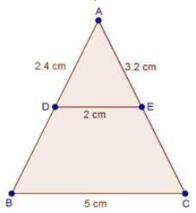
DE || BC
Now, In {tex}\triangle{/tex}ADE and {tex}\triangle {/tex}ABC
{tex}\angle A = \angle A{/tex} [common]
{tex}\angle A D E = \angle A B C{/tex} [{tex}\because{/tex} DE || BC {tex}\Rightarrow{/tex} Corresponding angles are equal]
{tex}\Rightarrow \triangle A D E= \triangle A B C{/tex} [By AA criteria]
{tex}\Rightarrow \frac { A B } { B C } = \frac { A D } { D E }{/tex} [{tex}\because{/tex} Corresponding sides of similar triangles are proportional]
{tex}\Rightarrow \frac { A B } { 5 } = \frac { 2.4 } { 2 }{/tex}
{tex}\Rightarrow A B = \frac { 2.4 \times 5 } { 2 }{/tex}
{tex}\Rightarrow{/tex} AB = 1.2 {tex}\times{/tex} 5
= 6.0 cm
{tex}\Rightarrow{/tex} AB = 6 cm
{tex}\therefore{/tex} BD = AB - AD
= 6 - 2.4
= 3.6 cm
{tex}\Rightarrow{/tex} DB = 3.6 cm
Now,
{tex}\frac { A C } { B C } = \frac { A E } { D E }{/tex} [{tex}\because{/tex} Corresponding sides of similar triangles are equal]
{tex}\Rightarrow \frac { A C } { 5 } = \frac { 3.2 } { 2 }{/tex}
{tex}\Rightarrow A C = \frac { 3.2 \times 5 } { 2 }{/tex}
= 1.6 {tex}\times{/tex} 5
= 8.0 cm
{tex}\Rightarrow{/tex} AC = 8 cm
{tex}\therefore{/tex} CE = AC - AE
= 8 - 3.2
= 4.8 cm
Hence, BD = 3.6 cm and CE = 4.8 cm
Posted by Krishna Chaurashiya 7 years, 4 months ago
- 0 answers
Posted by Sakib Siddique 7 years, 4 months ago
- 1 answers
Posted by Ashu Sharma 7 years, 4 months ago
- 2 answers
Posted by Moomal Kirad 7 years, 4 months ago
- 0 answers
Posted by Bhari .C.R 7 years, 4 months ago
- 0 answers
Posted by Tanya Grover 7 years, 4 months ago
- 2 answers
Anureet Kaur Saroaye 7 years, 4 months ago
Posted by Kushagra Gangwar 7 years, 4 months ago
- 2 answers
Posted by Jatin Chawla 7 years, 4 months ago
- 1 answers
Sandhya Singh 7 years, 4 months ago

myCBSEguide
Trusted by 1 Crore+ Students

Test Generator
Create papers online. It's FREE.

CUET Mock Tests
75,000+ questions to practice only on myCBSEguide app

Aayushvardhan Pandey 7 years, 4 months ago
0Thank You