
Ask questions which are clear, concise and easy to understand.
Ask QuestionPosted by Khushi Narad 6 years, 4 months ago
- 1 answers
Posted by Aryan Raj 7 years, 4 months ago
- 2 answers
Posted by Zoya Sayyed 7 years, 4 months ago
- 1 answers
Sanju Yadav 7 years, 4 months ago
Posted by Kaveri Patil 7 years, 4 months ago
- 0 answers
Posted by Chanchal Dhiman 6 years, 5 months ago
- 1 answers
Sia ? 6 years, 5 months ago
Let a = 3q + r {tex}: 0 \leq r < 3{/tex}
{tex}\therefore \quad a = 3 q ; \text { then } a ^ { 3 } = 27 q ^ { 3 } = 9 m ; \text { where } m = 3 q ^ { 3 }{/tex}
{tex}\text { when } a = 3 q + 1 ; \text { then } a = 27 q ^ { 2 } + 27 q ^ { 2 } + 9 q + 1{/tex}
{tex}= 9 \left( 3 q ^ { 3 } + 3 q ^ { 2 } + q \right) + 1{/tex}
{tex}= 9 m + 8 \quad \left( \text { where } m = 3 q ^ { 3 } + 3 q ^ { 2 } + q \right){/tex}
{tex}\text { when } a = 3 q + 2 ; \text { then } a ^ { 3 } = ( 3 q + 2 ) ^ { 2 }{/tex}
{tex}= 27 q ^ { 3 } + 54 q ^ { 2 } + 36 q + 8{/tex}
{tex}= 9 m + 8 \quad \left( \text { where } m = 3 q ^ { 3 } + 6 q ^ { 2 } + 4 q \right){/tex}
{tex}= 9 m + 8 \quad \left( \text { where } m = 3 q ^ { 3 } + 6 q ^ { 2 } + 4 q \right){/tex}
Hence, cubes of any positive integer is either of the from 9m, (9m + 1) or (9m + 8).
Posted by Sanket Kamate 7 years, 4 months ago
- 0 answers
Posted by Siddharth Singh 7 years, 4 months ago
- 1 answers
Oshin Rastogi 7 years, 4 months ago
Posted by Akanksha Varshney 7 years, 4 months ago
- 0 answers
Posted by Praveen Dixit 7 years, 4 months ago
- 2 answers
Posted by Visnu Anand 7 years, 4 months ago
- 1 answers
Posted by Koshika Pandey 7 years, 4 months ago
- 1 answers
Krish Rawat 7 years, 4 months ago
Posted by Yash Soni 7 years, 4 months ago
- 3 answers
Posted by Vipul Chaudhary 7 years, 4 months ago
- 5 answers
Posted by Kt Gamer 7 years, 4 months ago
- 1 answers
Dibya Ranjan Das Das 7 years, 4 months ago
Posted by Chayeem Basha 6 years, 5 months ago
- 1 answers
Sia ? 6 years, 5 months ago
Let the original speed of the aircraft be x km/hr.
Then, new speed = (x- 200) km/hr.
Duration of flight at original speed = {tex}{600 \over x}hrs{/tex}
Duration of flight at reduced speed = {tex}{600 \over x-200}hrs{/tex}
According to the question
{tex}{600 \over x-200} - {600 \over x} = {1 \over 2}{/tex}
{tex}\implies {600x - 600x +120000 \over x(x-200)} = {1 \over 2}{/tex}
{tex}\implies {120000 \over x^2 -200x} = {1 \over 2}{/tex}
{tex}\implies {/tex}x2 - 200x -240000 = 0
{tex}\implies {/tex}x2 - 600 x + 400 x - 240000 = 0
{tex}\implies {/tex}x (x - 600) + 400 (x - 600) = 0
{tex}\implies {/tex}(x- 600) (x + 400) = 0
Either x - 600 =0 or x + 400 = 0
{tex}\implies {/tex}x = 600, -400
since Speed cannot be negative. So x = 600
So, original speed of the aircraft was 600 km /hr.
Hence, duration of flight = {tex}{600 \over x}hrs = {600 \over 600}hrs = 1 hr{/tex}
Posted by Chanchal Dhiman 7 years, 4 months ago
- 0 answers
Posted by Arvind Sahu Arvind Sahu 7 years, 4 months ago
- 1 answers
Yogita Ingle 7 years, 4 months ago
General form of a quadratic polynomial: x2 - (sum of the roots)x + (product of the roots) = 0
Posted by Anjali Tiwari 6 years, 5 months ago
- 1 answers
Sia ? 6 years, 5 months ago
Let four parts be (a - 3d), (a - d), (a + d) and (a + 3d).
Then, Sum of four parts = 32
{tex}\Rightarrow{/tex} (a - 3d) + (a - d) + (a + d) + (a + 3d) = 32
{tex}\Rightarrow{/tex} 4a = 32
{tex}\Rightarrow{/tex} a = 8
and {tex}\frac { ( a - 3 d ) ( a + 3 d ) } { ( a - d ) ( a + d ) } = \frac { 7 } { 15 }{/tex}
{tex}\Rightarrow{/tex} {tex}\frac { a ^ { 2 } - 9 d ^ { 2 } } { a ^ { 2 } - d ^ { 2 } } = \frac { 7 } { 15 }{/tex}
{tex}\Rightarrow{/tex} {tex}\frac { 64 - 9 d ^ { 2 } } { 64 - d ^ { 2 } } = \frac { 7 } { 15 }{/tex} [put a = 8]
{tex}\Rightarrow{/tex} 960 - 135 d2 = 448 - 7 d2
{tex}\Rightarrow{/tex} 128 d2 = 512
{tex}\Rightarrow{/tex} d2 = 4
{tex}\therefore{/tex} d = {tex}\pm{/tex} 2
Hence, the required parts are 8 - 3 {tex}\times{/tex} 2, 8 - 2, 8 + 2, 8 + 3 {tex}\times{/tex} 2 or 8 - 3 (- 2), 8 - (- 2), 8 - 2, 8 + 3 (- 2) i.e., 2, 6, 10, 14.
Posted by Amit Sharma 7 years, 4 months ago
- 0 answers
Posted by Ritika Bhatia 6 years, 4 months ago
- 1 answers
Sia ? 6 years, 4 months ago
Let ABC be the equilateral triangle such that,
A = (3,0), B=(6,0) and C=(x,y)
Distance between:
{tex}\sqrt {( x_{2}-x_{1})^2+(y_{2} -y_{1})^{2} }{/tex}
we know that,
AB=BC=AC
By distance formula we get,
AB=BC=AC=3units
AC=BC
{tex}\sqrt{(3-x)^2+y^2}=\sqrt{(6-x)^2+y^2}{/tex}
{tex}9+x^2-6 x+y^2=36+x^2-12 x+y^2{/tex}
{tex}6 x=27{/tex}
{tex}x=27 / 6=9 / 2{/tex}
BC = 3 units
{tex}\sqrt{(6-\frac{27}{6})^2+y^2}=3{/tex}
{tex}(\frac{(36-27)}{6})^2+y^2=9{/tex}
{tex}(\frac{9}{6})^2+y^2=9{/tex}
{tex}(\frac{3}{2})^2+y^2=9{/tex}
{tex}\frac{9}{4}+y^2=9{/tex}
{tex}9+4 y^2=36{/tex}
{tex}4 y^2=27{/tex}
{tex}y^2=\frac{27}{4}{/tex}
{tex}y=\sqrt{(\frac{27}{4})}{/tex}
{tex}y=3 \sqrt{\frac{3}{2}}{/tex}
{tex}(x, y)=(9 / 2,3 \sqrt{\frac{3}{2}}){/tex}
Hence third vertex of equilateral triangle = C = {tex}(9 / 2,3 \sqrt{\frac{3}{2}}){/tex}
Posted by Ajay Sharma 7 years, 4 months ago
- 1 answers
Posted by Puneet Sharma 7 years, 4 months ago
- 1 answers
Anmol Patalay 7 years, 4 months ago
Posted by Suraj Tanwar 7 years, 4 months ago
- 1 answers
Anmol Patalay 7 years, 4 months ago
Posted by Shreyash Jaiswal 6 years, 4 months ago
- 1 answers
Sia ? 6 years, 4 months ago
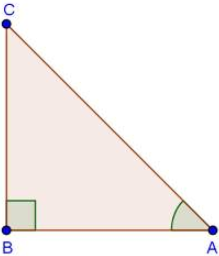
Given {tex}\sec A = \frac{{17}}{8} = \frac{{AC}}{{AB}}{/tex}
Let AC = 17K
and, AB = 8K
In {tex}\Delta ABC{/tex}, by Pythagoras theorem
BC2 + AB2 = AC2
BC2 + (8K)2 = (17K)2
BC2 + 64K2 = 289K2
BC2 = 289K2 - 64K2
BC2 = 225K2
{tex}BC = \sqrt {225{K^2}} = 15K{/tex}
{tex}\therefore \sin A = \frac{{BC}}{{AC}} = \frac{{15K}}{{17K}} = \frac{{15}}{{17}}{/tex}
{tex}\cos A = \frac{{AB}}{{AC}} = \frac{{8K}}{{17K}} = \frac{8}{{17}}{/tex}
{tex}\tan A = \frac{{BC}}{{AB}} = \frac{{15K}}{{8K}} = \frac{{15}}{8}{/tex}
LHS
{tex} = \frac{{3 - 4{{\sin }^2}A}}{{4{{\cos }^2}A - 3}}{/tex}
{tex} = \frac{{3 - 4 \times {{\left( {\frac{{15}}{{17}}} \right)}^2}}}{{4{{\left( {\frac{8}{{17}}} \right)}^2} - 3}}{/tex}
{tex} = \frac{{3 - \frac{{900}}{{289}}}}{{\frac{{256}}{{289}} - 3}}{/tex}
{tex} = \frac{{\frac{{867 - 900}}{{289}}}}{{\frac{{256 - 867}}{{289}}}}{/tex}
{tex} = \frac{{\frac{{ - 33}}{{289}}}}{{\frac{{ - 611}}{{289}}}}{/tex}
{tex} = \frac{{ - 33}}{{289}} \times \frac{{289}}{{ - 611}}{/tex}
{tex} = \frac{{33}}{{611}}{/tex}
RHS
{tex} = \frac{{3 - {{\tan }^2}A}}{{1 - 3{{\tan }^2}A}}{/tex}
{tex} = \frac{{3 - {{\left( {\frac{{15}}{8}} \right)}^2}}}{{1 - 3 \times {{\left( {\frac{{15}}{8}} \right)}^2}}}{/tex}
{tex} = \frac{{3 - \frac{{225}}{{64}}}}{{1 - \frac{{675}}{{64}}}}{/tex}
{tex} = \frac{{\frac{{192 - 225}}{{64}}}}{{\frac{{64 - 675}}{{64}}}}{/tex}
{tex} = \frac{{\frac{{ - 33}}{{64}}}}{{\frac{{ - 611}}{{64}}}}{/tex}
{tex}= \frac{{ - 33}}{{64}} \times \frac{{64}}{{ - 611}}{/tex}
{tex} = \frac{{33}}{{611}}{/tex}
Hence verified
Posted by Shriram Naik Naik 7 years, 4 months ago
- 5 answers
Mohan R Mohan R 7 years, 4 months ago
Posted by Zaneer Baig 7 years, 4 months ago
- 1 answers
Shriram Naik Naik 7 years, 4 months ago
Posted by Anurag Rawat 7 years, 4 months ago
- 3 answers

myCBSEguide
Trusted by 1 Crore+ Students

Test Generator
Create papers online. It's FREE.

CUET Mock Tests
75,000+ questions to practice only on myCBSEguide app

Sia ? 6 years, 4 months ago
Let ABCD be a rhombus whose diagonals are AC and BD.

Then, Area of rhombus ABCD
= Area of {tex}\bigtriangleup{/tex}ABD + Area of {tex}\bigtriangleup{/tex}CBD
{tex}={(BD)(AO)\over2}+{(BD)(OC)\over2}{/tex} . .[Diagonals of a rhombus are perpendiculars to each other]
{tex}={(BD)\over2}(AO+OC)={(BD)(AC)\over2}{/tex}
={tex}1\over2{/tex} product of the lengths of its diagonals.
0Thank You