
Ask questions which are clear, concise and easy to understand.
Ask QuestionPosted by Anshumaan Sharma 7 years, 4 months ago
- 1 answers
Posted by Lakshay Goyal 7 years, 4 months ago
- 2 answers
Dheeraj Verma 7 years, 4 months ago
Posted by Chetan Korupolu 5 years, 8 months ago
- 1 answers
Sia ? 6 years, 6 months ago
Let AD = 5x cm and DB = 4x cm. Then AB = AD + DB = (5x + 4x) cm = 9x cm.
In {tex}\triangle ADE{/tex} and {tex}\triangle ABC{/tex}, we have
{tex}\angle A D E = \angle A B C{/tex} [corresponding angles]
{tex}\angle A E D = \angle A C B{/tex} [corresponding angles]
{tex}\angle A = \angle A {/tex} [common in both triangles]
{tex}\therefore \quad \triangle A D E \sim \triangle A B C{/tex} [By AAA - Similarity Criteria ]
{tex}\Rightarrow \frac { D E } { B C } = \frac { A D } { A B }{/tex}[ As corresponding sides of similar triangles are proportionate to each other]
{tex}= \frac { 5 x } { 9 x } = \frac { 5 } { 9 }{/tex}
In {tex}\triangle DFE{/tex} and {tex}\triangle CFB{/tex} , we have
{tex}\angle E D F = \angle B C F{/tex} [alternate interior angles as DE|| BC ]
and {tex}\angle D E F = \angle C B F{/tex} [alternate interior angles as DE || BC].
{tex}\therefore \quad \triangle D F E \sim \triangle C F B{/tex} ( By AA similarity Criteria)
{tex}\Rightarrow \quad \frac { \operatorname { ar } ( \Delta D F E ) } { \operatorname { ar } ( \Delta C F B ) } = \frac { D E ^ { 2 } } { C B ^ { 2 } } = \frac { D E ^ { 2 } } { B C ^ { 2 } }{/tex}{tex}= \left( \frac { D E } { B C } \right) ^ { 2 }{/tex}
{tex}= \left( \frac { 5 } { 9 } \right) ^ { 2 } = \frac { 25 } { 81 }{/tex}
{tex}\Rightarrow \quad \operatorname { ar } ( \triangle D F E ) : \operatorname { ar } ( \triangle C F B ){/tex}
= 25 : 81.
Posted by Suhaib Suhaib 7 years, 4 months ago
- 1 answers
Tanzeela Raaz 7 years, 4 months ago
Posted by Vishal Jaiswal 6 years, 4 months ago
- 1 answers
Sia ? 6 years, 4 months ago
Given polynomial is f(x) = ax3 + 3bx2 + 3cx + d.
Let p-q, p, and p+q be the zeros of the polynomial f(x). Then,
Sum of the zeros = {tex}-\frac{\text { coefficient of } x^{2}}{\text { coefficient of } x^{3}}{/tex}
p - q + p + p + q = {tex}\frac{-3 b}{a}{/tex}
{tex}3 p=\frac{-3 b}{a}{/tex}
p = {tex}\frac{-b}{a}{/tex}
Since p is a zero of the polynomial f(x).
Therefore, f(p) = 0
f(p)=ap3 + 3bp2 + 3cp + d = 0
{tex}\Rightarrow{/tex}{tex}a\left(\frac{-b}{a}\right)^{3}+3 b \times\left(\frac{-b}{a}\right)^{2}+3 c \times\left(\frac{-b}{a}\right)+d=0{/tex}
{tex}\Rightarrow{/tex}{tex}\frac{-b^{3}}{a^{2}}+\frac{3 b^{3}}{a^{2}}-\frac{3 c b}{a}+d=0{/tex}
{tex}\Rightarrow{/tex}{tex}\frac{-b^{3}+3 b^{3}-3 a b c+a^{2} d}{a^{2}}=0{/tex}
{tex}\Rightarrow{/tex}2b3 - 3abc +a2d = 0
Therefore, 2b3 - 3abc + a2d = 0
Hence proved.
Posted by Altaf Khan 7 years, 4 months ago
- 1 answers
Tanzeela Raaz 7 years, 4 months ago
Posted by Kavitha Kavitha 7 years, 4 months ago
- 0 answers
Posted by Shan? .Va 6 years, 6 months ago
- 1 answers
Sia ? 6 years, 6 months ago
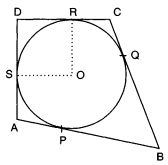
Since tangent to a circle is perpendicular to the radius through the point.
{tex} \therefore \quad \angle O R D = \angle O S D{/tex} = 90°
It is given that {tex} \angle D{/tex} = 90 °. Also, OR = OS. Therefore, ORDS is a square.
Since tangents from an exterior point to a circle are equal in length.
{tex} \therefore{/tex}BP = BQ
CQ = CR
and, DR = DS.
Now,
BP = BQ
{tex}\Rightarrow{/tex}BQ = 27 [{tex}\because{/tex} BP = 27cm(Given)]
{tex}\Rightarrow{/tex} BC - CQ = 27
38 -C Q = 27{tex} [ \because B C = 38 \mathrm { cm } ]{/tex}
CQ = 11cm
CR = 11cm{tex} [ \because C R = C Q ]{/tex}
CD - DR = 11
{tex}\Rightarrow{/tex} 25 -D R = 11 {tex} [ \because C D = 25 \mathrm { cm } ]{/tex}
{tex}\Rightarrow{/tex} DR = 14 cm
But, ORDS is a square. Therefore, OR = DR = 14 cm.
Hence, r = 14 cm.
Posted by Rajesh Rathore 6 years, 6 months ago
- 1 answers
Sia ? 6 years, 6 months ago
Given,
{tex}\frac { 1 } { ( a + b + x ) } = \frac { 1 } { a } + \frac { 1 } { b } + \frac { 1 } { x }{/tex}
{tex}\Rightarrow \quad \frac { 1 } { ( a + b + x ) } - \frac { 1 } { x } = \frac { 1 } { a } + \frac { 1 } { b } \Rightarrow \frac { x - ( a + b + x ) } { x ( a + b + x ) } = \frac { b + a } { a b }{/tex}
{tex}\Rightarrow \quad \frac { - ( a + b ) } { x ( a + b + x ) } = \frac { ( a + b ) } { a b }{/tex}
On dividing both sides by (a+b)
{tex}\Rightarrow \quad \frac { - 1 } { x ( a + b + x ) } = \frac { 1 } { a b }{/tex}
Now cross multiply
{tex}\Rightarrow{/tex} x(a + b + x) = -ab
{tex}\Rightarrow{/tex} x2 + ax + bx + ab = 0
{tex}\Rightarrow{/tex} x(x +a) + b(x +a) = 0
{tex}\Rightarrow{/tex} (x + a) (x + b) = 0
{tex}\Rightarrow{/tex} x + a = 0 or x + b = 0
{tex}\Rightarrow{/tex} x = -a or x = -b.
Therefore, -a and -b are the roots of the equation.
Posted by Himanshu Himanshu 6 years, 5 months ago
- 1 answers
Sia ? 6 years, 5 months ago
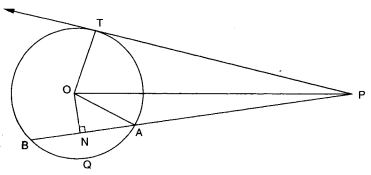
- PA .PB = (PN - AN)(PN + BN)
= (PN - AN) (PN + AN) {tex}\left[ \begin{array} { c } { \because O N \perp A B } \\ { \therefore N \text { is the mid-point of } A B } \\ { \Rightarrow A N = B N } \end{array} \right]{/tex}
= PN2 - AN2 - Applying Pythagoras theorem in right triangle PNO, we obtain
OP2 = ON2 + PN2
{tex}\Rightarrow{/tex}PN2 = OP2 - ON2
{tex}\therefore{/tex} PN2 - AN2 = (OP2 - ON2) - AN2
= OP2 - (ON2 + AN2)
= Op2 _ OA 2 [Using Pythagoras theorem in {tex}\Delta O N A{/tex}]
= OP2 - OT2 {tex}[ \because O A = O T = \text { radius } ]{/tex} - From (i) and (ii), we obtain
PA.PB = PN2 - AN2 and PN2 - AN2 = OP2 - OT2
{tex}\Rightarrow{/tex} PA .PB = OP2 - OT2
Applying Pythagoras theorem in {tex}\triangle O T P{/tex}, we obtain
OP2 = OT2 + PT2
{tex}\Rightarrow{/tex} OP2 - OT2 = PT2
Thus, we obtain
PA.PB = OP2 - OT2
and OP2 - OT2 = PT2
Hence, PA.PB = PT2.
Posted by Chahat Banga 7 years, 4 months ago
- 2 answers
Posted by Devesh Chaudhary 7 years, 4 months ago
- 1 answers
Posted by Anubhav Kumar Singh 7 years, 4 months ago
- 1 answers
Himay Sankhe 7 years, 4 months ago
Posted by Adheena Brijee 7 years, 4 months ago
- 1 answers
Posted by Ronak Verma 7 years, 4 months ago
- 1 answers
Posted by Divya Rai 7 years, 4 months ago
- 2 answers
Posted by Urvi Sharma 7 years, 4 months ago
- 3 answers
Monish Kumar 7 years, 4 months ago
Posted by Ram Kishun 7 years, 4 months ago
- 1 answers
Chirag Saini 7 years, 4 months ago
Posted by Akash Meher 7 years, 4 months ago
- 2 answers
Chirag Saini 7 years, 4 months ago
Posted by Akash Tripathi 6 years, 6 months ago
- 1 answers
Sia ? 6 years, 6 months ago
Given, an = 3 + 2n
a1 = 3 + 2{tex}\times{/tex}1 = 5
a2 = 3 + 2{tex}\times{/tex}2 = 7
a3 = 3 + 2{tex}\times{/tex}3 = 9
Thus the series is 5, 7, 9,......in which a = 5 and d = 7 - 5 = 2
{tex}\therefore \quad S _ { n } = \frac { n } { 2 } ( 2 a + ( n - 1 ) d ){/tex}
Sn = {tex}\frac n2{/tex}[2(5) + (n - 1)2]
Sn = {tex}\frac n2{/tex}[10 + 2n - 2]
Sn = {tex}\frac n2{/tex}[8 + 2n]
Sn = 4n + n2
Posted by Thrisha Vijayakumar 7 years, 4 months ago
- 1 answers
Utkarsh Dwivedi 7 years, 4 months ago
Posted by Susanta Sahu 7 years, 4 months ago
- 1 answers
Amanraj Aryan 7 years, 4 months ago
Posted by Vanchha Rawat 6 years, 5 months ago
- 1 answers
Sia ? 6 years, 5 months ago
Draw {tex}A E \perp B C{/tex}
In {tex}\Delta{/tex}AEB and {tex}\Delta{/tex}AEC, we have

AB = AC,
AE = AE [Common]
and, {tex}\angle{/tex}B = {tex}\angle{/tex}C [{tex}\because{/tex} AB = AC]
{tex}\therefore \quad \Delta A E B \cong \Delta A E C{/tex}
{tex}\Rightarrow{/tex} BE = CE [by CPCT]
Since {tex}\Delta{/tex}AED and {tex}\Delta{/tex}ABE are right triangles right-angled at E.
Therefore,
{tex}\Rightarrow{/tex} AD2 = AE2 + DE2 and AB2 = AE2 + BE2
{tex}\Rightarrow{/tex} AB2 - AD2 = BE2 - DE2
{tex}\Rightarrow{/tex} AB2 - AD2 = (BE+ DE) (BE - DE)
{tex}\Rightarrow{/tex} AB2 - AD2 = (CE+ DE) (BE - DE) [{tex}\because{/tex} BE = CE ]
{tex}\Rightarrow{/tex} AB2- AD2 = CD·BD
Hence, AB2 - AD2 = BD·CD
Posted by Lucky Bhatiya 7 years, 4 months ago
- 2 answers
Dibya Ranjan Das Das 7 years, 4 months ago
Kanika Yadav 7 years, 4 months ago
Posted by Sreelatha Athira S 6 years, 4 months ago
- 1 answers
Sia ? 6 years, 4 months ago
We have,
{tex}\frac{1}{{x - 3}} + \frac{2}{{x - 2}} = \frac{8}{x}{/tex}
{tex}\Rightarrow \frac{{1(x - 2) + 2(x - 3)}}{{(x - 3)(x - 2)}} = \frac{8}{x}{/tex}
{tex}\Rightarrow \frac{{x - 2 + 2x - 6}}{{(x - 3)(x - 2)}} = \frac{8}{x}{/tex}
{tex}\Rightarrow \frac{{3x - 8}}{{{x^2} - 2x - 3x + 6}} = \frac{8}{x}{/tex}
{tex}\Rightarrow \frac{{3x - 8}}{{{x^2} - 5x + 6}} = \frac{8}{x}{/tex}
Cross multiply,
{tex}\Rightarrow{/tex} {tex}x(3x-8)=8(x^2-5x+6){/tex}
{tex}\Rightarrow{/tex} {tex}3x^2-8x=8x^2-40x+48{/tex}
{tex}\Rightarrow{/tex} {tex}8x^2-40x+48-3x^2+8x=0{/tex}
{tex}\Rightarrow{/tex} {tex}5x^2-32x+48=0{/tex}
Factorise the equation,
{tex}\Rightarrow{/tex} 5x2 - 20x - 12x + 48 = 0
{tex}\Rightarrow{/tex} 5x(x - 4) - 12(x - 4) = 0
{tex}\Rightarrow{/tex} (5x - 12) (x - 4) = 0
{tex}\Rightarrow{/tex} (5x - 12) = 0 or (x - 4) = 0
{tex} \Rightarrow x = \frac{{12}}{5}{/tex} or x = 4
Posted by Ricky Khan 6 years, 5 months ago
- 1 answers
Sia ? 6 years, 5 months ago
Let two men start from the point C with velocity v each at the same time.
Also, {tex}\angle BCA = {45^o}{/tex}
Since, A and B are moving with same velocity v, so they will cover same distance in same time.
Therefore, {tex}\triangle ABC{/tex} is an isosceles triangle with AC = BC.
Now, draw {tex}CD \bot AB{/tex}
Let at any instant t, the distance between them is AB
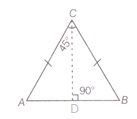
Let AC = BC = x and AB = y
In {tex}\triangle ACD{/tex} and {tex}\triangle DCB{/tex},
{tex}\angle CAD = \angle CBD{/tex} {tex}\left[ {\because AC = BC} \right]{/tex}
{tex}\angle CDA = \angle CDB = {90^o}{/tex}
{tex}\therefore \angle ACD = \angle DCB{/tex}
or {tex}\angle ACD = \frac{1}{2} \times \angle ACB{/tex} {tex} \Rightarrow \angle ACD = \frac{1}{2} \times {45^o}{/tex}
{tex} \Rightarrow \angle ACD = \frac{\pi }{8}{/tex}
{tex}\therefore \Rightarrow \sin \frac{\pi }{8} = \frac{{AD}}{{AC}}{/tex}
{tex}\therefore \Rightarrow \sin \frac{\pi }{8} = \frac{{y/2}}{x}\,\left[ {\because AD = \frac{y}{2}} \right]{/tex}
{tex}\Rightarrow \frac{y}{2} = x\sin \frac{\pi }{8}{/tex}
{tex} \Rightarrow y = 2x\sin \frac{\pi }{8}{/tex}
Now, differentiating both sides w.r.t t, we get
{tex}\frac{{dy}}{{dx}} = 2.\sin \frac{\pi }{8}.\frac{{dx}}{{dt}}{/tex}
{tex}= 2.\sin \frac{\pi }{8}.v\,\left[ {\because v = \frac{{dx}}{{dt}}} \right]{/tex}
{tex}= 2v.\frac{{\sqrt {2 - \sqrt 2 } }}{2}\,\,\left[ {\because \sin \frac{\pi }{8} = \frac{{\sqrt {2 - \sqrt 2 } }}{2}} \right]{/tex}
{tex} = \sqrt {2 - \sqrt 2 } {/tex} v unit /s
which is the rate at which A and B are being separated.
Posted by Akash Meher 7 years, 4 months ago
- 1 answers

myCBSEguide
Trusted by 1 Crore+ Students

Test Generator
Create papers online. It's FREE.

CUET Mock Tests
75,000+ questions to practice only on myCBSEguide app

Kannu Kranti Yadav 7 years, 4 months ago
3Thank You