
Ask questions which are clear, concise and easy to understand.
Ask QuestionPosted by Pushkar Tanwar 7 years, 4 months ago
- 1 answers
Posted by Aman Yadav 7 years, 4 months ago
- 1 answers
Posted by Himanshu Pandey 6 years, 5 months ago
- 1 answers
Sia ? 6 years, 5 months ago
Let {tex}\alpha{/tex} = 3, {tex}\beta{/tex} = {tex}\frac{1}{2}{/tex} and {tex}\gamma{/tex} = -1. Then,
{tex}( \alpha + \beta + \gamma ) = \left( 3 + \frac { 1 } { 2 } - 1 \right) = \frac { 5 } { 2 }{/tex},
{tex}( \alpha \beta + \beta \gamma + \gamma \alpha ) = \left( \frac { 3 } { 2 } - \frac { 1 } { 2 } - 3 \right) = \frac { - 4 } { 2 }{/tex} = -2
and {tex}\alpha \beta y = \left\{ 3 \times \frac { 1 } { 2 } \times ( - 1 ) \right\} = \frac { - 3 } { 2 }{/tex}
The polynomial with zeros α,β and {tex}\gamma{/tex} is:
{tex}\mathrm x^3-(\mathrm\alpha+\mathrm\beta+\mathrm\gamma)\mathrm x^2+(\mathrm{αβ}+\mathrm{βγ}+\mathrm{γα})\mathrm x-\mathrm{αβγ}{/tex}
{tex}=\mathrm x^3-\frac52\mathrm x^2-2\mathrm x+\frac32{/tex}
Thus, 2x3- 5x2- 4x + 3 is the desired polynomial.
Posted by Harman Kaur 7 years, 4 months ago
- 1 answers
Posted by Sahil Azami 7 years, 4 months ago
- 2 answers
Posted by Umesh Kumar 7 years, 4 months ago
- 2 answers
Posted by S Aniruddh 7 years, 4 months ago
- 4 answers
Posted by Aryan Kumar 7 years, 4 months ago
- 3 answers
Posted by Digesh Sahu Digesh Sahu 7 years, 4 months ago
- 1 answers
Posted by Muskan Gupta 6 years, 4 months ago
- 1 answers
Sia ? 6 years, 4 months ago
Given, {tex}\frac{2x}{x-3}+\frac{1}{2x+3}+\frac{3x+9}{(x-3)(2x+3)}=0{/tex}
{tex}\Rightarrow\frac{{2x(2x + 3) + x - 3 + 3x + 9}}{{(x - 3)(2x + 3)}} = 0{/tex}
{tex} \Rightarrow \frac{{4{x^2} + 6x + x - 3 + 3x + 9}}{{2{x^2} + 3x - 6x - 9}} = 0{/tex}
{tex} \Rightarrow \frac{4{x^2} + 10x +6 }{{2{x^2} - 3x - 9}} = 0{/tex}
Cross multiplying equation , we get ,
{tex} \Rightarrow 4{x^2} + 10x +6 = 0{/tex}
{tex} \Rightarrow 4{x^2} + 6x+4x +6 = 0{/tex}
{tex} \Rightarrow x(4{x} + 6)+1(4x +6) = 0{/tex}
{tex}\Rightarrow(x+1)=0{/tex} or {tex} (4x+6)=0{/tex}
{tex}\Rightarrow x=-1{/tex}
{tex}\Rightarrow x=-\frac{3}{2}{/tex}
Hence , the roots of the given quadratic equation are -1 and {tex}-\frac{3}{2}{/tex}
Posted by Sejal Ameta 6 years, 6 months ago
- 1 answers
Sia ? 6 years, 6 months ago
Surface area to colour = surface area of hemisphere + curved surface area of cone
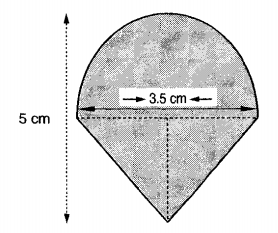
Diameter of hemisphere = 3.5 cm
So radius of hemispherical portion of the lattu = r = {tex}\frac { 3.5 } { 2 } \mathrm { cm }{/tex} = 1.75
r = Radius of the concial portion = {tex}\frac{3.5}2{/tex} = 1.75
Height of the conical portion = height of top - radius of hemisphere = {tex}{/tex} 5 - 1.75 = 3.25 cm
Let I be the slant height of the conical part. Then,
{tex}l^2=h^2+r^2{/tex}
{tex}\begin{array}{l}l^2=(3.25)^2+(1.75)^2\\\Rightarrow l^2\;=10.5625+3.0625\\\Rightarrow l^2=13.625\\\Rightarrow l=\sqrt{13.625}\\\Rightarrow l=3.69\end{array}{/tex}
Let S be the total surface area of the top. Then,
{tex}S = 2 \pi r ^ { 2 } + \pi r l{/tex}
{tex}\Rightarrow \quad S = \pi r ( 2 r + l ){/tex}
{tex}\begin{array}{l}\Rightarrow S=\frac{22}7\times1.75(2\times1.75+3.7)\\\;\;\;\;=\;5.5(3.5+3.7)\\=5.5(7.2)\\=39.6\;cm^2\end{array}{/tex}
Posted by Prerana Ghogre 6 years, 6 months ago
- 1 answers
Sia ? 6 years, 6 months ago

To construct: A line segment of length 8 cm and taking A as centre, to draw a circle of radius 4 cm and taking B as centre, draw another circle of radius 3 cm. Also, to construct tangents to each circle from the centre to the other circle.
Steps of Construction :
- Bisect BA. Let M be the mid-point of BA.
- Taking M as centre and MA as radius, draw a circle. Let it intersects the given circle at the points P and Q.
- Join BP and BQ.
Then, BP and BQ are the required two tangents from B to the circle with centre A. - Again, Let M be the mid-point of AB.
- Taking M as centre and MB as radius, draw a circle. Let it intersects the given circle at the points R and S.
- Join AR and AS.
Then, AR and AS are the required two tangents from A to the circle with centre B.
Justification: Join BP and BQ.
Then {tex}\angle APB{/tex} being an angle in the semicircle is 90o.
{tex} \Rightarrow BP \bot AP{/tex}
Since AP is a radius of the circle with centre A, BP has to be a tangent to a circle with centre A. Similarly, BQ is also a tangent to the circle with centre A.
Again join AR and AS.
Then {tex}\angle ARB{/tex} being an angle in the semicircle is 90o.
{tex} \Rightarrow AR \bot BR{/tex}
Since BR is a radius of the circle with centre B, AR has to be a tangent to a circle with centre B. Similarly, AS is also a tangent to the circle with centre B.
Posted by Ananya Shrivastava 7 years, 4 months ago
- 4 answers
Kannu Kranti Yadav 7 years, 4 months ago
Posted by Prajwal Latha 5 years, 8 months ago
- 1 answers
Sia ? 6 years, 6 months ago
Given: In the figure, ABC and AMP are two right triangles, right angled at B and M respectively,
To prove:
- {tex}\triangle {/tex}ABC {tex} \sim {/tex} {tex}\triangle {/tex}AMP
- {tex}\frac{{CA}}{{PA}} = \frac{{BC}}{{MP}}{/tex}
Proof:
- In {tex}\triangle {/tex}ABC {tex} \sim {/tex} {tex}\triangle {/tex}AMP
{tex}\angle{/tex}ABC = {tex}\angle{/tex}AMP (1) ........ [Each equal to 90o]
{tex}\angle{/tex}BAC={tex}\angle{/tex}MAP (2).........[Common angle]
In view of (1) and (2)
{tex}\triangle {/tex}ABC {tex} \sim {/tex} {tex}\triangle {/tex}AMP ..........AA similarity criterion - {tex}\triangle {/tex}ABC {tex} \sim {/tex} {tex}\triangle {/tex}AMP.........Proved above in(i)
{tex}\therefore {/tex} {tex}\frac{{CA}}{{PA}} = \frac{{BC}}{{MP}}{/tex}.........Corresponding sides of two similar triangles are proportional.
Posted by Chetan ._. 6 years, 6 months ago
- 1 answers
Sia ? 6 years, 6 months ago
Since, x2 = r2sin2Acos2B
y 2 = r2sin2A sin2B
and z2 = r2cos2A
L.H.S. = x2 + y2 + z2
{tex}=r^2sin^2Acos^2B+r^2sin^2Asin^2B+r^2cos^2A{/tex}
= {tex}r^2sin^2A(cos^2B+sin^2B)+r^2cos^2A{/tex}
= r2sin2 A + r2cos2A
= r2(sin2 A + cos2A)
= r2.
= R.H.S
Hence Proved.
Posted by Asish Chakma 7 years, 4 months ago
- 3 answers
Prerana Ghogre 7 years, 4 months ago
Posted by Jay Mittal 7 years, 4 months ago
- 2 answers
Posted by Sanobar Tamboli 7 years, 4 months ago
- 0 answers
Posted by Harsh Agarwal 7 years, 4 months ago
- 1 answers
Rahul Sha 7 years, 4 months ago
Posted by Amanjot Kaur 6 years, 6 months ago
- 1 answers
Sia ? 6 years, 6 months ago
Let the sum of k terms of A.P. is Sn = 3k2 - k
Now kth term of A.P = Sn - Sn-1
ak = (3k2 - k) - [3 (k - 1)2- ( k - 1)]
= (3k2 - k) - [3 (k2- 2k + 1) - ( k - 1)]
= 3k2 - k - [ 3k2 -6k + 3 - k + 1]
= 3k2 - k - [ 3k2 -7k + 4 ]
= 3k2 - k - 3k2 + 7k- 4
= 6k - 4
first term = a = {tex}6 \times 1 - 4 = 6 - 4 = 2{/tex}
Posted by Princess Yadav 6 years, 6 months ago
- 1 answers
Sia ? 6 years, 6 months ago
We have,
cosec{tex}\theta{/tex} - sin{tex}\theta{/tex} = m and sec{tex}\theta{/tex} - cos{tex}\theta{/tex} = n
{tex}\Rightarrow \quad \frac { 1 } { \sin \theta } - \sin \theta = m \text { and } \frac { 1 } { \cos \theta } - \cos \theta{/tex} = n
{tex}\Rightarrow \quad \frac { 1 - \sin ^ { 2 } \theta } { \sin \theta } = m \text { and } \frac { 1 - \cos ^ { 2 } \theta } { \cos \theta }{/tex} = n
{tex}\Rightarrow \quad \frac { \cos ^ { 2 } \theta } { \sin \theta } = m \text { and } \frac { \sin ^ { 2 } \theta } { \cos \theta }{/tex} = n
{tex}\therefore \quad \left( m ^ { 2 } n \right) ^ { 2 / 3 } + \left( m n ^ { 2 } \right) ^ { 2 / 3 } = \left( \frac { \cos ^ { 4 } \theta } { \sin ^ { 2 } \theta } \times \frac { \sin ^ { 2 } \theta } { \cos \theta } \right) ^ { 2 / 3 } + \left( \frac { \cos ^ { 2 } \theta } { \sin \theta } \times \frac { \sin ^ { 4 } \theta } { \cos ^ { 2 } \theta } \right) ^ { 2 / 3 }{/tex}
= (cos3{tex}\theta{/tex})2/3 + (sin3{tex}\theta{/tex})2/3 = cos2{tex}\theta{/tex} + sin2{tex}\theta{/tex} = 1
Hence, (m2n)2/3 + (mn2)2/3 = 1
Posted by Yadvendra Singh 7 years, 4 months ago
- 0 answers
Posted by Ramji Prajapati 6 years, 6 months ago
- 1 answers
Sia ? 6 years, 6 months ago
We have,
{tex}8 x ^ { 2 } - 22 x - 21 = 0{/tex}
{tex}\Rightarrow{/tex} 8x2 - 28x + 6x - 21 = 0
{tex}\Rightarrow{/tex} 4x(2x - 7) + 3 (2x - 7) = 0
{tex}\Rightarrow{/tex} (2x - 7) (4x + 3) = 0 {tex}\Rightarrow{/tex} 2x - 7 = 0 or, 4x + 3 = 0 {tex}\Rightarrow{/tex} {tex}x = \frac { 7 } { 2 } \text { or } x = - \frac { 3 } { 4 }{/tex}
Thus, {tex}x = \frac { 7 } { 2 } \text { and } x = - \frac { 3 } { 4 }{/tex} are two roots of the equation 8x2 - 22x - 21 = 0
Posted by Anju Verma 7 years, 4 months ago
- 1 answers
Rahul Sha 7 years, 4 months ago
Posted by Arpit Sharma 7 years, 4 months ago
- 1 answers
Posted by Pranav .B.Raj 7 years, 4 months ago
- 0 answers

myCBSEguide
Trusted by 1 Crore+ Students

Test Generator
Create papers online. It's FREE.

CUET Mock Tests
75,000+ questions to practice only on myCBSEguide app

Pradeep Singh 7 years, 4 months ago
0Thank You