
Ask questions which are clear, concise and easy to understand.
Ask QuestionPosted by Shivam Jamdagni 7 years, 4 months ago
- 1 answers
Posted by Rupsing Gond 7 years, 4 months ago
- 2 answers
Ajay Singh 7 years, 4 months ago
Posted by Anu Bagde 7 years, 4 months ago
- 0 answers
Posted by Durgesh Goel 7 years, 4 months ago
- 1 answers
Posted by Neerja Sharma 6 years, 6 months ago
- 1 answers
Sia ? 6 years, 6 months ago
To prove :
{tex}3 \left( A B ^ { 2 } + B C ^ { 2 } + C A ^ { 2 } \right) = 4 \left( A D ^ { 2 } + B E ^ { 2 } + C F ^ { 2 } \right){/tex}
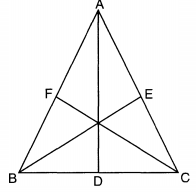
In triangle sum of squares of any two sides is equal to twice the square of half of the third side, together with twice the square of median bisecting it.
If AD is the median
{tex}A B ^ { 2 } + A C ^ { 2 } = 2 \left\{ A D ^ { 2 } + \frac { B C ^ { 2 } } { 4 } \right\}{/tex}
or, {tex}2 \left( A B ^ { 2 } + A C ^ { 2 } \right) = 4 A D ^ { 2 } + B C ^ { 2 }{/tex} ...(i)
Similarly by taking BE & CF as medians,
{tex}2 \left( A B ^ { 2 } + B C ^ { 2 } \right) = 4 B E ^ { 2 } + A C ^ { 2 }{/tex} ...(ii)
& {tex}2 \left( A C ^ { 2 } + B C ^ { 2 } \right) = 4 C F ^ { 2 } + A B ^ { 2 }{/tex} ...(iii)
By adding, (i), (ii) and (iii), we get
{tex}3 \left( A B ^ { 2 } + B C ^ { 2 } + A C ^ { 2 } \right) = 4 \left( A D ^ { 2 } + B E ^ { 2 } + C F ^ { 2 } \right){/tex}
Hence proved.
Posted by Shivam Jat 5 years, 8 months ago
- 1 answers
Yogita Ingle 7 years, 4 months ago
Real Numbers:
- All rational and all irrational number makes the collection of real number. It is denoted by the letter R
- We can represent real numbers on the number line. The square root of any positive real number exists and that also can be represented on number line
- The sum or difference of a rational number and an irrational number is an irrational number.
- The product or division of a rational number with an irrational number is an irrational number.
- This process of visualization of representing a decimal expansion on the number line is known as the process of successive magnification
Posted by Tanish Dhanotiya 7 years, 4 months ago
- 4 answers
Posted by Vaibhav Shukla 7 years, 4 months ago
- 1 answers
Aryan Mishra 7 years, 4 months ago
Posted by Anushka Bhatnagar 7 years, 4 months ago
- 1 answers
Posted by Manas Choudhari 6 years, 6 months ago
- 1 answers
Sia ? 6 years, 6 months ago
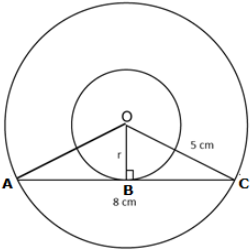
Since AC is a tangent to the inner circle.
{tex}\angle OBC = 90^\circ {/tex}
AC is a chord of the outer circle.
We know that, the perpendicular drawn from the centre to a chord of a circle, bisects the chord.
{tex}AC = 2BC \\ 8=2BC {/tex}
{tex}\Rightarrow{/tex} BC = 4 cm
In {tex}\Delta{/tex}OBC,
By Pythagoras theorem,
OC2 = OB2 + BC2
{tex}\Rightarrow{/tex} 52 = r2 + 42
{tex}\Rightarrow{/tex} r2 = 52 - 42
{tex}\Rightarrow{/tex} r2 = 25 - 16
{tex}\Rightarrow{/tex} r2 = 9 cm
{tex}\Rightarrow{/tex} r = 3 cm
Posted by Kanha Sharma 7 years, 4 months ago
- 2 answers
Shivay Brahmåñ 7 years, 4 months ago
Posted by Aditya Raj 6 years, 6 months ago
- 1 answers
Sia ? 6 years, 6 months ago
{tex}= \frac { 1 + \tan ^ { 2 } A } { 1 + \cot ^ { 2 } A } = \frac { 1 + \tan ^ { 2 } A } { 1 + \frac { 1 } { \tan ^ { 2 } A } } \cdot \because \cot A = \frac { 1 } { \tan A }{/tex}
{tex}= \frac { 1 + \tan ^ { 2 } A } { \frac { \tan ^ { 2 } A + 1 } { \tan ^ { 2 } A } } = \tan ^ { 2 } A \ldots \ldots ( 1 ){/tex}
{tex}\left( \frac { 1 - \tan A } { 1 - \cot A } \right) ^ { 2 } = \left( \frac { 1 - \tan A } { 1 - \frac { 1 } { \tan A } } \right) ^ { 2 }{/tex}
{tex}= \left\{ \frac { 1 - \tan A } { \left( \frac { \tan A - 1 } { \tan A } \right) } \right\} ^ { 2 } = ( - \tan A ) ^ { 2 } = \tan ^ { 2 } A{/tex} ....... (2)
(1) and (2) taken together given the result.
Posted by Sakshi Mohan 7 years, 4 months ago
- 2 answers
Posted by Razz Yadav 7 years, 4 months ago
- 2 answers
Posted by Sahil Jain 7 years, 4 months ago
- 1 answers
Posted by Sonu Prajapati 7 years, 4 months ago
- 1 answers
Priyanshu Singh 7 years, 4 months ago
Posted by Rajdev Attri 6 years, 6 months ago
- 1 answers
Sia ? 6 years, 6 months ago
Given in the quadrilateral ABCD
{tex}\frac{AO}{BO}=\frac{CO}{DO}{/tex}
or, {tex}\frac { A O } { C O } = \frac { B O } { D O }{/tex} ...(i)
Draw EO {tex}\parallel{/tex} AB on
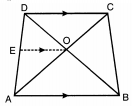
In {tex}\triangle A B D,{/tex} EO {tex}\parallel{/tex} AB (By construction)
{tex}\therefore {/tex} {tex}\frac { A E } { E D } = \frac { B O } { D O }{/tex} (By BPT)...(ii)
From (i) and (ii) we get
{tex}\frac{AO}{CO}=\frac{AE}{ED}{/tex}
Hence by converse of BPT in {tex}\triangle{/tex}ADC
{tex}EO\|CD{/tex}
But {tex}EO \|AB {/tex}
So {tex}AB\|CD {/tex}
Therefore ABCD is a trapezium
Posted by Rajdev Attri 7 years, 4 months ago
- 0 answers
Posted by Shubham Joshi 7 years, 4 months ago
- 1 answers
Posted by Arjun Thakur 7 years, 4 months ago
- 2 answers
Posted by Srushti Kunkolienkar 7 years, 4 months ago
- 3 answers
Abhishek Varma 7 years, 4 months ago
Posted by Anju Gupta 7 years, 4 months ago
- 1 answers
Kannu Kranti Yadav 7 years, 4 months ago
Posted by Kushagra Jaiswal 6 years, 6 months ago
- 1 answers
Sia ? 6 years, 6 months ago
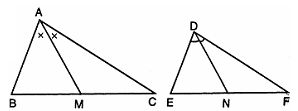
Given: {tex}\triangle {/tex}ABC {tex} \sim {/tex} {tex}\triangle {/tex}DEF
AM is the bisector of {tex}\angle{/tex} BAC and is the corresponding bisector of {tex}\angle{/tex} EDF
To prove:{tex}\frac{{area\vartriangle ABC}}{{area\vartriangle DEF}} = \frac{{A{M^2}}}{{D{N^2}}}{/tex}
Proof: {tex}\frac{{area\vartriangle ABC}}{{area\vartriangle DEF}} = \frac{{A{B^2}}}{{D{E^2}}}{/tex}.......(i) [Area theorem]
Now {tex}\triangle {/tex}ABC {tex} \sim {/tex} {tex}\triangle {/tex}DEF
{tex}\Rightarrow {/tex} {tex}\angle{/tex} A = {tex}\angle{/tex} D {tex}\Rightarrow {/tex} {tex}\frac{1}{2}\angle A = \frac{1}{2}\angle D{/tex}
{tex}\Rightarrow {/tex} {tex}\angle{/tex}BAM = {tex}\angle{/tex}EDN
In {tex}\triangle {/tex}ABM and DEN {tex}\angle{/tex} B = {tex}\angle{/tex} E and {tex}\angle{/tex} BAM= {tex}\angle{/tex}EDN
{tex}\Rightarrow {/tex} {tex}\triangle {/tex}ABM {tex} \sim {/tex} {tex}\triangle {/tex}DEN
{tex}\Rightarrow {/tex} {tex}\frac{{AB}}{{DE}} = \frac{{AM}}{{DN}} \Rightarrow \frac{{A{B^2}}}{{D{E^2}}} = \frac{{A{M^2}}}{{D{N^2}}}{/tex}...................(ii)
{tex}\Rightarrow {/tex} {tex}\frac{{area\vartriangle ABC}}{{area\vartriangle DEF}} = \frac{{A{M^2}}}{{D{N^2}}}{/tex} [From (i) and (ii)] Proved.
Posted by Lalit Kumar 7 years, 4 months ago
- 1 answers
Jasmine Kaur 7 years, 4 months ago
Posted by Shashi Ramachandran 7 years, 4 months ago
- 1 answers

myCBSEguide
Trusted by 1 Crore+ Students

Test Generator
Create papers online. It's FREE.

CUET Mock Tests
75,000+ questions to practice only on myCBSEguide app

Mayank Chhabra 7 years, 4 months ago
0Thank You