
Ask questions which are clear, concise and easy to understand.
Ask QuestionPosted by Priyanshu Bhandari 7 years, 4 months ago
- 2 answers
Upasana Yadav 7 years, 4 months ago
Posted by Jasleen Kour 5 years, 8 months ago
- 3 answers
Posted by Ipshita Pathak 7 years, 4 months ago
- 1 answers
Posted by Sharmin Chasmawala 7 years, 4 months ago
- 0 answers
Posted by Vipasha Saini 6 years, 6 months ago
- 1 answers
Sia ? 6 years, 6 months ago
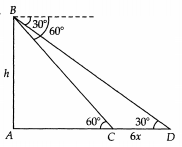
Let the speed of car be x m/sec.
{tex}\therefore {/tex} Distance covered in 6 sec. = 6 x.
{tex}\therefore {/tex} DC = 6x m
Let distance (remaining) CA covered in t sec
{tex}\therefore {/tex} CA = tx
Now in {tex}\triangle A D B{/tex} , AD = AC = CD = 6x + 9x
{tex}\therefore \quad \tan 30 ^ { \circ } = \frac { h } { 6 x + t x }{/tex}
{tex}\frac { h } { x } = \frac { 6 + t } { \sqrt { 3 } }{/tex} ....(i)
In {tex}\triangle{/tex}ABC
{tex}\frac{AB}{AC}=\frac{h}{tx}=tan60°=√3{/tex}
{tex}\frac{h}{x}=t√3….....(ii){/tex}
From (I)and(ii)
t√3(√3) = 6 + t
2t = 6 or t = 3 sec
Hence time taken by car from C to the tower is 3 sec.
Posted by Muskan Shriwastva 6 years, 6 months ago
- 1 answers
Sia ? 6 years, 6 months ago
Here, a3 = 15
S10 = 125
We know that
an = a + (n - 1)d
{tex} \Rightarrow {/tex} a3 = a + (3 - 1)d
{tex} \Rightarrow {/tex} a3 = a + 2d
{tex} \Rightarrow {/tex} 15 = a + 2d
{tex} \Rightarrow {/tex} a + 2d = 15 ...... (1)
Again, we know that
{tex}{S_n} = \frac{n}{2}\left[ {2a + (n - 1)d} \right]{/tex}
{tex} \Rightarrow {S_{10}} = \frac{{10}}{2}\left[ {2a + (10 - 1)d} \right]{/tex}
{tex} \Rightarrow {/tex} S10 = 5(2a + 9d)
{tex} \Rightarrow {/tex} 125 = 5(2a + 9d)
{tex} \Rightarrow {/tex} 25 = 2a + 9d
{tex} \Rightarrow {/tex} 2a + 9d = 25 ....... (2)
Solving equation (1) and equation (2), we get
a = 17
d = -1
Now an = a + (n - 1)d
{tex} \Rightarrow {/tex} a10 = a + (10 - 1)d
{tex} \Rightarrow {/tex} a10 = a + 9d
{tex} \Rightarrow {/tex} a10 = 17 + 9(-1)
{tex} \Rightarrow {/tex} a10 = 17 - 9
{tex} \Rightarrow {/tex} a10 = 8
Posted by Cha Hal 7 years, 4 months ago
- 1 answers
Posted by Honey Singh 6 years, 4 months ago
- 1 answers
Sia ? 6 years, 4 months ago
Elevation is height above a given level, especially sea level.
Posted by Prakhar Kushwaha 7 years, 4 months ago
- 0 answers
Posted by Neymar Fadhi Jr 7 years, 4 months ago
- 1 answers
Posted by Jeeva Dharshan 7 years, 4 months ago
- 0 answers
Posted by Harsh Lakra 7 years, 4 months ago
- 1 answers
Posted by Chetan Reddy 7 years, 4 months ago
- 1 answers
Sia ? 6 years, 6 months ago
Check marking scheme here : <a href="https://mycbseguide.com/cbse-syllabus.html">https://mycbseguide.com/cbse-syllabus.html</a>
Posted by Sonu Yadav 6 years, 6 months ago
- 1 answers
Sia ? 6 years, 6 months ago
Let S1 be the sum of the first n even natural numbers.
Then, S1 = 2 + 4 + 6 + ....+ 2n
{tex}\Rightarrow{/tex} S1 = {tex}\frac{n}{2}{/tex}[2 {tex}\times{/tex} 2 + (n - 1)2]
{tex}\Rightarrow{/tex} S1 = {tex}\frac{n}{2}{/tex}[4 + 2n - 2] = n(n + 1) ........(i)
Let the S2 be the sum of the first n odd natural numbers.
Then, S2 = {tex}\frac{n}{2}{/tex}[2 {tex}\times{/tex} 1 + (n - 1)2] = n2
From (i),we have, {tex}{/tex} {tex}{/tex}{tex}S_1=n^2(1+\frac{1}{n})=(1+\frac{1}{n})n^2=(1+\frac{1}{n})S_2{/tex}
Therefore, the sum of first n even natural numbers is equal to (1 + {tex}\frac{1}{n}{/tex}) times the sum of the first n odd natural numbers {tex}=(1+\frac{1}{n})S_2{/tex}
Posted by Raushan Kumar 7 years, 4 months ago
- 1 answers
Posted by Farhan Khan Farhan 7 years, 4 months ago
- 1 answers
Posted by Ankit Dhakad 7 years, 4 months ago
- 2 answers
Rahul Yadav 7 years, 4 months ago
Posted by Adnan Adnan 7 years, 4 months ago
- 1 answers
Posted by Thrupthi N 7 years, 4 months ago
- 1 answers
Posted by Palkesh Laddha 7 years, 4 months ago
- 3 answers
..... ...... 7 years, 4 months ago
Kumar Aditya Rajput 7 years, 4 months ago
Posted by The Devil Prince 6 years, 4 months ago
- 1 answers
Sia ? 6 years, 4 months ago
LHS = {tex}\frac { \tan \theta } { 1 - \cot \theta } + \frac { \cot \theta } { 1 - \tan \theta }{/tex}
{tex}= \frac { \frac { \sin \theta } { \cos \theta } } { 1 - \frac { \cos \theta } { \sin \theta } } + \frac { \frac { \cos \theta } { \sin \theta } } { 1 - \frac { \sin \theta } { \cos \theta } }{/tex} {tex}\left[ \because \tan \theta = \frac { \sin \theta } { \cos \theta } , \cot \theta = \frac { \cos \theta } { \sin \theta } \right]{/tex}
{tex}= \frac { \sin ^ { 2 } \theta } { \cos \theta ( \sin \theta - \cos \theta ) } + \frac { \cos ^ { 2 } \theta } { \sin \theta ( \cos \theta - \sin \theta ) }{/tex}
{tex}= \frac { \sin ^ { 2 } \theta } { \cos \theta ( \sin \theta - \cos \theta ) } - \frac { \cos ^ { 2 } \theta } { \sin \theta ( \sin \theta - \cos \theta ) }{/tex}
{tex}= \frac { \sin ^ { 3 } \theta - \cos ^ { 3 } \theta } { \sin \theta \cos \theta ( \sin \theta - \cos \theta ) }{/tex}
{tex}= \frac { ( \sin \theta - \cos \theta ) \left( \sin ^ { 2 } \theta + \cos ^ { 2 } \theta + \sin \theta \cos \theta \right) } { ( \sin \theta - \cos \theta ) \sin \theta \cos \theta }{/tex} [ a3 - b3 = (a - b)(a2 + ab + b2) ]
{tex}= \frac { 1 + \sin \theta \cos \theta } { \sin \theta \cos \theta }{/tex}
{tex}= \frac { 1 } { \sin \theta \cos \theta } + 1 = 1 + \sec \theta cosec \theta{/tex} = RHS
therefore, RHS = LHS
Posted by Bulbul . 7 years, 4 months ago
- 1 answers
Anu Walia 7 years, 4 months ago
Posted by Sarabjeet Kaur 7 years, 4 months ago
- 2 answers
Posted by Anu Walia 6 years, 4 months ago
- 1 answers
Sia ? 6 years, 4 months ago
Let a be the first term and d be the common difference of the given AP. Then,
S1 = sum of first n terms of the given AP,
S2 = sum of first 2n terms of the given AP,
S3 = sum of first 3n terms of the given AP.
S1 ={tex}\frac{n}{2}{/tex}{tex}\cdot{/tex}{2a+(n-1)d}, S2={tex}\frac{{2n}}{2}{/tex}{tex}\cdot{/tex}{2a+(2n-1)d}, and S3= {tex}\frac{{3n}}{2}{/tex}{tex}\cdot{/tex}{2a+(3n-1)d}
{tex}\Rightarrow{/tex}3(S2-S1) = 3{tex}\cdot{/tex}[{2na+n(2n - 1)d} - {na+{tex}\frac{1}{2}{/tex}n(n-1)d}]
= 3{tex}\cdot{/tex}[na + {tex}\frac{3}{2}{/tex}n2d-{tex}\frac{1}{2}{/tex}nd] = {tex}\frac{{3n}}{2}{/tex}{tex}\cdot{/tex}[2a+3nd - d]
= {tex}\frac{{3n}}{2}{/tex}{tex}\cdot{/tex}[2a+(3n-1)d}=S3.
Hence, S3=3(S2-S1).
Posted by Yuvaraj U 7 years, 4 months ago
- 0 answers
Posted by Preeti Kannaujiya 7 years, 4 months ago
- 1 answers
Anu Walia 7 years, 4 months ago

myCBSEguide
Trusted by 1 Crore+ Students

Test Generator
Create papers online. It's FREE.

CUET Mock Tests
75,000+ questions to practice only on myCBSEguide app

Kumar Aditya Rajput 7 years, 4 months ago
0Thank You