
Ask questions which are clear, concise and easy to understand.
Ask QuestionPosted by Chitralekha Khaund 5 years, 9 months ago
- 1 answers
Posted by Subal Kalai Kalai 5 years, 9 months ago
- 1 answers
Gaurav Seth 5 years, 9 months ago
Map Skills
(i) On an outline map of India mark and label the following rivers: Ganga, Satluj, Damodar, Krishna, Narmada, Tapi, Mahanadi, and Brahmaputra.
(ii) On an outline map of India mark and label the following lakes: Chilika, Sambhar, Wular, Pulicat, Kolleru.
Answer

Posted by Subal Kalai Kalai 5 years, 9 months ago
- 1 answers
Gaurav Seth 5 years, 8 months ago
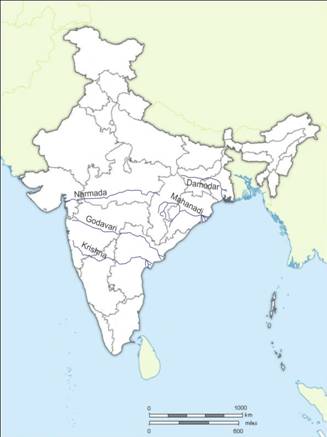
On an outline map of India, mark and label the following rivers :
1. Mahanadi .
2. Krishna .
3. Godavari .
4. Damodar .
5. Narmada .
Posted by Arvind Kumar Shah 5 years, 9 months ago
- 2 answers
Gaurav Seth 5 years, 9 months ago
Industrial Society and Social Change
- Industrialization resulted in a large number of people working in factories. Work hours were usually long and the workers were getting poor wages. Unemployment was quite common.
- As towns were growing rapidly, there were problems of housing and sanitation.
- Many among the liberals and radicals were property owners and employers. They wanted the benefit of industrialization to reach the workforce. They believed that healthy and educated citizens would be more productive for the economy.
- Some liberals and radicals wanted revolutions which could end all kind of governments established in Europe in 1815.
Posted by Kirtiraj Singh Solanki 5 years, 9 months ago
- 1 answers
Meghna Thapar 5 years, 8 months ago
Coal was formed by the decomposition of large land plants and trees buried under the earth about 300 million years ago. At that time, the earth had dense forests in low lying wet land areas. Due to natural processes like earthquakes, volcanoes, and floods, these forests were buried under the surface of earth and got compressed due to the deposition of soil over it. The temperature also rose as they sank deeper and deeper. Under high pressure and high temperature, dead plants got slowly converted into coal. As coal contains mainly carbon, the slow process of conversion of dead vegetation into coal is called carbonisation. Since it was formed from the remains of vegetation, coal is also called a fossil fuel.Petroleum was formed by the decomposition of the remains of the tiny plants and animals buried under the sea millions of years ago. When the tiny plants and animals died, their bodies sank to the bottom of the sea and were soon covered with mud and sand. Due to high pressure, heat and action of bacteria, in the absence of air, the dead remains of tiny plants and animals were slowly converted into petroleum. The petroleum thus formed got trapped between two layers of impervious rocks, forming an oil deposit.
Posted by Frederick Moses 5 years, 9 months ago
- 1 answers
Yogita Ingle 5 years, 9 months ago
Bhabhar is a narrow belt lying parallel to the Shiwaliks. When rivers come down from the mountains, they deposit pebbles in this belt lying parallel to the Siwaliks. All rivers disappear into the bhabhar belt.
Posted by Chitralekha Khaund 5 years, 9 months ago
- 1 answers
Gaurav Seth 5 years, 9 months ago
Zimbabwe attained independence from White minority rule in 1980. Since then the country has been ruled by ZANU-PF, the party that led the freedom struggle. Its leader, Robert Mugabe, has been ruling the country since independence. Elections have been held regularly and always won by ZANU-PF. President Mugabe is popular but also uses unfair practices in elections. Over the years his government has changed the constitution several times to increase the powers of the President and make him less accountable. Opposition party workers are harassed and their meeting disrupted. Public protests and demonstrations against the government are declared illegal. There is a law that limits the right to criticise the President. Television and radio are controlled by the government and give only the ruling party’s version. There are independent newspapers but the government harasses those journalists who go against it. The government has ignored some court judgments that went against it and has pressurised judges.
Posted by Shaurya Singh 5 years, 9 months ago
- 2 answers
Yogita Ingle 5 years, 9 months ago
Tithe and Taille were taxes levied by the French government. The differences between them are :
- Tithe is one tenth part of something paid as a contribution to a religious organization or a compulsory tax to government. Taille was a direct land tax.
- Tithe was levied on both noble and common man.. While Taille was levied on the French peasantry and non nobles in Ancient Regime France. The nobles and clergy were exempt from taille.
- Tithe was calculated as one tenth part of something. Taille was imposed on each household based on how much land it held.
Posted by Simran Kapoor 5 years, 9 months ago
- 1 answers
Yogita Ingle 5 years, 9 months ago
A constitution is the most important part of any country's political ecosystem. It is a written body of basic rules and fundamental policies for the citizens of that country.
Our country's constitution is the largest written constitution in the world.
Role of constitution:
1) establishing fundamental principles
2) establishing the proper environment for the political works in that country
3) establishing lawsystem in that country
Posted by Vishnupriya.R R 5 years, 9 months ago
- 1 answers
Yogita Ingle 5 years, 9 months ago
The spider feeds on the fly, whereas the fly does hard labour for finding its food. Similarly, in 18th century, France, the nobles lived off the labour of the peasants. The social reality of the time was that peasants had to pay feudal dues as well as rendering services for the nobles.
Posted by Vagish Bansal 5 years, 9 months ago
- 0 answers
Posted by Aarti Munda 5 years, 9 months ago
- 1 answers
Rutaja Singh 5 years, 9 months ago
Posted by Rohini Alandkar 5 years, 9 months ago
- 1 answers
Rutaja Singh 5 years, 9 months ago
Posted by Naveen Kasana 5 years, 9 months ago
- 5 answers
Rutaja Singh 5 years, 9 months ago
Yogita Ingle 5 years, 9 months ago
(i)Louis XVI was from the Bourbon family of kings, who ascended the throne of France In 1774.
(ii)He was 20 years old when he got married to the Austrian princess Marie Antoinette.
(iii)Under Louis XVI, France helped the thirteen American colonies to gain their independence from the common enemy, Britain.
Posted by Priya Yadav 5 years, 9 months ago
- 2 answers
Yogita Ingle 5 years, 9 months ago
A person who is unable to get proper education and shelter and nutritious food, or if a child is forced to child labour or they face social and caste discrimination, then they come under human poverty.
Posted by Chitralekha Khaund 5 years, 9 months ago
- 1 answers
Yogita Ingle 5 years, 9 months ago
ZANU – PF stands for The Zimbabwe African National Union – Patriotic Front. This party has been ruling since independence i.e.1980. The party has been led by Robert Mugabe. The specialty of this party is that it has always won elections.
Posted by Dhanyatha S Maddodi 5 years, 9 months ago
- 1 answers
Simran Kapoor 5 years, 9 months ago
Posted by Lucky Racer 5 years, 9 months ago
- 1 answers
Yogita Ingle 5 years, 9 months ago
The drafting of the constitution was done by the Constituent Assembly which originally had 389 members. The numbers came down to 239 members after the partition known as the Constituent Assembly.
Dr. Babasaheb Ambedkar, was the chairman of the drafting committee and Dr. Rajendra Prasad was chairman of the Constituent Assembly. Our constitution was adopted on 26th November, 1949. This came into effect on 26th January, 1950 which we commemorate as our Republic Day. The debates during formation of the constitution were recorded in the ‘constitutional assembly debates’.
Posted by Chitralekha Khaund 5 years, 9 months ago
- 1 answers
Yogita Ingle 5 years, 9 months ago
The word denial refers to the contradiction. There were many denials of equal rights to vote in the world politics. Some are as:
1- Women hadn't the equal right of vote till 1920, and then with the help of suffrage movements, they were able to get the right in 1920.
2- In USA, the black people couldn't vote till 1965.
3- In Saudi Arabia, women are not the part of voting.
4- In Fiji, the local Fijians vote is weighed more than the Indian-Fiji.
Posted by Chitralekha Khaund 5 years, 9 months ago
- 1 answers
Gaurav Seth 5 years, 9 months ago
The Institutional Revolutionary Party (PRI) was very strong in Mexico till 2000. Several oppositional parties contested elections but never managed to win because of the PRI. There were many reasons behind it:
(i) The PRI used many dirty tricks to win the elections.
(ii) All those who were employed in government offices had to attend all the meetings held by the PRI.
(iii) Teachers of government schools used to force parents to vote for the PRI.
(iv) Media largely ignored the activities of opposition political parties except to criticize them.
(v) Sometimes the polling booths were shifted from one place to another in the last minute, which made it difficult for people to cast their votes.
(vi) The PRI spent a large sum of money in the election campaign for its candidates. Mexico did not conduct fair elections as every election was won by PRI.
Posted by Chitralekha Khaund 5 years, 9 months ago
- 1 answers
Yogita Ingle 5 years, 9 months ago
China is not regarded a democratic country because it is ruled by the Communist Party. Elections are held in China but in the country, only the members of the Chinese Communist party or its eight allied parties can contest elections, and thus, only the Communist party can form the Government. Free and fair elections are not held in China. thus, China is not a democracy.
Posted by Chitralekha Khaund 5 years, 9 months ago
- 1 answers
Yogita Ingle 5 years, 9 months ago
Pakistan under General Musharraf is not called a democracy because the rulers were not elected by the people.
People might have elected their representatives to the national and provincial assemblies but these elected representatives were not really the rulers. They could not take the final decisions.
The power to take final decisions rested with army officials and with General Musharraf, and none of them were elected by the people.
Posted by Chitralekha Khaund 5 years, 9 months ago
- 1 answers
Meghna Thapar 5 years, 9 months ago
In August 2002, Pervez Musharraf issued a 'Legal Framework Order' that amended the constitution of Pakistan. According to this order, the President could dismiss the national or provincial assemblies. The legal framework order was the 17th amendment made to the constitution of Pakistan in August 2002. These amendments were implemented by General Parvez Musharraf, the president of Pakistan at that time.
Posted by Shambhavi Saumya 5 years, 9 months ago
- 0 answers
Posted by Kripa K Naik 5 years, 9 months ago
- 1 answers
Yogita Ingle 5 years, 9 months ago
- Nelson Mandela was born on 18th July 1918 into a royal family of the Thembu tribe in the village of Mvezo in Cape Province. The tribe spoke the language Xhosa.
- His birth name was Rolihlahla. Aged nine, Mandela was adopted by another high-ranking member of the tribe who groomed him for a leadership role in the tribe.
- Mandela became the first member of his family to receive formal education when he attended the local missionary school. He was given the English name ‘Nelson’ at the school, as was the custom then.
- For his secondary education, he went to another missionary school. The Christian faith was to have a profound impact on him.
- In 1939, Mandela entered the prestigious University of Fort Hare which was the only western-modelled institute of higher learning for black African students then.
- However, he never completed his education as he was expelled for boycotting against the policies of the institute. Mandela returned home only to find out that his marriage had been arranged. To escape this, he fled to Johannesburg and started work as a night watchman.
- He also studied for his bachelor’s degree by correspondence and found employment as a law clerk.
- At the University of Witwatersrand, where he enrolled to study law, Mandela befriended many activists, both black and white.
- He joined the African National Congress (ANC) in 1944. He also established its youth wing along with other leaders like Oliver Tambo, called the African National Congress Youth League (ANCYL).
- In the 1948 elections in South Africa, the National Party came to power and implemented harsh segregation policies. The non-whites were placed under severe restrictions and denied basic rights. They were even barred from the government.
- The ANC started its campaign for full citizenship for all South Africans through peaceful, non-violent means.
- Mandela travelled the length and breadth of the country advocating equal rights. He led the ANC’s Campaign for the Defiance of Unjust Laws in 1952. He, along with Tambo, also started the country’s first black law firm to fight cases for black people affected adversely by unjust segregation laws.
- In 1956, Mandela was arrested. He was released in 1961 after the trial but the situation was becoming increasingly tensed. The Pan Africanist Congress (PAN) had been formed in 1959 which advocated armed resistance against apartheid.
- In 1960, the police opened fire at a group of peaceful black protestors in Sharpeville. 69 people were killed. Riots ensued in different parts of the country. The ANC and the PAC were banned by the government. It was also during this time that Mandela gave up peaceful resistance and started a more radical approach.
- In 1961, he founded the Umkhonto we Sizwe (MK) with his colleagues. This was an armed wing of the ANC.
- The MK under Mandela’s leadership started a sabotage movement against the government.
- He travelled abroad in January 1962 despite being banned from doing so and met Tambo who was exiled in London. He also received guerrilla training in Algeria.
Posted by Priya Yeul 5 years, 9 months ago
- 1 answers
Gaurav Seth 5 years, 9 months ago
Stalin’s collectivisation programme:
(i)Stalin forced all peasants to cultivate in collective farms, kolkhoz. The bulk of land and implements were transferred to the ownership of collective farms. Peasants worked on the land, and the kolkhoz profit was shared.
(ii)Enraged peasants resisted the authorities and destroyed their livestock. Between 1929 and 1931, the number of cattle fell by one-third.
(iii)Those who resisted collectivisation were severely punished. Many were deported and exiled.
(iv)As they resisted collectivisation, peasants argued that they were not rich and they were not against socialism. They merely did not want to work in collective farms for a variety of reasons.
(v)Stalin’s government allowed some independent cultivation, but treated such cultivators unsympathetically.
Posted by Vaishnavi Pawar 5 years, 9 months ago
- 1 answers
Gaurav Seth 5 years, 9 months ago
- The system of apartheid divided the people and labelled them on the basis of their skin colour.
- The natives of South Africa were the ‘Blacks’, the people of mixed races were ‘Coloured’ and the people who migrated from India, ‘The Indians’.
- All Non-Whites were treated as inferiors and were deprived of their right to vote.
- They were forbidden from living in white areas.
- They could work in white areas only if they had a permit.
- Trains, buses, taxis, hotels, hospitals, schools, colleges, libraries, 'cinema halls, beaches, swimming pools, public toilets were all separate for whites and blacks.
- The Blacks could not visit the churches where the whites worshipped.
Posted by Olivia Aggarwal 5 years, 9 months ago
- 1 answers
Meghna Thapar 5 years, 9 months ago
Pervez Musharraf is a Pakistani former four-star general and politician who became the tenth president of Pakistan after the successful 1999 Pakistani coup d'état. He held the presidency from 2001 until 2008 when he tendered his resignation to avoid impeachment. In 2003, Musharraf squarely blamed Nawaz Sharif for the military take over and held responsible for the martial law against his government while accused him of being an autocrat and weakening the might of the military.
Posted by Supreet Mohapatra 5 years, 9 months ago
- 1 answers
Gaurav Seth 5 years, 9 months ago
(i) Democracy is not only about rulers and governments. Democracy is a principle that can be applied to any sphere of life. A democratic decision involves consultation with and consent of all those who are affected by that decision. In this sense, it can be applied to any organization other than the government.
(ii) We can have democratic classrooms where the students can ask questions without hesitation. Where the teachers have a democratic temperament. Where the interaction is not a one-way traffic but a healthy two-way interaction.
(iii) Democracy can be seen in families also. We could have democratic families where the decisions are not taken by any one individual and imposed on rest of the family members. All the family members should sit down and arrive at a general concensus. My opinion should matter as much as my father's. In this way, we can have, democracy in our family also.
Posted by Jay Kumar Mishra 5 years, 9 months ago
- 1 answers
Yogita Ingle 5 years, 9 months ago
BHABAR:
- The rivers deposit pebbles in a narrow belt.
- It comprises of pebble- studded rocks in the shape of porus beds.
- This region is known as bhabar.
- The width of this belt is about 8 to 16 km and it lies parallel to the Shiwaliks.
TERAI:
The Terai is a lowland region in southern Nepal and northern India that lies south of the outer foothills of the Himalayas, the Siwalik Hills, and north of the Indo-Gangetic Plain.
BHANGAR:
- The slightly elevated, terraced land of older alluvium—and khadar, the more fertile fresh alluvium on the low-lying floodplain.
- In general, the ratio ofbhangar areas to those of khadar increases upstream along all major rivers.

myCBSEguide
Trusted by 1 Crore+ Students

Test Generator
Create papers online. It's FREE.

CUET Mock Tests
75,000+ questions to practice only on myCBSEguide app

Gaurav Seth 5 years, 9 months ago
The example of Zimbabwe shows that popular approval of the rulers is necessary in a democracy, but it is not sufficient. Popular governments can be undemocratic. Popular leaders can be autocratic. If we wish to assess a democracy, it is important to look at the elections. But it is equally important to look before and after the elections. There should be sufficient room for normal political activity, including political opposition, in the period before elections. This requires that the state should respect some basic rights of the citizen. They should be free to think, to have opinions, to express these in public, to form associations, to protest and take other political actions. Everyone should be equal in the eyes of law. These rights must be protected by an independent judiciary whose orders are obeyed by everyone.
0Thank You