
Ask questions which are clear, concise and easy to understand.
Ask QuestionPosted by Pratheeksha Naik 5 years, 5 months ago
- 2 answers
Posted by Pratheeksha Naik 5 years, 5 months ago
- 2 answers
Gaurav Seth 5 years, 5 months ago
What was the set of ideas that Lenin expressed in the newspaper Pravda following his return to Russia?
- The April Theses
- The Communist Manifesto
- The Federalist Papers
- Das Kapital
Answer: The April Theses
Posted by Pratheeksha Naik 5 years, 5 months ago
- 1 answers
Gaurav Seth 5 years, 5 months ago
Gregorian calendar
In February 1918 Soviet Russia adopted the Gregorian calendar which was already being used across Western Europe. This replaced the Julian calendar, which was 13 days behind.
Posted by Himani Sharma 5 years, 5 months ago
- 1 answers
Gaurav Seth 5 years, 5 months ago
there were various steps taken by the Bolsheviks party to transform russian into a socialist society.
1 . nationalisation of private bank and heavy industries. this was in the manifes to of the Bolsheviks party since a long time.
2. working hours of workers restricted to 8 hours a day and worker were entitled to fixed ration as decided by the state.
3. Church property was seized and transformed into god was to store food grains and other essential.
4. the communist completey destroyed old Russian literature and culture and replaced it with marxist literature to build a so called new socialist man
Posted by Rahul Kumar 5 years, 5 months ago
- 3 answers
Gaurav Seth 5 years, 5 months ago
The peculiar features of Nazism were (i) Nazis believed in the idea of one people, one empire and one leader. (ii) It did not tolerate other parties and tried to crush all other organizations and parties and wanted to remove socialism, communism and democracy from Germany. (iii) According to Nazism there was no equality between people. In this view, the blue eyed Nordic German Aryans were at the top while the Jews were located at the lowest rung. (iv) It was propagated that the Jews were responsible for the economic misery of the Germans. (v) Nazis propagated war and glorified aggression. (vi) Nazis believed in the idea of Lebensraum on living space, i.e., new areas should be acquired so that more space is available for the Germans to settle. (vii) Nazis wanted to create a separate racial community of pure Germans by physically eliminating all those who were seen as undesirable by them. (viii) The Nazis believed that Jews were inferior and the cause of German misery and therefore should be totally eliminated. (ix) The Nazi argument was simple. The strongest race would survive and the weak ones would perish. (x) The Aryan race was the finest. It had to retain its purity, become stronger and dominate the world.
Manyata Joshi 5 years, 5 months ago
Posted by Machukmi Chawung 5 years, 5 months ago
- 2 answers
Gaurav Seth 5 years, 5 months ago
I N D I A: Drainage and Lakes
This map shows various rivers that flow across the states, national capital, union territories and international boundaries. It also shows the major lakes of India.

Posted by Angela Amrutha James 5 years, 5 months ago
- 2 answers
Posted by Nickson Sharma 5 years, 5 months ago
- 2 answers
Somay Mamgain 5 years, 5 months ago
Posted by Ankit Shah 5 years, 5 months ago
- 0 answers
Posted by Aviral Mangat 5 years, 5 months ago
- 1 answers
Unknown Student 5 years, 5 months ago
Posted by Meera Boghani 5 years, 5 months ago
- 1 answers
Unknown Student 5 years, 5 months ago
Posted by Vidya Pansare 5 years, 5 months ago
- 1 answers
Manyata Joshi 5 years, 5 months ago
Posted by Khushi Yadav 5 years, 5 months ago
- 5 answers
Arpit Agnihotri 5 years, 5 months ago
Aditya Khare 5 years, 5 months ago
Posted by Aaditya Solanki 5 years, 5 months ago
- 0 answers
Posted by Aaditya Solanki 5 years, 5 months ago
- 0 answers
Posted by Vedant Kale 5 years, 5 months ago
- 2 answers
Unknown Student 5 years, 5 months ago
Manyata Joshi 5 years, 5 months ago
Posted by Dechen Bhutia 5 years, 5 months ago
- 1 answers
Posted by Ishika Gupta 5 years, 5 months ago
- 1 answers
Gaurav Seth 5 years, 5 months ago
French revolution started in 1789. The series of events started by the middle class shook the upper classes. The people revolted against the cruel regime of monarchy. This revolution put forward the ideas of liberty, fraternity, and equality. The revolution began on 14th July, 1789 with the storming of the fortress-prison, the Bastille. The Bastille was hated by all, because it stood for the despotic power of the king. The fortress was demolished.
Posted by Ayushi Tiwari 2 years, 8 months ago
- 2 answers
Reiteysh Shrivastava 2 years, 6 months ago
Posted by Trisha Verma 5 years, 5 months ago
- 1 answers
Aarushi Erande 5 years, 5 months ago
Posted by M Shrigan 5 years, 5 months ago
- 4 answers
Nancy Kajal 5 years, 5 months ago
Aditya Goswami 5 years, 5 months ago
Yogita Ingle 5 years, 5 months ago
Conservatives believed in traditional and cultural values. They were the people who supported monarchy and nobility. They believed that privileges of the monarchy and nobility should exist. After the French Revolution, they contended that gradual changes should be brought in the society.
Pavleen Bagga 5 years, 5 months ago
Posted by Lav Khator 5 years, 5 months ago
- 3 answers
Gaurav Seth 5 years, 5 months ago
| BASIS | ECONOMIC ACTIVITIES | NON-ECONOMIC ACTIVITIES |
| (1) Meaning | Activity performed to earn a livelihood. | That activity is performed out of love, sympathy, sentiments, patriotism, etc. |
| (2) Purpose | Undertaken to earn money and satisfy physiological needs. | Undertaken to satisfy psychological or emotional needs. |
| (3) Types | Business, profession, and employment. | Social responsibility, religious responsibility, personal satisfaction, etc. |
| (4) Benefits | Money and wealth. | Self-satisfaction. |
| (5) Examples | A worker working in a factory. | A boy helping an old man to cross the road. |
Gaurav Seth 5 years, 5 months ago
| Market Activities | Non-market Activities |
| 1. Market activities involve remuneration to any one who performs, i.e., activity performed for pay or profit. | 1. Non-metal activities are the production for self-consumption. |
| 2. These include production of goods or services including government service. | 2. These can be consumption and processing of primary product and own account production of fixed assets. |
Yogita Ingle 5 years, 5 months ago
1) Market activity involved those activities which are performed basically for the purpose of the sale in the market and that include profit. The main motive of doing such activities to earn money by selling the output in the market. Whereas non market activities are those activities primarily undertaken for the purpose of self consumption. This activity don't give profit as they are for self consumption.
2) It includes the production of goods and services including the government services whereas it neither for sale in the market nor for earning profit . This activity can't be for construction and processing of primary products for one's own use.
3) Example- a vegetable vendor selling vegetables, a shoemaker selling shoes. Whereas example- a farmer cultivate primarily for himself and his family and not for earning profit .
Posted by Sukhbeer Singh Sukhbeer Singh 5 years, 5 months ago
- 1 answers
Manyata Joshi 5 years, 5 months ago
Posted by Prabhjit Singh 5 years, 5 months ago
- 1 answers
Manyata Joshi 5 years, 5 months ago
Posted by Yuvraj Singh 5 years, 5 months ago
- 1 answers
Manyata Joshi 5 years, 5 months ago
Posted by Rohit Tiwari 5 years, 5 months ago
- 1 answers
Gaurav Seth 5 years, 5 months ago
What was the Bastille?
The Bastille was a fortress built in the late 1300s to protect Paris during the Hundred Years' War. By the late 1700s, the Bastille was mostly used as a state prison by King Louis XVI.
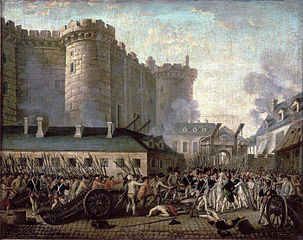
<i>Storming of the Bastille</i>
Who stormed the Bastille?
The revolutionaries who stormed the Bastille were mostly craftsmen and store owners who lived in Paris. They were members of a French social class called the Third Estate. There were around 1000 men who participated in the attack.
Why did they storm the Bastille?
The Third Estate had recently made demands of the king and had demanded that the commoners have more of a say in government. They were worried that he was preparing the French army for an attack. In order to arm themselves, they first took over the Hotel des Invalides in Paris where they were able to get muskets. However, they didn't have gun powder.
The Bastille was rumored to be full of political prisoners and was a symbol to many of the oppression of the king. It also had stores of gunpowder that the revolutionaries needed for their weapons.
Storming the Bastille
On the morning of July 14, the revolutionaries approached the Bastille. They demanded that the military leader of the Bastille, Governor de Launay, surrender the prison and hand over the gunpowder. He refused.
As negotiations drug on, the crowd became agitated. In the early afternoon, they managed to get into the courtyard. Once inside the courtyard, they began to try and break into the main fortress. The soldiers in the Bastille became scared and fired into the crowd. The fighting had began. The turning point in the fight came when some of the soldiers joined the side of the crowd.
Posted by K M Thikshitha 5 years, 5 months ago
- 2 answers
Nancy Kajal 5 years, 5 months ago
Shreya Pandey 5 years, 5 months ago
Posted by Abhishek Kumar 5 years, 5 months ago
- 2 answers
Nancy Kajal 5 years, 5 months ago
Yogita Ingle 5 years, 5 months ago
Literacy rate has surged forward from 64.83 per cent in 2001 to 74.04 per cent in 2011 showing an increase of 9.21 percentage points.
Posted by Abhishek Kumar 5 years, 5 months ago
- 4 answers

myCBSEguide
Trusted by 1 Crore+ Students

Test Generator
Create papers online. It's FREE.

CUET Mock Tests
75,000+ questions to practice only on myCBSEguide app

Gaurav Seth 5 years, 5 months ago
Lenin used the slogan "All power to the soviets!" to oppose the Provisional Government led by Kerensky. Based on the Bolshevik view of the state, the word soviet extended its meaning to any overarching body that obtained the authority of a group of soviets.
0Thank You