
Ask questions which are clear, concise and easy to understand.
Ask QuestionPosted by Ashish Bhatt 8 years, 7 months ago
- 2 answers
Posted by Devashish Mishra 8 years, 7 months ago
- 1 answers
Dharmendra Kumar 8 years, 7 months ago
(125)x ={tex}25\over 5^x{/tex}
( 53)x = 25× (5x)-1 [by using {tex}{1\over a^n}=a^{-n}{/tex} ]
53x = 52 × 5-x [by using (an)m=anm]
53x = 52-x [by using an× am = an+m ]
3x=2-x [by using if an = am than n=m]
3x+x=2
4x=2
x={tex}2\over 4{/tex}
x= {tex}1\over 2{/tex}
Posted by Parth Srivastav 8 years, 7 months ago
- 2 answers
Dharmendra Kumar 8 years, 7 months ago
x2 +18x+32=x2 +16x+2x+32
= x(x+16)+2(x+16)
= (x+16)(x+2)
Posted by Saahir Syed 8 years, 7 months ago
- 0 answers
Posted by Aryan Manglani 8 years, 7 months ago
- 0 answers
Posted by Amit Kumar 8 years, 7 months ago
- 1 answers
Posted by Ayush Baliyan 8 years, 7 months ago
- 3 answers
Posted by Rohit Kumar 8 years, 7 months ago
- 3 answers
Posted by Pratishtha Agnihotri 8 years, 7 months ago
- 0 answers
Posted by Maddi Pavan 8 years, 7 months ago
- 0 answers
Posted by Pushpendra Mishra 4 years, 3 months ago
- 3 answers
Posted by Ayush Pallod 8 years, 7 months ago
- 0 answers
Posted by Rupal Sharma 8 years, 7 months ago
- 0 answers
Posted by Tushar Varshney 8 years, 7 months ago
- 1 answers
Soumya Ghoshal 8 years, 7 months ago
8a³-b³-12a²b+6ab²
=(2a-b)(4a²+2ab+b²)-6ab(2a-b)
=(2a-b)(4a²+2ab+b²-6ab)
=(2a-b)(4a²-4ab+b²)
=(2a-b){(2a)²-2×2a×b+(b)²}
=(2a-b)(2a-b)²
=(2a-b)(2a-b)(2a-b)
Posted by Khushi Jain 8 years, 7 months ago
- 4 answers
Posted by V K 8 years, 7 months ago
- 0 answers
Posted by V K 8 years, 7 months ago
- 0 answers
Posted by V K 8 years, 7 months ago
- 1 answers
Hans Raj 8 years, 7 months ago
22/ 7 is not equal to pi
we know that pi is irrational and cannot be expressed as a ratio
for many practical purposes , we need some approximate value of pi
we found that 22/7 is really good approximation for practical purposes particularly when we do manual calculation
pi = 3.1415.....
22/7 = 3.1428....
actually 22/7 is > pi
Posted by Vineet Gulia 8 years, 7 months ago
- 0 answers
Posted by Atul Singh 8 years, 7 months ago
- 0 answers
Posted by Rishav Kumar 8 years, 7 months ago
- 1 answers
Arpita Banerjee 8 years, 7 months ago
Steps involved are as follows:
Step I: Draw a number line and mark the center point as zero.
Step II: Mark right side of the zero as (1) and the left side as (-1).
<a href="http://www.math-only-math.com/images/irrational-numbers-number-line.png" rel="gallery[pageGallery]" title="Irrational Numbers Number Line"> </a>
</a>
Step III: We won’t be considering (-1) for our purpose.
Step IV: With 2 units as length draw a line from (1) such that it is perpendicular to the line.
Step V: Now join the point (0) and the end of new line of 2 units length.
Step VI: A right angled triangle is constructed.
Step VII: Now let us name the triangle as ABC such that AB is the height (perpendicular), BC is the base of triangle and AC is the hypotenuse of the right angled triangle ABC.
<a href="http://www.math-only-math.com/images/square-root-of-5.png" rel="gallery[pageGallery]" title="Square Root of 5">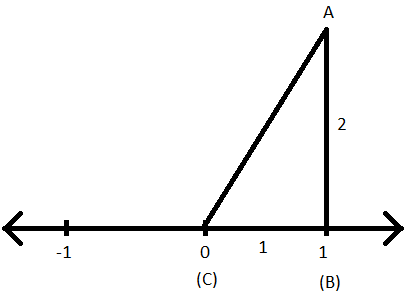 </a>
</a>
Step VIII: Now length of hypotenuse, i.e., AC can be found by applying Pythagoras theorem to the triangle ABC.
AC2 = AB2+ BC2
⟹ AC2 = 22+ 12
⟹ AC2 = 4 + 1
⟹ AC2 = 5
⟹ AC = √5
<a href="http://www.math-only-math.com/images/square-root-of-5-on-number-line.png" rel="gallery[pageGallery]" title="Square Root of 5 on Number Line"> </a>
</a>
Step IX: Now with AC as radius and C as the centre cut an arc on the same number line and name the point as D.
Step X: Since AC is the radius of the arc and hence, CD will also be the radius of the arc whose length is √5.
Step XI: Hence, D is the representation of √5 on the number line.
<a href="http://www.math-only-math.com/images/represent-square-root-of-5-on-number-line.png" rel="gallery[pageGallery]" title="Represent Square Root of 5 on Number Line"> </a>
</a>
Posted by Reena Karim 8 years, 7 months ago
- 3 answers
Niranjana Srinivasan 5 years, 6 months ago
Arpita Banerjee 8 years, 7 months ago
Given x = 3 + 2√2
⇒ x = 2 + 1 + 2√2
⇒ x = (√2)2 + 12 + 2×√2×1
⇒ x = (√2 + 1)2
∴ x = (√2 + 1)
⇒(1/x) = 1/ (√2 + 1)
Multiply and divide by (√2 − 1)
⇒(1/x) = (√2 − 1) / [(√2 + 1)(√2 − 1)]
⇒(1/x) = (√2 − 1) / [2 − 1]
∴ (1/x) = (√2 − 1)
Consider [x + (1/x)] = [(√2 + 1) + (√2 − 1)]
= 2√2
Akash Champ 8 years, 7 months ago
Posted by Srikant Kumar 8 years, 7 months ago
- 1 answers
Dharmendra Kumar 8 years, 7 months ago
Let unit place of two digit number is x and tens place is y.
Then the two digit number is 10y+x
A.T Q.
10y+x=6×(x+y)+4
10y+x = 6x+6y+4
10y+x-6x-6y=4
4y-5x=4
Posted by Yuvika Singh 8 years, 7 months ago
- 1 answers
Dharmendra Kumar 8 years, 7 months ago
Given x+y=10 and x=z ----(1)
x+y-y=10-y [by Euclid's axiom (3) if equals are subtracted from equals then the remainders are also equal.]
x=10-y ------(2)
From eq.(1) and (2)
z=10-y [by using Euclid's axiom(1) things which are equal to same thing are equal to one another.]
z+y=10-y+y [ by using Euclid's axiom (2) if equals ate added to equals, then wholes are equal.]
z+y=10 H.Proved
Posted by Prantik Kalita 8 years, 7 months ago
- 3 answers
Posted by Shreeja Sasi 8 years, 7 months ago
- 1 answers
Posted by Varsha Javagal 8 years, 7 months ago
- 0 answers

myCBSEguide
Trusted by 1 Crore+ Students

Test Generator
Create papers online. It's FREE.

CUET Mock Tests
75,000+ questions to practice only on myCBSEguide app

Aman Kumar 8 years, 7 months ago
0Thank You