
Ask questions which are clear, concise and easy to understand.
Ask QuestionPosted by Chinky Bhan 6 years, 6 months ago
- 1 answers
Posted by Harsh Gupta 6 years, 6 months ago
- 1 answers
Pramod Pant 6 years, 6 months ago
Posted by Shubhangi Mozarkar 6 years, 6 months ago
- 1 answers
Yogita Ingle 6 years, 6 months ago
5/7=0.7142 9/11=0.818181
first we have to change the the number into decimal or rational
decimal form of 5/7 is 0.71428571 and the decimal form of 9/11 is 81818181
hence the rational number are between 0.71428571 and 0.81818181
rational numbers between 5/7 and 9/11
1) 0.72428571
2) 0.73428571
3) 0.74428571
.
.
.
.
upto 0.80818181
you can take any number between them as irrational.
Posted by Naman Sen 6 years, 6 months ago
- 0 answers
Posted by Shivika Arora 6 years, 6 months ago
- 1 answers
Namrata Jindal 6 years, 6 months ago
Posted by Riya Suriyavanshi 6 years, 6 months ago
- 0 answers
Posted by Riya Suriyavanshi 6 years, 6 months ago
- 1 answers
Sia ? 6 years, 6 months ago
Take AB= BC = 1cm
{tex}\angle B = {90^0}{/tex}
In {tex}\triangle{/tex}ABC
AC2 = AB2 + BC2
AC2 = 1 + 1
AC2 = 2
AC = {tex}\sqrt{2}{/tex}
In {tex}\triangle{/tex}OCD
{tex}\angle C = {90^0}{/tex}
OD2 = OC2 + DC2
OD2 = ({tex}\sqrt{2}{/tex})2 + 1
OD2 = 2 + 1
OD2 = 3
OD = {tex}\sqrt{3}{/tex}
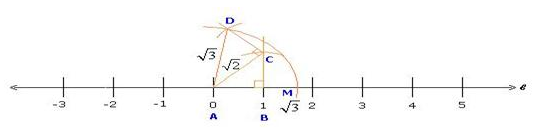
Posted by Jashanjot K Jashan 6 years, 6 months ago
- 2 answers
Sia ? 6 years, 6 months ago
First rational number between {tex}\frac{1}{2}{/tex} and {tex}\frac{1}{3}{/tex}
{tex}= \frac{1}{2}\left[ {\frac{1}{2} + \frac{1}{3}} \right] \Rightarrow \frac{1}{2}\left[ {\frac{{3 + 2}}{6}} \right] \Rightarrow \frac{5}{{12}}{/tex}
{tex} {\text{ = }}\frac{{\text{1}}}{{\text{2}}}{\text{,}}\frac{{\text{5}}}{{{\text{12}}}}{\text{ and }}\frac{{\text{1}}}{{\text{3}}}{/tex}
Second rational number between{tex}\frac{1}{2}and\frac{1}{3}{/tex}
{tex} {\text{ = }}\frac{1}{2}\left[ {\frac{1}{2} + \frac{5}{{12}}} \right] \Rightarrow \frac{1}{2}\left[ {\frac{{6 + 5}}{{12}}} \right] \Rightarrow \frac{{11}}{{24}} {/tex}
{tex} {\text{ = }}\frac{5}{{12}}and\frac{{11}}{{24}}{\text{ are two rational numbers between }}\frac{1}{2}and\frac{1}{3} {/tex}
Sachin Ahlawat 6 years, 6 months ago
Posted by Shorya Sharma 6 years, 6 months ago
- 2 answers
Rupa Goel 6 years, 6 months ago
Posted by Pradeep Yadav 6 years, 6 months ago
- 0 answers
Posted by Dev Bhati 6 years, 6 months ago
- 0 answers
Posted by Keshav Deshmukh 6 years, 6 months ago
- 1 answers
Sia ? 6 years, 6 months ago
Given: Perimeter of rectangular wall = {tex}2\left( l+b \right){/tex} = 250 m ……….(i)
Now Area of the four walls of the room
={tex}\frac{\text{Total cost to paint walls of the room}}{\text{Cost to paint 1 }{{\text{m}}^{2}}\text{ of the walls}}{/tex}
={tex}\frac{15000}{10} = 1500 {{m}^{2}}{/tex} ……….(ii)
{tex}\because{/tex} Area of the four walls = Lateral surface area = {tex}2\left( bh+hl \right){/tex}={tex}2h\left( b+l \right){/tex} = 1500
{tex}\Rightarrow {/tex} {tex}250\times h=1500{/tex} [using eq. (i) and (ii)
{tex}\Rightarrow {/tex} {tex}h=\frac{1500}{250}{/tex} = 6 m
Hence required height of the hall is 6 m.
Posted by Md Irshad 6 years, 6 months ago
- 3 answers
Sachin Ahlawat 6 years, 6 months ago
Posted by Shreya Maheshwari 6 years, 6 months ago
- 0 answers
Posted by Naresh Mittal 6 years, 6 months ago
- 0 answers
Posted by Sudha Nandakumar 6 years, 6 months ago
- 2 answers
Md Irshad 6 years, 6 months ago
Posted by Ayisha Deora 6 years, 6 months ago
- 0 answers
Posted by Krishna Aggarwal 6 years, 6 months ago
- 1 answers
Sameeksha V H 6 years, 6 months ago
Posted by Shruti Narasimhan 6 years, 6 months ago
- 0 answers
Posted by Nikshit Joshi 6 years, 6 months ago
- 2 answers
Sia ? 6 years, 6 months ago
A rational number lying between {tex}\frac {3} {6}{/tex} and {tex}\frac 25{/tex}
{tex}\frac{\frac{3}{6}+\frac{2}{5}}{2}{/tex}{tex}=\frac{\frac{15+12}{30}}{2}{/tex}{tex}=\frac{\frac{27}{30}}{2}=\frac{27}{60}{/tex}
Sakshi Sahu 6 years, 6 months ago
Posted by Simrandeep Kaur 6 years, 6 months ago
- 3 answers
Posted by Sumit Thakur 6 years, 6 months ago
- 0 answers
Posted by Sanjit Ram 6 years, 6 months ago
- 1 answers
Posted by Sumit Thakur 6 years, 6 months ago
- 1 answers
Sia ? 6 years, 6 months ago
We have, x2 + 4 ix - 4 = 0 ...(i)
On comparing Eq. (i) with ax2 + bx + c = 0, we get
a = 1, b = 4 i and c = - 4
{tex}\because{/tex} x = {tex}\frac { - b \pm \sqrt { b ^ { 2 } - 4 a c } } { 2 a }{/tex}
{tex}\therefore{/tex} x = {tex}\frac { - 4 i \pm \sqrt { ( 4 i ) ^ { 2 } - 4 \times 1 \times ( - 4 ) } } { 2 \times 1 }{/tex}
= {tex}\frac { - 4 i \pm \sqrt { - 16 + 16 } } { 2 }{/tex}
= {tex}\frac { - 4 i } { 2 }{/tex} = - 2 i
Hence, the roots of the given equation are - 2 i and - 2 i.
Posted by Charna Jak 6 years, 6 months ago
- 0 answers
Posted by Jai Phadtare 6 years, 6 months ago
- 1 answers
Gaurav Seth 6 years, 6 months ago
( √3 + √2 ) / ( √3 - √2 )
= [(√3 + √2)(√3 + √2)]/[(√3-√2)(√3+√2)]
= ( √3 + √2 )² / [ (√3 )² - ( √2 )² ]
= [ (√3)² +2×(√3 )(√2) + (√2)² ]/(3-2)
= 3 + 2√6 + 2
= 5 + 2√6
Posted by Mayank Sinha 6 years, 6 months ago
- 3 answers
Posted by Mdmoheen Fda 6 years, 6 months ago
- 1 answers
Purva Dhammi 6 years, 6 months ago
(4,0)
As it lies on x-axis so coordinate of y would be zero.
And right to the origin implies x to be positive

myCBSEguide
Trusted by 1 Crore+ Students

Test Generator
Create papers online. It's FREE.

CUET Mock Tests
75,000+ questions to practice only on myCBSEguide app

Sia ? 6 years, 6 months ago
{tex}\frac { 4 + \sqrt { 5 } } { 4 - \sqrt { 5 } } + \frac { 4 - \sqrt { 5 } } { 4 + \sqrt { 5 } }{/tex}
{tex}= \frac { ( 4 + \sqrt { 5 } ) ( 4 + \sqrt { 5 } ) + ( 4 - \sqrt { 5 } ) ( 4 - \sqrt { 5 } ) } { ( 4 - \sqrt { 5 } ) ( 4 + \sqrt { 5 } ) }{/tex}
{tex}= \frac { ( 4 + \sqrt { 5 } ) ^ { 2 } + ( 4 - \sqrt { 5 } ) ^ { 2 } } { ( 4 - \sqrt { 5 } ) ( 4 + \sqrt { 5 } ) }{/tex}
{tex}= \frac { \left\{ ( 4 ) ^ { 2 } + 2 ( 4 ) ( \sqrt { 5 } ) + ( \sqrt { 5 } ) ^ { 2 } \right\} + \left\{ ( 4 ) ^ { 2 } - 2 ( 4 ) ( \sqrt { 5 } ) + ( \sqrt { 5 } ) ^ { 2 } \right\} } { ( 4 ) ^ { 2 } - ( \sqrt { 5 } ) ^ { 2 } }{/tex}
{tex}= \frac { ( 16 + 8 \sqrt { 5 } + 5 ) + ( 16 - 8 \sqrt { 5 } + 5 ) } { 16 - 5 } = \frac { 42 } { 11 }{/tex}
4Thank You