
Ask questions which are clear, concise and easy to understand.
Ask QuestionPosted by Aman Kumar 6 years, 3 months ago
- 1 answers
Posted by Shivraj Patil 6 years, 3 months ago
- 1 answers
Sia ? 6 years, 3 months ago
Given: A quadrilateral ABCD.
To prove: AB + BC + CD + DA > AC + BD
Proof: In {tex}\Delta ABC{/tex}, we have
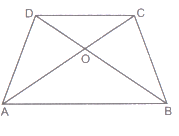
AB + BC > AC…(1) [{tex}\because{/tex} Sum of the lengths of any two sides of a triangle must be greater than the third side]
In {tex}\Delta BCD{/tex}, we have
BC + CD > BD...(2) [Same reason]
In {tex}\Delta CDA{/tex}, we have
CD + DA > AC…(3) [Same reason]
In {tex}\Delta DAB{/tex}, we have
AD + AB > BD…(4) [Same reason]
Adding (1), (2), (3) and (4), we get
AB + BC + BC + CD + CD + DA + AD + AB > AC + BD + AC + BD
{tex}\Rightarrow{/tex} 2AB + 2BC + 2CD + 2DA > 2AC + 2BD
{tex}\Rightarrow{/tex} 2(AB + BC + CD + DA) > 2(AC + BD)
{tex}\Rightarrow{/tex} AB + BC + CD + DA > AC + BD
Hence, proved.
Posted by Chandeshwar Prasad 6 years, 3 months ago
- 0 answers
Posted by Raghvendra Singh Singh 6 years, 3 months ago
- 2 answers
Posted by Shubham Thite 6 years, 3 months ago
- 0 answers
Posted by Sachin Gupta 6 years, 3 months ago
- 1 answers
Posted by Sachin Gupta 6 years, 3 months ago
- 0 answers
Posted by Ananya Paul 6 years, 3 months ago
- 0 answers
Posted by Ishika Roy 6 years, 3 months ago
- 0 answers
Posted by Bhargavi Vala 6 years, 3 months ago
- 3 answers
Gaurav Seth 6 years, 3 months ago
Question: In a ∆ABC, AB = 15 cm, BC = 13 cm and AC = 14 cm. Find the area of ∆ABC and hence its altitude on AC.
Answer
The triangle sides are
Let a = AB = 15 cm, BC = 13 cm = b, c = AC = 14 cm say
Now,
Posted by Pooja Khokhar 6 years, 3 months ago
- 0 answers
Posted by Pooja Khokhar 6 years, 3 months ago
- 1 answers
Posted by Pooja Khokhar 6 years, 3 months ago
- 0 answers
Posted by Omaan 10119931 6 years, 3 months ago
- 0 answers
Posted by Davinder Kumar 6 years, 3 months ago
- 0 answers
Posted by Sreeraman Mahima 6 years, 3 months ago
- 0 answers
Posted by Ankit Kumar 6 years, 3 months ago
- 2 answers
Purvi Shah 6 years, 3 months ago
Posted by Piyush Thakur 6 years, 3 months ago
- 7 answers
Posted by Saurav Singh 6 years, 3 months ago
- 1 answers
Sia ? 6 years, 3 months ago
{tex}4+\frac{\sqrt{5}}{4} \ - \sqrt{5}+\frac{4-\sqrt{5}}{4}+\sqrt{5}{/tex}
{tex}=4+\frac{\sqrt{5}}{4}+\frac{4-\sqrt{5}}{4}{/tex}
{tex}=\frac{16+\sqrt{5}+(4-\sqrt{5})}{4}{/tex}
{tex}=\frac{16+\sqrt{5}+4-\sqrt{5}}{4}{/tex}
{tex}=\frac{20}{4}{/tex}
=5
Posted by Aneesa Jasheen 6 years, 3 months ago
- 2 answers
Posted by Abhi Shek 6 years, 3 months ago
- 1 answers
Posted by Priyanshu Ghosh 6 years, 3 months ago
- 2 answers
Posted by Sanjay Kumar 6 years, 3 months ago
- 2 answers

myCBSEguide
Trusted by 1 Crore+ Students

Test Generator
Create papers online. It's FREE.

CUET Mock Tests
75,000+ questions to practice only on myCBSEguide app

Sia ? 6 years, 3 months ago
We have, {tex}x^{2}+\frac{1}{x^{2}}=34{/tex}
Also,
{tex}\Rightarrow\left(x+\frac{1}{x}\right)^{2}=x^{2}+\frac{1}{x^{2}}+2 x^{2} \times \frac{1}{x^{2}}{/tex}
{tex}\Rightarrow \left(x+\frac{1}{x}\right)^{2}=34+2{/tex}
{tex}\Rightarrow \ n+\frac{1}{n}=\sqrt{36}=6{/tex}
Now,
{tex}\Rightarrow \left(x+\frac{1}{x}\right)^{3}=x^{3}+\frac{1}{x^{3}}+3 x_{\times} \frac{1}{x}\left(x+\frac{1}{x}\right){/tex}
{tex}\Rightarrow 6^{3}=x^{3}+\frac{1}{x^{3}}+3 \times 6{/tex}
{tex}\Rightarrow \quad x^{3}+\frac{1}{x^{3}}{/tex}= 216 - 18
{tex} x^{3}+\frac{1}{x^{3}}-9{/tex}= 216 - 18 - 9
= 216 - 27
=189
0Thank You