
Ask questions which are clear, concise and easy to understand.
Ask QuestionPosted by # G*Nius Parker 5 years, 2 months ago
- 1 answers
Posted by Arunima Tripathi 5 years, 2 months ago
- 5 answers
Vanshika Deora 5 years, 2 months ago
Posted by Kanav Dumra 5 years, 2 months ago
- 3 answers
Jugal Kalal 5 years, 2 months ago
Gaurav Seth 5 years, 2 months ago
SQUARE ROOTS BY LONG DIVISION METHOD - LAW

(i) First we make the pair of the digits starting from the digit's at one's place.
For making the pair place a bar over every pair of digits.
If the number of digits in it odd, then the left-most single digit will have a bar.
(ii) Find the largest number whose square is less than or equal to the number under the extreme left bar.
Take this number as the divisor and the number under the extreme left bar as dividend.
Divide and get the remainder.
(iii) To the right of the remainder place the number that is under the next bar.
(iv) Now double the divisor and enter it with blank on its right.
(v) Think a largest possible digit to fill the blank which will also become the new digit in the quotient such that when the new divisor is multiplied to the new quotient the product is less than or equal to the dividend.
(vi) Repeat these steps till get the remainder 0 and no digits are left in the given number.
Example:
Find the square root of 529 by long division method.</article>
SQUARE ROOTS OF DECIMAL NUMBERS BY DIVISION METHOD - LAW
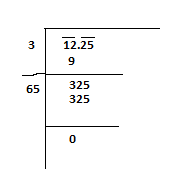
(i) First we make the pair of the digits of the integral part and decimal part by placing the bar of each pair.
(ii) Find the largest number whose square is less than or equal to the number under the extreme left bar.
Take this number as the divisor and the number under the extreme left bar as dividend.
Divide and get the remainder.
(iii) To the right of the remainder place the number that is under the next bar.
(iv) Now double the divisor and enter it with blank on its right.
(v) Think a largest possible digit to fill the blank which will also become the new digit in the quotient such that when the new divisor is multiplied to the new quotient the product is less than or equal to the dividend.
(vi) Repeat these steps till get the remainder 0 and no digits are left in the given number.</article>
Posted by Amarjyoti Biswal 5 years, 2 months ago
- 1 answers
Posted by Yukti Verma 5 years, 2 months ago
- 3 answers
Yukti Verma 5 years, 2 months ago
Gaurav Seth 5 years, 2 months ago
CBSE Class 9 Mathematics (041) - Deleted portion:
|
UNIT I-NUMBER SYSTEMS |
|
|
Chapter |
Topics |
|
REAL NUMBERS |
· Representation of terminating / non-terminating recurring decimals on the number line through successive magnification. · Explaining that every real number is represented by a unique point on the number line and conversely, viz. every point on the number line represents a unique real number. · Definition of nth root of a real number. |
|
UNIT II-ALGEBRA |
|
|
Chapter |
Topics |
|
POLYNOMIALS |
· Motivate and State the Remainder Theorem with examples. Statement and proof of the Factor Theorem. · x3+y3+z3-3xyz |
|
LINEAR EQUATIONS IN TWO VARIABLES |
Examples, problems on Ratio and Proportion |
|
UNIT III-COORDINATE GEOMETRY |
|
|
Chapter |
Topics |
|
COORDINATE GEOMETRY |
No deletion |
|
UNIT IV-GEOMETRY |
|
|
Chapter |
Topics |
|
INTRODUCTION TO EUCLID'S GEOMETRY |
Delete the Chapter |
|
LINES AND ANGLES |
No Deletion |
|
TRIANGLES |
Proof of the theorem deleted- Two triangles are congruent if any two angles and the included side of one triangle is equal to any two angles and the included side of the other triangle (ASA Congruence). Topic Deleted-Triangle inequalities and relation between ‘angle and facing side' inequalities in triangles |
|
QUADRILATERALS |
No deletion |
|
AREA |
Delete the Chapter |
|
CIRCLES |
There is one and only one circle passing through three given non-collinear points. If a line segment joining two points subtends equal angle at two other points lying on the same side of the line containing the segment, the four points lie on a circle. |
|
CONSTRUCTIONS |
Construction of a triangle of given perimeter and base angles |
|
UNIT V- Mensuration |
|
|
Chapter |
Topics |
|
UNIT VI-MENSURATION |
|
|
AREA |
Application of Heron’s Formula in finding the area of a quadrilateral. |
|
SURFACE AREAS AND VOLUMES |
No deletion |
|
UNIT VI-STATISTICS & PROBABILITY |
|
|
Chapter |
Topics |
|
STATISTICS |
· Histograms (with varying base lengths), · Frequency polygons. · Mean, median and mode of ungrouped data. |
|
PROBABILITY |
No deletion |
Posted by Sadik Sayyed 5 years, 2 months ago
- 1 answers
Gaurav Seth 5 years, 2 months ago
Prove that There is one circle, and only one, which passes through three given points not in a straight line.
Answer
Data:
X, Y and Z are three points not in a straight line.
To Prove:
A unique circle passes through X, Y and Z.
Construction:
Join XY and YZ. Draw perpendicular bisectors of XY and YZ to meet at O.
Proof:
Posted by Priya Dharshini 5 years, 2 months ago
- 1 answers
Yogita Ingle 5 years, 2 months ago
(i) Draw BC = 7 cm.
(ii) Construct ∠YBC = 75°.
(iii) From ray BY, cut-off line segment BD = AB + BC = 13cm.
(iv) Join CD.
(v) Draw the perpendicular bisector of CD meeting BY at A.
(vi) Join AC to obtain the required triangle ABC.
Justification
Since A lies on the perpendicular bisector of CD.
∴ AC = AD
Now BD = 13 cm
⇒ BA + AD = 13 cm
⇒ BA + BC = 13cm
Hence, △ABC is the required triangle.
Posted by Shubham Dubey 2 5 years, 2 months ago
- 2 answers
Amarjyoti Biswal 5 years, 2 months ago
Posted by Keshav Gupta 5 years, 2 months ago
- 1 answers
Yogita Ingle 5 years, 2 months ago
Draw a line PQ.
Take any point L on this line.
Construct perpendicular AL on PQ.
Cut a line segment AD from D equal to 4.5 cm.

Make angles equal to 30° at A on both sides of AD, say ∠CAD and ∠BAD where B and C lie on XY.
Then, ABC is the required triangle.
Justification:
Since ∠A = 30° + 30° = 60° and AL ⊥ BC,
Therefore, ∆ABC is an equilateral triangle with altitude AL = 4.5 cm.
Posted by Kartik Kumar 5 years, 2 months ago
- 3 answers
Posted by Jashan Gill 5 years, 2 months ago
- 2 answers
Gaurav Seth 5 years, 2 months ago
A n s w e r:
1 / 6 is the answer
as if the dice is thrown once....it has only one six ... therefore the is a fixed probability of getting six is one
Posted by Pinky Jain 5 years, 2 months ago
- 2 answers
Yogita Ingle 5 years, 2 months ago
A =4πr2
d=2r
Solving forA
A = π d2 = π·162 ≈804.24772 cm²
Posted by Keshav Gupta 5 years, 2 months ago
- 3 answers
Gaurav Seth 5 years, 2 months ago
Since the frequency table is in inclusive form we will first convert it into exclusive form by adding h/2 to upper limit and subtracting h/2 to lower limit.
Now we have
9.5-19.5
19.5-29.5
29.5-39.5
39.5-49.5
49.5-59.5
Gaurav Seth 5 years, 2 months ago
Since the frequency table is in inclusive form we will first convert it into exclusive form by adding h/2 to upper limit and subtracting h/2 to lower limit.
Now we have
Frequency(f1)
9.5-19.5
19.5-29.5
29.5-39.5
39.5-49.5
49.5-59.5
Yogita Ingle 5 years, 2 months ago
10−19,20−29,30−39,...
Here the class intervals are not continuous. To make them continuous take the mean of upper limit of first class and lower limit of second class.
Mean = (19+20)/2 = 19.5, which gives the upper limit of first class and lower limit of second class for the continuous class intervals.
Posted by Keshav Gupta 5 years, 2 months ago
- 1 answers
Posted by Mannat Preet Kaur 5 years, 2 months ago
- 5 answers
Loveteer Singh 5 years, 2 months ago
Posted by Mannat Preet Kaur 5 years, 2 months ago
- 4 answers
Yogita Ingle 5 years, 2 months ago
The cartesian coordinate plane is divided into four finite regions called quadrants. There are four quadrants in the cartesian plane.
Posted by Pinky Jain 5 years, 2 months ago
- 5 answers
Loveteer Singh 5 years, 2 months ago
Yogita Ingle 5 years, 2 months ago
radius is 4 cm and height is 28 CM
the volume of cylinder = πr2h
= 22/7 × 42 × 28
= 22 × 16 × 4
= 1,408 cm3
Posted by Sana Tomar 5 years, 2 months ago
- 3 answers
Abhishek Jha 5 years, 2 months ago
Yogita Ingle 5 years, 2 months ago

Consider triangle YPZ
Angle P=120
It is a isosceles triangle so
Angle Y=Z
Linear pair
180-120=60
60/2 = 30
Bisector Y=30+20
y = 50
Yogita Ingle 5 years, 2 months ago
In ∆ PYZ,
<YPZ =120°
PY=PZ
.'.<PYZ= 180°-120°/2=60°/2=30°
'.'<XYP= 40°
.'. <XYZ = 40° + 30° = 70°
Posted by Shalomi Tripathi 5 years, 2 months ago
- 1 answers
Gaurav Seth 5 years, 2 months ago
In AOAB, ∠OAB + ∠ABO + ∠BOA = 180°
∠OAB + ∠OAB + 90° = 180° ⇒ 2∠OAB = 180°- 90°
[angles opposite to equal sides are equal] [angle sum property of a triangle] [from Eq. (i)]
⇒ ∠OAB = 90°/2 = 45° …(i)
In ΔACB, ∠ACB + ∠CBA + ∠CAB = 180°
∴ 45°+ 30°+ ∠CAB = 180°
⇒ ∠CAB = 180° – 75° = 105°
∠CAO+ ∠OAB = 105°
∠CAO + 45° = 105°
∠CAO = 105° – 45° = 60°
Posted by Manu Dev 5 years, 2 months ago
- 4 answers
Posted by Roopak Kumar 5 years, 2 months ago
- 1 answers
Yogita Ingle 5 years, 2 months ago
Volume of the cuboid = 12 ×12 ×9 = 1296 cm².
Volume of the cube = 3³ = 27cm².
Let the number of cubes that can be cut from the cuboid be "n".
n × volume of cube = volume of cuboid
n = volume of cubic cuboid / volume of cube.
n = 1296 / 27
n = 48.
Therefore, 72 cubes can be cut out.
Posted by Kartik Kumar 5 years, 2 months ago
- 2 answers
Vedprakash Pandey 5 years, 2 months ago
Divya Kumari 5 years, 2 months ago
Posted by Biliyar Debbarma 5 years, 2 months ago
- 2 answers
Tanu Prajapati 5 years, 2 months ago
Posted by Rohini Girase 5 years, 2 months ago
- 1 answers
Gaurav Seth 5 years, 2 months ago
Given: ABCD is a trapezium where AB||CD and AD = BC
To prove: ABCD is cyclic.
Construction: Draw DL⊥AB and CM⊥AB.
Proof: In ΔALD and ΔBMC,
AD = BC (given)
DL = CM (distance between parallel sides)
∠ALD = ∠BMC (90°)
ΔALD ≅ ΔBMC (RHS congruence criterion)
⇒ ∠DAL = ∠CBM (C.P.C.T) (1)
Since AB||CD,
∠DAL + ∠ADC = 180° (sum of adjacent interior angles is supplementary)
⇒ ∠CBM + ∠ADC = 180° (from (1))
⇒ ABCD is a cyclic trapezium (Sum of opposite angles is supplementary)
Posted by Pinky Jain 5 years, 2 months ago
- 2 answers
Indhu Indhu 5 years, 2 months ago
Gaurav Seth 5 years, 2 months ago
the formula to find total surface area of cone is
πr(r+l)
to find l use l²=r²+h²
∴l²=3²+4²
=9+16
=25
∴l=5cm
now using π r ( r + l )
3.14 *3(3+5)
3.14 *3(8)
9.42*8
75.36 cm²
Posted by Naman Dubey 5 years, 2 months ago
- 4 answers
Gaurav Seth 5 years, 2 months ago
A circle’s perimeter is called the circumference. The symbol of the circumference is C.
The Circumference (or) perimeter of a circle = 2πR
where,
R is the radius of the circle
π is the mathematical constant with an approximate (up to two decimal points) value of 3.14
Again,
Pi (π) is a special mathematical constant; it is the ratio of circumference to diameter of any circle.
where C = π D
C is the circumference of the circle
D is the diameter of the circle
For example: If the radius of the circle is 4cm then find its circumference.
Given: Radius = 4cm
Circumference = 2πr
= 2 x 3.14 x 4
= 25.12 cm
Posted by Riya Sahu 5 years, 2 months ago
- 2 answers
Posted by Amatullah Lightwala 5 years, 2 months ago
- 1 answers
Gaurav Seth 5 years, 2 months ago
1. State whether the following statements are true or false. Justify your answers.
(i) Every irrational number is a real number.
Solution:
True
Irrational Numbers – A number is said to be irrational, if it cannot be written in the p/q, where p and q are integers and q ≠ 0.
i.e., Irrational numbers = π, e, √3, 5+√2, 6.23146…. , 0.101001001000….
Real numbers – The collection of both rational and irrational numbers are known as real numbers.
i.e., Real numbers = √2, √5, 0.102…
Every irrational number is a real number, however, every real numbers are not irrational numbers.
(ii) Every point on the number line is of the form √m where m is a natural number.
Solution:
False
The statement is false since as per the rule, a negative number cannot be expressed as square roots.
E.g., √9 =3 is a natural number.
But √2 = 1.414 is not a natural number.
Similarly, we know that there are negative numbers on the number line but when we take the root of a negative number it becomes a complex number and not a natural number.
E.g., √-7 = 7i, where i = √-1
The statement that every point on the number line is of the form √m, where m is a natural number is false.
For more click on the given link:
<a data-ved="2ahUKEwj58_izssrtAhUs4zgGHbGcCaUQFjALegQICRAC" href="https://mycbseguide.com/blog/ncert-solutions-class-9-maths-exercise-1-2/" ping="/url?sa=t&source=web&rct=j&url=https://mycbseguide.com/blog/ncert-solutions-class-9-maths-exercise-1-2/&ved=2ahUKEwj58_izssrtAhUs4zgGHbGcCaUQFjALegQICRAC" rel="noopener" target="_blank">NCERT Solutions for Class 9 Maths Exercise 1.2 ...</a>

myCBSEguide
Trusted by 1 Crore+ Students

Test Generator
Create papers online. It's FREE.

CUET Mock Tests
75,000+ questions to practice only on myCBSEguide app

Yogita Ingle 5 years, 2 months ago
6kt2 - 21kt -12k
taking out common 3k
3k(2t2 - 7t - 4)
= 3k(2t2 - 8t +t -4)
= 3k[ 2t(t - 4) +1(t-4)]
= 3k(t-4)(2t+1)
dimensions are 3k , t-4 , 2t+1
0Thank You