
Ask questions which are clear, concise and easy to understand.
Ask QuestionPosted by Hãrjåß Käûr 5 years, 2 months ago
- 2 answers
Posted by Saranya B 5 years, 2 months ago
- 1 answers
Posted by Teju Kn 5 years, 2 months ago
- 2 answers
Shubham Singh 5 years, 2 months ago
Yogita Ingle 5 years, 2 months ago
Since we want five numbers, we write 3/5 and 4/5 So multiply in numerator and denominator by 5+1 =6 we get

Posted by Anuj Yadav 5 years, 2 months ago
- 0 answers
Posted by Anuj Yadav 5 years, 2 months ago
- 1 answers
Posted by Avneesh Kumar 5 years, 2 months ago
- 1 answers
Yogita Ingle 5 years, 2 months ago
base = 10 cm and height = 3 cm
Area of parallelogram = base × height sq. units
= 10 × 3
= 30 sq. cm
Posted by Vanshika Dik 5 years, 2 months ago
- 1 answers
Indhu Indhu 5 years, 2 months ago
Posted by Ishita Budhwar 5 years, 2 months ago
- 2 answers
Yogita Ingle 5 years, 2 months ago
Step's of construction
(1) Draw BC = 6 cm.
(2) Construct ∠CBX = 60°.
(3) Along BX , set off BP = 9 cm.
(4) Join CP
(5) Draw the perpendicular bisector of CP tp intersect BP at A .
(6) Join AC. Then, ∆ABC is the required triangle.

Posted by Asha Rani 5 years, 2 months ago
- 1 answers
Gaurav Seth 5 years, 2 months ago
From the figure, we know that,
AB and CD intersect each other at point O.
Let the two pairs of vertically opposite angles be,
1st pair – ∠AOC and ∠BOD
2nd pair – ∠AOD and ∠BOC
To prove:
Vertically opposite angles are equal,
i.e., ∠AOC = ∠BOD, and ∠AOD = ∠BOC
From the figure,
The ray AO stands on the line CD.
We know that,
If a ray lies on a line then the sum of the adjacent angles is equal to 180°.
⇒ ∠AOC + ∠AOD = 180° (By linear pair axiom) … (i)
Similarly, the ray DO lies on the line AOB.
⇒ ∠AOD + ∠BOD = 180° (By linear pair axiom) … (ii)
From equations (i) and (ii),
We have,
∠AOC + ∠AOD = ∠AOD + ∠BOD
⇒ ∠AOC = ∠BOD – – – – (iii)
Similarly, the ray BO lies on the line COD.
⇒ ∠DOB + ∠COB = 180° (By linear pair axiom) – – – – (iv)
Also, the ray CO lies on the line AOB.
⇒ ∠COB + ∠AOC = 180° (By linear pair axiom) – – – – (v)
From equations (iv) and (v),
We have,
∠DOB + ∠COB = ∠COB + ∠AOC
⇒ ∠DOB = ∠AOC – – – – (vi)
Thus, from equation (iii) and equation (vi),
We have,
∠AOC = ∠BOD, and ∠DOB = ∠AOC
Therefore, we get, vertically opposite angles are equal.
Hence Proved.
Posted by Aarya Gupta 5 years, 2 months ago
- 2 answers
Posted by Diya Jogi 5 years, 2 months ago
- 3 answers
Sreevidhya Muralidharan 5 years, 2 months ago
Posted by P R 5 years, 2 months ago
- 2 answers
Sreevidhya Muralidharan 5 years, 2 months ago
Gaurav Seth 5 years, 2 months ago
- Draw a line AB by measuring 9.3cm
- From the point, B add 1cm and mark it as C
- Mark the point of bisection by a compass and say it as ‘O’
- Measure AO which is the radius and draws a semi-circle.
- From B draw a perpendicular AB touching the semi-circle and mark as D
- Draw an arc on the number line by taking compass pointer on B and pencil on D
- The point which intersects the number line is the square root of 9.3
Posted by Jasnoor Kaur Sandha 5 years, 2 months ago
- 2 answers
Posted by Gargi Rajput 5 years, 2 months ago
- 2 answers
Gaurav Seth 5 years, 2 months ago
If two equal chords of a circle intersect within the circle, prove that the segments of one chord are equal to corresponding segments of the other chord.
Solution:
Let AB and CD be two equal cords (i.e. AB = CD). In the above question, it is given that AB and CD intersect at a point, say, E.
It is now to be proven that the line segments AE = DE and CE = BE
Construction Steps:
Step 1: From the center of the circle, draw a perpendicular to AB i.e. OM ⊥ AB
Step 2: Similarly, draw ON ⊥ CD.
Step 3: Join OE.
Now, the diagram is as follows-
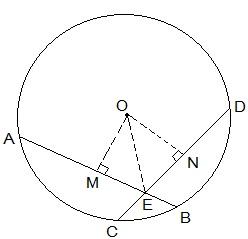
Proof:
From the diagram, it is seen that OM bisects AB and so, OM ⊥ AB
Similarly, ON bisects CD and so, ON ⊥ CD
It is known that AB = CD. So,
AM = ND — (i)
and MB = CN — (ii)
Now, triangles ΔOME and ΔONE are similar by RHS congruency since
OME = ONE (They are perpendiculars)
OE = OE (It is the common side)
OM = ON (AB and CD are equal and so, they are equidistant from the centre)
∴ ΔOME ΔONE
ME = EN (by CPCT) — (iii)
Now, from equations (i) and (ii) we get,
AM+ME = ND+EN
So, AE = ED
Now from equations (ii) and (iii) we get,
MB-ME = CN-EN
So, EB = CE (Hence proved).
Posted by Rajnish Tiwari 5 years, 2 months ago
- 1 answers
Posted by Puram Kowshika Gayathri 5 years, 2 months ago
- 3 answers
Posted by Payal Kumari 5 years, 2 months ago
- 5 answers
K. K. 5 years, 2 months ago
Posted by Nitin Kumar Jain 5 years, 2 months ago
- 1 answers
Gaurav Seth 5 years, 2 months ago
Given: A parallelogram ABCD and AC is its diagonal .
To prove : △ABC ≅ △CDA
Proof : In △ABC and △CDA, we have
∠DAC = ∠BCA [alt. int. angles, since AD | | BC]
AC = AC [common side]
and ∠BAC = ∠DAC [alt. int. angles, since AB | | DC]
∴ By ASA congruence axiom, we have
△ABC ≅ △CDA
Posted by Subhojit Mukherjee 5 years, 2 months ago
- 1 answers
Sreevidhya Muralidharan 5 years, 2 months ago
Posted by Suraj Yadav 5 years, 2 months ago
- 4 answers
Suraj Yadav 5 years, 2 months ago
Suraj Yadav 5 years, 2 months ago
Suraj Yadav 5 years, 2 months ago
Posted by Aniket Kumar 5 years, 2 months ago
- 4 answers
Aniket Kumar 5 years, 2 months ago
Aniket Kumar 5 years, 2 months ago
Posted by Arul S 5 years, 2 months ago
- 1 answers
Sreevidhya Muralidharan 5 years, 2 months ago
Posted by P R 5 years, 2 months ago
- 1 answers
Sreevidhya Muralidharan 5 years, 2 months ago
Posted by Poorni Gowda 5 years, 2 months ago
- 1 answers
Gaurav Seth 5 years, 2 months ago
Types of Triangles Based on Sides
According to the lengths of their sides, triangles can be classified into three types which are:
- Scalene
- Isosceles
- Equilateral
If all three sides have the same length then it is an EQUILATERAL triangle, if only two sides have the same length then it is an ISOSCELES triangle and if there are no sides that have the same length then it is a SCALENE triangle.
Posted by Vijayalaxmi Malagitti 5 years, 2 months ago
- 1 answers
Aakhya Verma 5 years, 2 months ago
Posted by Divyam Gupta 5 years, 2 months ago
- 1 answers
Aakhya Verma 5 years, 2 months ago
Posted by Harshit Rajput 5 years, 2 months ago
- 1 answers
Posted by Priyanka Sharma 5 years, 2 months ago
- 1 answers
Yogita Ingle 5 years, 2 months ago
5/√3-√5
Divide and multiply by √3+√5
= 5(√3+√5)/ (√3-√5)(√3+√5)
= 5(√3+√5)/ (√3)2 - (√5)2
= 5(√3+√5)/ 3 - 5
= = 5(√3+√5)/(-2)
- 5/2 (√3+√5)
Posted by Piya Shah 5 years, 2 months ago
- 1 answers

myCBSEguide
Trusted by 1 Crore+ Students

Test Generator
Create papers online. It's FREE.

CUET Mock Tests
75,000+ questions to practice only on myCBSEguide app

Hãrjåß Käûr 5 years, 2 months ago
1Thank You