
Ask questions which are clear, concise and easy to understand.
Ask QuestionPosted by Sandeep Bansal 8 years, 9 months ago
- 2 answers
Rashmi Bajpayee 8 years, 9 months ago
Volume of each cube = 125 cu cm
Then, side of each cube = 5cm
If these are joined, then the dimensions of cuboid
Length = 15 cm, Breadth = 5 cm, Height = 5 cm
Total surface area of cuboid = 2(lb + bh + hl)
= 2(15 × 5 + 5 × 5 + 5 × 15)
= 2(75 + 25 + 75)
= 2 × 175
= 350 sq cm
Karthika Gireesh 8 years, 9 months ago
Volume of cube =a3=125cm3
a=cube root of 125=5cm
So,length of cuboid=3×5=15cm
h=5cm
b=5cm
TSA of cuboid=2 (lh+bh+lb)
=2 (15+5+5+5+15+5)
=2×50
=100cm2
Posted by Sandeep Bansal 8 years, 9 months ago
- 0 answers
Posted by Sandeep Bansal 8 years, 9 months ago
- 1 answers
Posted by Sinna Parveen 8 years, 9 months ago
- 0 answers
Posted by Vansh Jain 8 years, 9 months ago
- 0 answers
Posted by Satyajit Sharma 8 years, 9 months ago
- 1 answers
Posted by Kamalesh Sharma 8 years, 9 months ago
- 2 answers
Naveen Sharma 8 years, 9 months ago
Ans. Volume of cubical Tank = 15.625 m3
Let Side of cubical Tank = x m
Then,
{tex}=> x^3 = 15.625{/tex}
{tex}=> x = 2.5 m{/tex}
Present Deptj of water = 1.2 m
Present volume of water = {tex}2.5\times 2.5\times 1.2 = 7.5m^3{/tex}
Volume of water used = 15.625 - 7.5 = 8.125m3
Ratio = 8.125 : 7.5 = 13 : 12
Rashmi Bajpayee 8 years, 9 months ago
Volume of cubical tank = 15.625 cu. m
(Side)3 = 15.625 cu. m
Side = 2.5 m
Volume of water used = 2.5 × 2.5 × 1.2 = 7.5 cu. m
Volume of water left in tank = 15.625 - 7.5 = 8.125 cu. m
Required ratio = 7.5/8.125 = 12/13 = 12 : 13
Posted by Kamalesh Sharma 8 years, 9 months ago
- 1 answers
Posted by Surjeet Singh Sindhal 8 years, 9 months ago
- 1 answers
Rashmi Bajpayee 8 years, 9 months ago
Let Surjeet has Rs. x and Baljeet has Rs. y
Then, according to question,
x + 40 = 3(y - 40)
x - 3y + 160 = 0
Two solutions
x = 110, y = 90. And. x = 50, y = 70
Posted by Sejal Yadav 8 years, 9 months ago
- 1 answers
Naveen Sharma 8 years, 9 months ago
Ans. A frequency is the number of times a data value occurs. For example, if ten students score 80 in statistics, then the score of 80 has a frequency of 10. Frequency is often represented by the letter f.
Cumulative frequency: it is used to determine the number of observations that lie below a particular value in a data set.
The cumulative frequency is calculated by adding each frequency from a frequency distribution table to the sum of its predecessors. the last value will always be equal to the total for all observations. Denoted by cf.
Posted by Devanshu Jadhav 8 years, 9 months ago
- 1 answers
Shweta Gulati 8 years, 9 months ago
Factors of 18 are 1,2,3,6,9,18
Range = Maximum value - Minimum value
= 18-1
= 17
Posted by Dhairya Pandya 8 years, 9 months ago
- 4 answers
Posted by Sejal Yadav 8 years, 9 months ago
- 2 answers
Rashmi Bajpayee 8 years, 9 months ago
Putting x = 2 and y = 0 in the given equation,
2 x 2 + k x 0 = 10 × k
4 + 0 = 10k
10k = 4
k = 4/10 = 2/5
Posted by Chawla Saab 8 years, 9 months ago
- 1 answers
Posted by Udit Rawat 8 years, 9 months ago
- 0 answers
Posted by Kirti Dhawan 8 years, 9 months ago
- 1 answers
Naveen Sharma 8 years, 9 months ago
Ans. Let base of triangle = b
altitude of triangle (h) = 4cm
Area of triangle = 8 cm
We know
Area of triangle = {tex}{1\over2}\times b \times h{/tex}
=> {tex}8 = {1\over2}\times b \times 4{/tex}
=> b = 4cm
As triangle and ||gm have Same base,
So base of ||gm = 4cm
Posted by Devanshu Jadhav 8 years, 9 months ago
- 1 answers
Rashmi Bajpayee 8 years, 9 months ago
Mean = Sum of observations / Total no. of observations
Sum of observations = 12 × 10 = 120
Now,. New Sum of observations = 120 + 10 × 3 = 150
New Mean = 150/10 = 15
Posted by Radhika Gupta 8 years, 9 months ago
- 1 answers
Naveen Sharma 8 years, 9 months ago
Ans. Because sum of all angles of a triangle is 180. It is not possible to have one right angle and obtuse angle in same triangle as right angle is 90 and obtuse is any angle greater than 90., so their sum ll be more than 180 that is not.possible in case of triangle.
Posted by Smit Agrawal 8 years, 9 months ago
- 6 answers
Jd Shukla 8 years, 9 months ago
Let a cylinder be with height h ,its inner and outer radii be r andR respectively.
Now,its TSA=2pirh +2piRh+2pi(R2+r2)
Rashmi Bajpayee 8 years, 9 months ago
TSA of hollow cylinder
= 2πRh + 2πrh + 2(πR2 - πr2)
= 2π[Rh + rh + (R + r)(R - r)]
= 2π[h(R + r) + (R + r)(R - r)]
= 2π(R + r)(h + R + r)
Naveen Sharma 8 years, 9 months ago
Ans. T.S.A of hollow cylinder = {tex}2\pi h(R+r){/tex}
Where R is outer radius and r is inner radius of hollow cylinder.
Posted by Madhav Kalia 8 years, 9 months ago
- 1 answers
Manish Gandhi 8 years, 9 months ago
TSA for Cuboid = 2 (lb + bh + lh) = 800m square (given)
LSA for Cuboid = 2 (lh + bh) = 300m square (given)
Now, TSA - LSA = 2 (lb + bh + lh) - 2 (lh + bh) = 2lb
Also, TSA - LSA = 800 - 300 = 500m square
=> 2lb = 500 => lb = 500/2 = 250m square (Answer)
Posted by Rima Paul 8 years, 9 months ago
- 1 answers
Jheel Porwal 8 years, 9 months ago
OB=OC(radii)
Let ang.OBC=ang.OCB=x
In triangle BOC
Ang.OBC + ang. OCB + BOC= 180
x + x +ang.BOC=180
Ang.BOC= 180 - 2x ........ eq. 1
Ang.BOC=2 Ang.BAC [arc BC subtended ang.BOC at the centre & ang.BAC in segment]
Using eq. 1
2 ang.BAC= 180 - 2x (divide by 2 to
Both sides)
2ang.BAC = 180 - 2x
<hr />2 2 2
Ang.BAC = 90 - x
Ang.BAC = 90 - ang. OBC
Ang.OBC + ang.BAC = 90 degrees.
Hence proved!
Posted by Vishal Kumar 8 years, 9 months ago
- 1 answers
Shally Sunekha 8 years, 9 months ago
The median will be n=10 and half of 10 ...5
Answer is 5
Posted by Avani Agarwal 8 years, 9 months ago
- 1 answers
Naveen Sharma 8 years, 9 months ago
Ans. Let the smallest angle = x
Then another angle = 2x-30
As opposite angles are equal,
Then
=> x +x+2x-30+2x-30 = 360
=> 6x = 420
=> x = 70
So Angles of ||gm are 70,110,70,110
Posted by Pradeep Jain 8 years, 9 months ago
- 1 answers
Shweta Gulati 8 years, 9 months ago
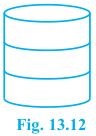
Radius of the frame (r) = 20/2 cm = 10 cm
Height of the frame (h) = 30 cm + 2×2.5 cm = 35 cm
2.5 cm of margin will be added both side in the height.
Cloth required for covering the lampshade = curved surface area = 2πrh
= (2 × 22/7 × 10 × 35)cm2
= 2200 cm2
Posted by Gagan Nirmalkar 8 years, 9 months ago
- 1 answers
Sakshi Singh 8 years, 9 months ago
You r given with the radius as 10 cm
For both parts draw a rt. Angle triangle by joining centre in the circumference both the chords are meeting in both cases.
Now using the theorem that line from centre at 90 bisects the chord
Then use Pythagoras theorem in both the cases
1) add the ans of both the chords
2) subtract ans of both the chords
Posted by Sri Adithya Yaddanapudi 8 years, 9 months ago
- 1 answers
Rupender Singh 8 years, 9 months ago
Side of Cube = 21 cm = diameter of sphere
{tex}\therefore {/tex} radius of sphere, r = {tex}\frac{21}{2}{/tex}cm
Volume of sphere = {tex}\frac{4}{3} \pi r^3{/tex}
= {tex}\frac{4}{3} × \frac{22}{7} × \frac{21}{2} × \frac{21}{2} × \frac{21}{2}{/tex}
= 4851 {tex}cm^3{/tex}

myCBSEguide
Trusted by 1 Crore+ Students

Test Generator
Create papers online. It's FREE.

CUET Mock Tests
75,000+ questions to practice only on myCBSEguide app

Rashmi Bajpayee 8 years, 9 months ago
Given : 4πr2 = 6a2
r2/a2 = 6/4π
r/a = √6/2√π
Ratio of their volume = (4/3)πr3/a3
= (4π/3)(6/4π)(√6/2√™)
= √6/√π = √6 : √π
Hence proved.
2Thank You