
Ask questions which are clear, concise and easy to understand.
Ask QuestionPosted by Dimple Bhatia 8 years, 9 months ago
- 0 answers
Posted by Enayath Ur Rahman 8 years, 9 months ago
- 1 answers
Naveen Sharma 8 years, 9 months ago
Ans. Let monthly income of Rahul = x
Monthly income of Any = y
Then
{tex}=> y = {3x\over 2} + 100{/tex}
=> 2y = 3x +100
=> 3x - 2y + 100 = 0
Required Linear Equation.
Posted by Kings Videoss 8 years, 9 months ago
- 0 answers
Posted by Naman Bansal 8 years, 9 months ago
- 1 answers
Naveen Sharma 8 years, 9 months ago
Ans. Diameter of cloth = 28cm
Radius of cloth =28/2 cm = 14 cm
height of cloth h = 17cm + 2 × 2 cm (i.e., margin) = 21 cm
Cloth required for covering the lampshade = Its curved surface area = 2πrh
{tex}=> 2\times {22\over 7}\times14\times 21{/tex}= 1848cm2
Let total cloth was x cm2As {tex}{1\over 12}^{th} {/tex}cloth has been wasted,
{tex}{11\over 12}th {/tex} cloth was used in making
So, {tex}{11x\over 12} = 1848 {/tex}
=> x = 2016 cm2
Posted by Premlata Awasare 8 years, 9 months ago
- 0 answers
Posted by Dipasha Dev 8 years, 9 months ago
- 1 answers
Shweta Gulati 8 years, 9 months ago
We know that two triangles on the same base and between the same parallels are equal in area.
Consider the following figure.

In the above figure, triangle ADX and ACX are on the same base AX and between the parallels AB and DC.
Therefore, ar .,..(1)
Similarly, triangle ACX and ACY are on the same base AC and between the parallels XY and AC.
Therefore,  ....(2)
From equations (1) and (2), we have

Posted by Premlata Awasare 8 years, 9 months ago
- 1 answers
Naveen Sharma 8 years, 9 months ago
Ans. Let old radius of cylinder = r
old Height of clyinder = h
old CSA of Cylinder = {tex}2\pi r h{/tex}
New radius of cylinder = {tex}r + {75\times r \over 100} = {7r\over 4}{/tex}
New height of cylinder = {tex}h - {h\times 50\over 100} = {h\over 2}{/tex}
New CSA of Cylinder = {tex}2\times \pi\times {7r\over 4}\times {h\over 2} {/tex}
{tex}={ 7\pi rh \over 4}{/tex}
Change (decrease) in CSA ={tex}2\pi rh - { 7\pi rh \over 4} = {\pi rh \over 4}{/tex}
% decrease = {tex}{\pi rh \over 4 \times 2 \pi rh }\times 100 = 12{1\over 2}\%{/tex}
Posted by Shivam .G 8 years, 9 months ago
- 1 answers
Harsh Raj 8 years, 9 months ago
If coin is tossed only 5 times then how the total outcome become 9 .
Posted by Sahil Deshpande 8 years, 9 months ago
- 1 answers
Shweta Gulati 8 years, 9 months ago
A cylinder with radius r and height h has CSA = 2{tex} {\pi}{/tex}rh
In case, radius is doubled
New radius = 2r
Height is halved, new height = h\2
CSA = 2{tex}{\pi}{/tex}(2r)(h\2)
= 2{tex} { \pi}{/tex}rh
So, change in CSA is observed!
Posted by Premlata Awasare 8 years, 9 months ago
- 1 answers
Shweta Gulati 8 years, 9 months ago
Longest pole is the diagonal of the room,
and it can be calculated as
d = {tex}{ \sqrt ( l^2 +\ b^2 + \ h^2) } {/tex}
= (202+202+102)1/2
=9001/2
= 30cm
Posted by Jd Shukla 8 years, 9 months ago
- 1 answers
Neeraj Sharma 8 years, 9 months ago

{tex}let\,radius\,of\,cylinder\,is\,r{/tex}
{tex}so\,PE = r\,cm{/tex}
{tex}let\,AP = h\,cm{/tex}
{tex}then\,PQ = \left( {10 - h} \right)cm{/tex}
{tex}\sin ce\,\Delta APE \sim \Delta AQC{/tex}
{tex}So,{/tex}
{tex}{{AP} \over {AQ}} = {{PE} \over {QC}}{/tex}
{tex}{h \over {10}} = {r \over 4}{/tex}
{tex}h = {{10r} \over 4}{/tex}
{tex}so,\,PQ = 10 - {{10r} \over 4} = \left( {10 - {{5r} \over 2}} \right)cm{/tex}
{tex}CSA\,of\,cylinder = 2\pi r\left( {10 - {{5r} \over 2}} \right){/tex}
{tex} = \pi r\left( {20 - 5r} \right){/tex}
{tex} = 5\pi r\left( {4 - r} \right)c{m^2}{/tex}
Largest possible curved surface area of cylinder={tex}5\pi r\left( {4 - r} \right)c{m^2}{/tex}
Posted by Tamanna Puri 8 years, 9 months ago
- 0 answers
Posted by Swarnjeet Arora 8 years, 9 months ago
- 1 answers
Shweta Gulati 8 years, 9 months ago
Let the first coordinate be x ; the second coordinate be y
So, x+y =5
To draw the graph , find its two solutions
When x = 0 , y=5
When y =0 , x=5
Plot them on a graph paper and you will see that these points make up a triangle with x- and y-axis.
Area of triangle = {tex}{ 1\over 2}{/tex}{tex}{ b\ X \ h}{/tex}
= (5 X 5 )/2 = 25/2 = 12.5 square units
Posted by Shailaja Buddala 8 years, 9 months ago
- 2 answers
Rashmi Bajpayee 8 years, 9 months ago
Mean = sum of 200 numbers / 200
180 = sum of 200 numbers / 200
Sum of 200 numbers = 180 × 200 = 36000
Now, if each number is increased by 10, then
Sum of 200 numbers = 36000 + 200 × 10 = 38000
New mean = 38000/200 = 190
New mean is 190
Posted by Shivansh Dwivedi 8 years, 9 months ago
- 2 answers
Neeraj Sharma 8 years, 9 months ago
{tex}h = 24\,cm{/tex}
{tex}CSA = 550\,c{m^2}{/tex}
{tex}\pi rl = 550\,c{m^2}{/tex}
{tex}{{22} \over 7} \times r \times \sqrt {{h^2} + {r^2}} = 550{/tex}
{tex}r \times \sqrt {576 + {r^2}} = 175{/tex}
{tex}squaring\,on\,both\,sides{/tex}
{tex}{r^2}\left( {576 + {r^2}} \right) = 30625{/tex}
{tex}on\,solving{/tex}
{tex}r = \,7cm{/tex}
{tex}volume = {1 \over 3}\pi {r^2}h = {1 \over 3} \times {{22} \over 7} \times {\left( 7 \right)^2} \times 24{/tex}
{tex}volume = 1232\,c{m^3}{/tex}
Posted by Rajendra G M 8 years, 9 months ago
- 1 answers
Neeraj Sharma 8 years, 9 months ago
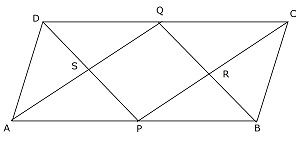
{tex}ABCD\,is\,a\,||gm{/tex}
{tex}AB = DC{/tex}
{tex}{1 \over 2}AB = {1 \over 2}DC{/tex}
{tex}Since\,P\,and\,Q\,are\,the\,mid\,po{\mathop{\rm int}} s\,of\,AB\,and\,CD{/tex}
{tex}PB = DQ{/tex}
{tex}also\,PB||DQ{/tex}
{tex}Hence\,DPBQ\,is\,a\,||gm{/tex}
{tex} \Rightarrow DP||BQ \ldots \ldots \left( 1 \right){/tex}
{tex}similarly{/tex}
{tex}APCQ\,is\,a\,||gm{/tex}
{tex} \Rightarrow AQ||BC \ldots \ldots \left( 2 \right){/tex}
{tex}From\,\left( 1 \right)\,and\,\left( 2 \right){/tex}
{tex}DP||BQ\,and\,AQ||BC{/tex}
{tex} \Rightarrow SP||QR\,and\,SQ||PR{/tex}
{tex}Hence\,PSQR\,is\,a\,||gm{/tex}


Posted by Yash Dubey 8 years, 9 months ago
- 2 answers
Rashmi Bajpayee 8 years, 9 months ago
This question is asked by the student of class 9th. Therefore, we cannot use Trigonometry to solve it.
Here is the another solution.
Let the side of equilateral triangle be 'a' cm.
Since in an equilateral triangle, the altitude is perpendicular to the opposite side and bisects it.
Also, in an equilateral triangle ABC,
3 x Area of triangle OBC = Area of triangle ABC
=> 3 x 1/2 x Base x Height = 1/2 x Base x Height
=> 3 x 1/2 x a x OM = 1/2 x a x AM
=> 3OM = AM
=> 3OM = 20 + OM
=> 2OM = 20
=> OM = 10 cm
Now, in triangle OBC, using Pythagoras Theorem,
BM2 = OB2 - OM2
=> BM<font size="2">2</font> = 20<font size="2">2</font> - 10<font size="2">2</font>
=> BM<font size="2">2</font> = 400 - 100 = 300
=> BM = 10(3)1/2
Therefore, the side of equilateral triangle ABC, BC = 2 x BM = 20(3)1/2
Naveen Sharma 8 years, 9 months ago
Ans.

Here we know that
{tex}\angle {/tex}OBM = 30
So In right angle triangle OMB,
cos 30 = {tex}{BM\over 20}{/tex}{tex}=> {\sqrt 3\over 2}={ BM\over 20}{/tex}
BM= {tex}10\sqrt3{/tex}cm
Now we know that perpendicular from the centre divides the chord in two equal part so
BC= 2BM = {tex}20\sqrt 3 cm{/tex}
Posted by Paras Singhal 8 years, 9 months ago
- 1 answers
Shweta Gulati 8 years, 9 months ago
Circumference of the base of the cup = circumference of sheet

Posted by Sandeep Bansal 8 years, 9 months ago
- 1 answers
Neeraj Sharma 8 years, 9 months ago
{tex}h = 24\,cm{/tex}
{tex}CSA = 550\,c{m^2}{/tex}
{tex}\pi rl = 550\,c{m^2}{/tex}
{tex}{{22} \over 7} \times r \times \sqrt {{h^2} + {r^2}} = 550{/tex}
{tex}{{22} \over 7} \times r \times \sqrt {576 + {r^2}} = 550{/tex}
{tex}r \times \sqrt {576 + {r^2}} = 175{/tex}
squaring on both sides
{tex}{r^2}\left( {576 + {r^2}} \right) = 30625{/tex}
on solving
{tex}r = 7\,cm{/tex}
{tex}volume = {1 \over 3}\pi {r^2}h = {1 \over 3} \times {{22} \over 7} \times {\left( 7 \right)^2} \times 24{/tex}
{tex}volume = 1232\,c{m^3}{/tex}
Posted by Sandeep Bansal 8 years, 9 months ago
- 2 answers
Rashmi Bajpayee 8 years, 9 months ago
Surface area of sphere = 4πr2 = πd2
New diameter = d - 25% of d = 3d/4
New Surface Area = π(3d/4)2 = 9πd2/16
Decrease in Surface area = πd2 - (9πd2/16) = 7πd2/16
% decrease in SA = (7πd2/16 × πd2) × 100
= 43.75%
Posted by Sandeep Bansal 8 years, 9 months ago
- 1 answers
Rashmi Bajpayee 8 years, 9 months ago
Mean = Sum of 10 numbers/10
Sum of 10 numbers = 55 × 10 = 550
Second condition
Sum of 9 numbers = 50 × 9 = 450
Excluded number = 550 - 450 = 100
Posted by Sandeep Bansal 8 years, 9 months ago
- 2 answers
Shweta Gulati 8 years, 9 months ago
Given - Mean : Median = 2:3
i.e 3Mean = 2Median -(1)
As we know the empirical formula of Mean, Median and mode
3 Median = 2Mean +Mode
Using eqn (1)
9 Mean = 4Mean + 2Mode
5 Mean = 2 Mode
5 : 2 = Mode : Mean
Posted by Sandeep Bansal 8 years, 9 months ago
- 1 answers
Rashmi Bajpayee 8 years, 9 months ago
Volume of cone = (1/3)πr2h
New Radius = r + 10% of r = 11r/10
New height = h + 10% of h = 11h/10
New Volume = (1/3)(11r/10)2(11h/10)
= (1/3)πr2h × (1331/1000)
Increased volume = (1/3)πr2h - (1/3)πr2h(1331/1000) = (1/3)πr2h(331/1000)
% of increased volume = (New volume/Old volume)×100
= 3.31%
Posted by Sandeep Bansal 8 years, 9 months ago
- 2 answers
Shweta Gulati 8 years, 9 months ago
Class size = Difference between consecutive class marks = 57-52 =5
Lower class limit = 52 - (5/2) = 52-2.5 = 49.5 [ Half of class size is subtracted]
Upper class limit = 52 + (5/2) = 52+2.5 = 54.5 [Half of class size is added]
Jd Shukla 8 years, 9 months ago
class limits of two interwals are-49.5-54.5,54.5-59.5 and so on.

myCBSEguide
Trusted by 1 Crore+ Students

Test Generator
Create papers online. It's FREE.

CUET Mock Tests
75,000+ questions to practice only on myCBSEguide app
