
Ask questions which are clear, concise and easy to understand.
Ask QuestionPosted by Apurba Murasing 8 years, 9 months ago
- 0 answers
Posted by Amal P Deep 8 years, 9 months ago
- 0 answers
Posted by Anuja Anil 8 years, 9 months ago
- 1 answers
🅿🅰🆆🅰🅽 . 7 years, 10 months ago
B = D (opposite angles of a parallelogram)
But B + D = 180o (opposite angles of a cyclic quad. are supplementary)
B = D = 90o
We know that, a parallelogram with one angle as 90o is a rectangle.
So, ABCD is a rectangle.
AC = BD (diagonals of a rectangle are equal)
Posted by Prempal Kumar 8 years, 9 months ago
- 0 answers
Posted by Avanthika Sriram 8 years, 9 months ago
- 0 answers
Posted by Anuja Anil 8 years, 9 months ago
- 1 answers
Srikrishna Neelakantan 8 years, 9 months ago
Since 5,6 are the only numbers ina die greater than 4.
HenceP(>4)=possible outcomes/total numberof outcomes
=2/6=1/3which is the probability
Posted by Anuja Anil 8 years, 9 months ago
- 1 answers
Shweta Gulati 8 years, 9 months ago
To write it as a linear equation in two variables,
0.y + 2.x =5
Solution :
You can take any values of y but you will always get x= 5/2
Posted by Anuja Anil 8 years, 9 months ago
- 0 answers
Posted by Anuja Anil 8 years, 9 months ago
- 0 answers
Posted by Santhosh Chandrasekar 8 years, 9 months ago
- 1 answers
Khushi Koshta 8 years, 9 months ago
pls name the 3d figure
cone cylinder hemisphere sphere or frustum
Posted by Anuja Anil 8 years, 9 months ago
- 0 answers
Posted by Anuja Anil 8 years, 9 months ago
- 1 answers
Santhosh Chandrasekar 8 years, 9 months ago
The central angle in a semicirle is 180o since it is a straight line. Inscribed angle is half of the central angle so 1/2 of 180o is 90o.
Hence angle in a semicircle is 90o.
Posted by Anuja Anil 8 years, 9 months ago
- 1 answers
Naveen Sharma 8 years, 9 months ago
Ans. When y Varies directly as x, the eqaution will be in form of
y = kx, where k is constant of proportionality.
Putting y = 12 and x = 4, we get
=> 12 = 4k
=> k = 3
So, y = 3x
Linear Equation : y - 3x = 0
When x = 5
y - 3*5 = 0
=> y = 15
Posted by Shikha Goel 8 years, 9 months ago
- 1 answers
Naveen Sharma 8 years, 9 months ago
Ans. Degree Measure Theorem states that angle subtended by an arc of a circle at the centre is twice the angle subtended by it at any point on the circle.
Given : An arc PQ of a circle C with center O and radius r with a point R in arc \(\stackrel\frown{QP}\) other than P or Q.To Prove : \(\angle POQ = 2\angle PRQ\)
Construction : Join RO and draw the ray ROM.
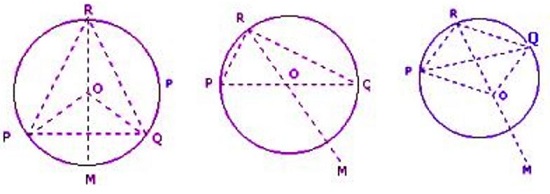
Proof : There will be three cases as
(i) \(\stackrel\frown{PQ}\)is a minor arc
(ii)\(\stackrel\frown{PQ}\) is a semi-circle
(iii)\(\stackrel\frown{PQ}\) is a major arc
[Image Here ]
In each of these three cases, the exterior angle of a triangle is equal to the sum of two interior opposite angles.
Therefore, \(\angle POM = \angle PRO + \angle RPO \) ............ (1)
\(\angle MOQ = \angle ORQ + \angle RQO \).......... (2)
\(In\space \triangle OPR \space and \space \triangle OQR \)
Now, OP = OR and OR = OQ (radii of the same circle)
\(\angle PRO = \angle RPO\) and \(\angle ORQ = \angle RQO \) (angles opposite to the equal sides are equal)
Hence, \(\angle POM = 2\angle PRO\) .......... (3)
And \(\angle MOQ = 2 \angle ORQ\) ............ (4)
Case (1) : adding equations (3) and (4) we get
\(\angle POM + \angle MOQ = 2\angle PRO + 2\angle ORQ \)
\(\angle POQ = 2(\angle PRO + \angle ORQ) = 2 \angle PRQ \)
\(\angle POQ = 2\angle PRQ\)
Hence Proved.
Similarly, you can proceed for case (ii) and case (iii)
Posted by Sonali Yadav 8 years, 9 months ago
- 1 answers
Rashmi Bajpayee 8 years, 9 months ago
CSA of hollow cylinder ÷ 2πh(R + r)
TSA of hollow cylinder = 2π(R + r)(h + R - r)
Posted by Mariam P 8 years, 9 months ago
- 0 answers
Posted by Mariam P 8 years, 9 months ago
- 1 answers
Bindu Agarwal 8 years, 9 months ago
The circle circumscribing the rectangle will have diameter along the diagonal of the rectangle and centre as the midpoint of the diagonal. Since the angle subtended by diameter at any point above or below it is 90 degree and here it is the interior angle of the rectange . THerefore radius = 10/2 = 5cm
Area = \(\pi 5^2 = 25\pi cm^2\)
Posted by Shriniwas Jat 8 years, 9 months ago
- 1 answers
Naveen Sharma 8 years, 9 months ago
Ans.

Given : ABCD is a trapezium with AB || DC, DC = 30cm , AB = 50cm
To Prove: \(ar(DCYX)={7\over 9} ar(XYBA)\)
Construction: Join DY and produce it to meet AB produced at P.
Proof : \(In\space \triangle BYP \space and\space \triangle CYD \)
\(\angle BYP = \angle CYD\) (vertically opposite angles)
\(\angle DCY = \angle PBY\) (Alternate opposite angles as DC || AP and BC is the transversal)
BY = CY (Y is the mid point of BC)
Thus \(\triangle BYP \cong \triangle CYD\) (by ASA criterion)
=> DY = YP and DC = BP [by CPCT] ......... (2)
=> Y is the mid point of AD
XY || AP and XY = \({1\over 2}\)AP [Mid-point theorem] ........ (2)
=> AP = AB + BP
=> AP = AB + DC [From (1)]
=> AP = 50 + 30 = 80
\(=> XY = {1\over 2} \times 80 = 40 cm\)
Since X and Y are the mid points of AD and BC respectively.
Trapezium DCYX and ABYX are of same height, say h cm
Now,
\(=> {ar(DCYX) \over ar(XYBA)} = {{1\over 2} (DC+XY)\times h \over {1\over 2} (AB+XY)\times h} = {30+40\over 50+40} = {70\over 90} = {7\over 9}\)
\(=> {ar(DCYX) ={7\over 9} ar(XYBA)} \)
Hence Proved
Posted by Nitika Singhal 8 years, 9 months ago
- 1 answers
Naveen Sharma 8 years, 9 months ago
Ans.

Given: ABCD is a parallelogram in which points P and Q trisects the BC.
\(=> BP = PQ = QC = {1\over 3}BC\)
To prove: \(ar (\triangle APQ) = ar (\triangle DPQ) = {1\over 6} ar(\|gm \space ABCD)\)
Construction : Through P and Q, draw PR and QS parallel to AB. Now PQRS is a parallelogram and its base \( PQ = {1\over 3} BC\)
Proof :
Now, \(\triangle APD \space and \space \triangle AQD\) lie on the same base AD and between the same parallel AD and BC.
\(ar (\triangle APD) \space = ar \space( \triangle AQD)\) .......... (1)
Subtracting \(ar (\triangle AOD)\) from both sides, we get
\(=> ar (\triangle APD) - ar (\triangle AOD) \space = ar \space( \triangle AQD) -ar (\triangle AOD) \)
\(=> ar (\triangle APO) = ar (\triangle OQD) \) ............... (2)
Adding \(ar (\triangle OPQ)\) on both sides in (2), we get
\(=> ar (\triangle APO) + ar (\triangle OPQ) = ar (\triangle OQD) + ar (\triangle OPQ)\)
\(=> ar (\triangle APQ) = ar (\triangle DPQ)\) ....... (3)
Again, triangle APQ and parallelogram PQSR are on the same base PQ and between same parallels PQ and AD
\(ar (\triangle APQ) ={1\over2} ar (\|gm \space PQRS)\) ........ (4)
Now,
\({ar(\| gm \space ABCD )\over ar(\| gm \space PQRS )} = {BC \times height\over PQ\times height } = {3PQ\over PQ} = 3\)
\(=> ar(\| gm \space PQRS ) = {1\over 3} ar(\| gm \space ABCD ) \) ....... (5)
\(=> ar (\triangle APQ) ={1\over2} \times {1\over 3}ar (\|gm \space ABCD)\)
\(=> ar (\triangle APQ) ={1\over6}ar (\|gm \space ABCD)\) ....... (6)
From (3) and (6)
\(=> ar (\triangle APQ) = ar (\triangle DPQ)={1\over6}ar (\|gm \space ABCD)\)
Hence Proved
Posted by Niranjay Yadav 8 years, 9 months ago
- 1 answers
Naveen Sharma 8 years, 9 months ago
Ans. \(Area \space of \space Rhombus \space = {1\over 2} (d_1\times d_2)\)
Where d1 and d2 are length of two diagonals.
Posted by Pranzal Kumar Sinha 8 years, 9 months ago
- 0 answers
Posted by Sadhna Kashyap 8 years, 9 months ago
- 1 answers
Naveen Sharma 8 years, 9 months ago
Ans. Depth/Height of Cylinderical Vessel = 10m
Total Cost =Rs. 2200
Rate of Painting =Rs 20/m2
i) Inner Curved Surface Area Area= 2200/20 = 110m2
ii) As we know
Curved surface area = \(2\pi rh\)
\(=> 2\times {22\over 7}\times r\times 10 = 110\)
\(=> r = {110 \times 7 \over 2\times 22\times 10} = {7\over 4}\)
=> r = 1.75m
Posted by Sadhna Kashyap 8 years, 9 months ago
- 2 answers
Naveen Sharma 8 years, 9 months ago
Ans. Radius of Cone = 4x
Slant Height of Cone = 7x
Curved Surface Area of Cone = 792 cm2
We Know
\(CSA \space of \space Cone = \pi r l \)
\(=> 792 = {22\over 7 } \times 4x \times 7x \)
\(=> 4x^2 = 36 \)
\(=> x^2 = 9\)
\(=> x = 3 \)
i) Radius of Cone = \(4\times 3 = 12 cm\)
Slant Height of Cone = \(7\times 3 = 21 cm\)
ii) Enviornment Care, Creativity
Rupender Singh 8 years, 9 months ago
r : l = 4 : 7
Let r = 4x
l = 7x
Curved Surface Area = 792
π r l = 792
\(22/7\) × 4x × 7x = 792
x2 = \(792/22 × 4\)
x = 3
radius = 4 × 3 = 12 cm
slant height = 7 × 3 = 21 cm

myCBSEguide
Trusted by 1 Crore+ Students

Test Generator
Create papers online. It's FREE.

CUET Mock Tests
75,000+ questions to practice only on myCBSEguide app
