
Can anyone what send me Kepler's …

CBSE, JEE, NEET, CUET
Question Bank, Mock Tests, Exam Papers
NCERT Solutions, Sample Papers, Notes, Videos
Posted by Mungi Rajesh 5 years, 3 months ago
- 4 answers
Gaurav Seth 5 years, 3 months ago
Kepler First law – The Law of Orbits
According to Kepler’s first law,” All the planets revolve around the sun in elliptical orbits having the sun at one of the foci”. The point at which the planet is close to the sun is known as perihelion and the point at which the planet is farther from the sun is known as aphelion.
It is the characteristics of an ellipse that the sum of the distances of any planet from two foci is constant. The elliptical orbit of a planet is responsible for the occurrence of seasons.
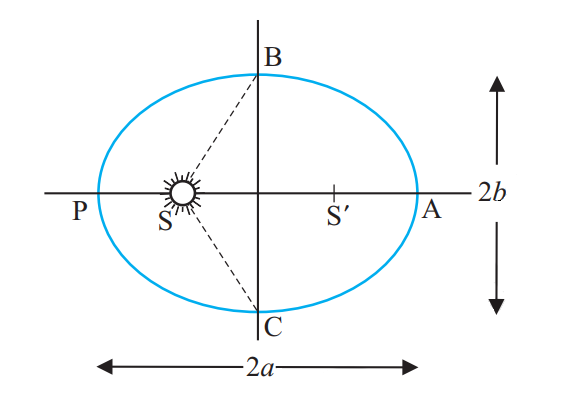
Kepler First Law – The Law of Orbits
<a id="Kepler’s Second Law - The law of Equal Areas" name="Kepler’s Second Law - The law of Equal Areas"></a>
Kepler’s Second Law – The Law of Equal Areas
Kepler’s second law states ” The radius vector drawn from the sun to the planet sweeps out equal areas in equal intervals of time”
As the orbit is not circular, the planet’s kinetic energy is not constant in its path. It has more <a href="https://byjus.com/physics/kinetic-energy/">kinetic energy</a> near perihelion and less kinetic energy near aphelion implies more speed at perihelion and less speed (vmin) at aphelion. If r is the distance of planet from sun, at perihelion (rmin) and at aphelion (rmax), then,
rmin + rmax = 2a × (length of major axis of an ellipse) . . . . . . . (1)
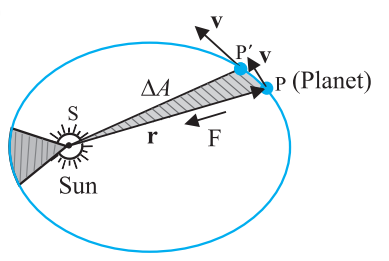
Kepler’s Second Law – The law of Equal Areas
For an infinitesimal movement of the planet in a time interval in an elliptical orbit, the area swept by the planet in time is given by;
dA/dt = d/dt [ 1/2 × r × (v dt)]= 1/2 × rv . . . . . (2)
At perihelion r = rmin, v = vmax then from Equation 2;
dA/dt = 1/2 × rmin × vmax) = [m × vmax × rmin]/2m = L/2m;
At aphelion r = rmax, v = vmin then from Equation 2;
dA/dt = 1/2 × vmin × rmax = [m × vmin × rmax]/2m = L/2m
Kepler’s second law can also be stated as “The areal velocity of a planet revolving around the sun in elliptical orbit remains constant which implies the angular momentum of a planet remains constant”. As the angular momentum is constant all planetary motions are planar motions, which is a direct consequence of central force.
Kepler’s Third Law – The Law of Periods
According to Kepler’s law of periods,” The square of the time period of revolution of a planet around the sun in an elliptical orbit is directly proportional to the cube of its semi-major axis”.
T2 ∝ a3
Shorter the orbit of the planet around the sun, shorter the time taken to complete one revolution. Using the equations of Newton’s law of gravitation and laws of motion, Kepler’s third law takes a more general form:
P2 = 4π2 /[G(M1+ M2)] × a3
where M1 and M2 are the masses of the two orbiting objects in solar masses.
 Test
Test
Related Questions
Posted by Harshita Tondey 1 year, 8 months ago
- 3 answers
Posted by Tushar Sharma 1 year, 8 months ago
- 2 answers
Posted by Surya Kumar 1 year, 8 months ago
- 1 answers
Posted by Harshal Patil 1 year, 1 month ago
- 0 answers
Posted by Pandey Ji 9 months, 1 week ago
- 0 answers
Posted by Aadarsh Tripathi 1 year, 8 months ago
- 2 answers
Posted by Rani Alan 1 year, 8 months ago
- 1 answers
Posted by Ansh Preet 3 months ago
- 1 answers
myCBSEguide
Trusted by 1 Crore+ Students

Test Generator
Create papers online. It's FREE.

CUET Mock Tests
75,000+ questions to practice only on myCBSEguide app

Malaika Sharma 5 years, 3 months ago
0Thank You