
Prove the Pythagoras theorem

CBSE, JEE, NEET, CUET
Question Bank, Mock Tests, Exam Papers
NCERT Solutions, Sample Papers, Notes, Videos
Posted by Aditi Shenoy 5 years, 3 months ago
- 2 answers
Yogita Ingle 5 years, 3 months ago
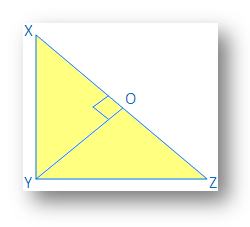
Given: A ∆ XYZ in which ∠XYZ = 90°.
To prove: XZ2 = XY2 + YZ2
Construction: Draw YO ⊥ XZ
Proof: In ∆XOY and ∆XYZ, we have,
∠X = ∠X → common
∠XOY = ∠XYZ → each equal to 90°
Therefore, ∆ XOY ~ ∆ XYZ → by AA-similarity
⇒ XO/XY = XY/XZ
⇒ XO × XZ = XY2 ----------------- (i)
In ∆YOZ and ∆XYZ, we have,
∠Z = ∠Z → common
∠YOZ = ∠XYZ → each equal to 90°
Therefore, ∆ YOZ ~ ∆ XYZ → by AA-similarity
⇒ OZ/YZ = YZ/XZ
⇒ OZ × XZ = YZ2 ----------------- (ii)
From (i) and (ii) we get,
XO × XZ + OZ × XZ = (XY2 + YZ2)
⇒ (XO + OZ) × XZ = (XY2 + YZ2)
⇒ XZ × XZ = (XY2 + YZ2)
⇒ XZ 2 = (XY2 + YZ2)
 Test
Test
Related Questions
Posted by Savitha Savitha 1 year, 6 months ago
- 0 answers
Posted by Alvin Thomas 5 months ago
- 0 answers
Posted by Yash Pandey 8 months, 1 week ago
- 0 answers
Posted by Sheikh Alfaz 3 months, 3 weeks ago
- 0 answers
Posted by Akhilesh Patidar 1 year, 6 months ago
- 0 answers
Posted by Duruvan Sivan 8 months, 1 week ago
- 0 answers
myCBSEguide
Trusted by 1 Crore+ Students

Test Generator
Create papers online. It's FREE.

CUET Mock Tests
75,000+ questions to practice only on myCBSEguide app

Chaitanya Saini 5 years, 3 months ago
0Thank You