
What is Ohm's Law Discribe about …

CBSE, JEE, NEET, CUET
Question Bank, Mock Tests, Exam Papers
NCERT Solutions, Sample Papers, Notes, Videos
Posted by Rishi Kishore 5 years, 7 months ago
- 2 answers
Gaurav Seth 5 years, 7 months ago
Ohm’s Law
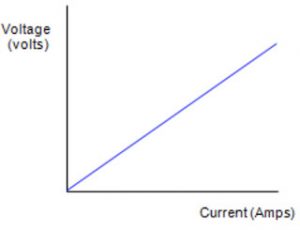
George Simon ohm(in 1826)studied relationship between I and V across the ends of conductor.
Ohm’s Law states that electric current flowing in a conductor is directly proportional to potential difference across the ends of the conductor,provided temperature and other physical conditions remains constant.
V=IR
R=Resistance of conductor
Resistance of a conductor is the property of conductor to oppose the flow of charge through it.
R = V/I
Unit of resistance is ohm
1 ohm = 1 Volt / 1 Ampere
Resistance of a conductor is said to be 1 ohm if a potential difference of 1 volts across the ends of conductor makes a current of 1 ampere to flow through it.
Slope = I / V
Slope of graph V and I=Resistance of a conductor
V=IR
I= V/R
If R is halved then I is doubled.
If R is doubled then I is halved.
 Test
Test
Related Questions
Posted by Harshal Patil 1 year, 1 month ago
- 0 answers
Posted by Ansh Preet 3 months ago
- 1 answers
Posted by Rani Alan 1 year, 8 months ago
- 1 answers
Posted by Harshita Tondey 1 year, 8 months ago
- 3 answers
Posted by Surya Kumar 1 year, 8 months ago
- 1 answers
Posted by Tushar Sharma 1 year, 8 months ago
- 2 answers
Posted by Pandey Ji 9 months, 1 week ago
- 0 answers
Posted by Aadarsh Tripathi 1 year, 8 months ago
- 2 answers
myCBSEguide
Trusted by 1 Crore+ Students

Test Generator
Create papers online. It's FREE.

CUET Mock Tests
75,000+ questions to practice only on myCBSEguide app

Aaman Khan 5 years, 7 months ago
3Thank You