<div id="answer-id">
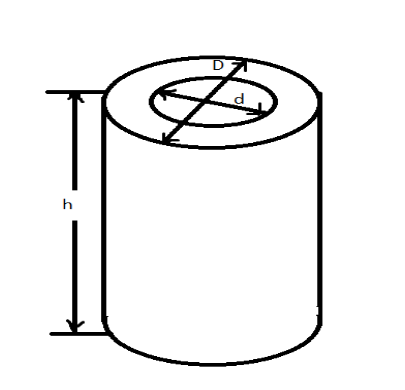
<div>The difference between the outer and inner curved surface area of hollow right circular cylinder 14cm long is 88<nobr aria-hidden="true">cm2</nobr>
<script type="math/tex" id="MathJax-Element-4">cm^2</script>, using this we make our equation number one. Similarly, the difference of volume of inner and outer part of hollow right circular cylinder is also given, using this we make another equation named as equation number two. By adding both the equations, we get one of the diameters and putting the value of one of the diameters, we also get the value of another diameter.
Complete Step-by-step answer:
</div>
<div itemprop="description">The difference of outer curved surface area and inner curved surface area is 88<nobr aria-hidden="true">cm2</nobr>
<script type="math/tex" id="MathJax-Element-5">cm^2</script> given in the question.
So,
Outer curved surface area – Inner curved surface area <nobr aria-hidden="true">=88cm2</nobr>
<script type="math/tex" id="MathJax-Element-6">=88c{{m}^{2}}</script>.
Since, the curved surface area of a cylinder is <nobr aria-hidden="true">2πrh</nobr>
<script type="math/tex" id="MathJax-Element-7">2\pi rh</script>, where r is the radius and h is the height of the cylinder.
In our problem, the height of the cylinder is 14 cm.
<nobr aria-hidden="true">2πRh − 2πrh = 882πh (R−r) = 88R − r = 882 × 227 × 14R − r = 88 × 72 × 22 × 14R−r = 1...(1)</nobr>
Also, the difference of volume of outer part and inner part of cylinder is given.
So, Volume of outer part – Volume of inner part<nobr aria-hidden="true">=176</nobr>
<script type="math/tex" id="MathJax-Element-9">=176</script>.
Since, the volume of a cylinder is <nobr aria-hidden="true">πr2h</nobr>
<script type="math/tex" id="MathJax-Element-10">\pi {{r}^{2}}h</script>, where r is the radius and h is the height of the cylinder.
<nobr aria-hidden="true">πR2h − πr2h = 176πh(R2 − r2) = 176</nobr>
We expand the <nobr aria-hidden="true">(R2−r2)</nobr>
<script type="math/tex" id="MathJax-Element-12">({{R}^{2}}-{{r}^{2}})</script> using the identity <nobr aria-hidden="true">(a
2−b
2)=(a−b)(a+b)</nobr>.
<nobr aria-hidden="true">πh(R−r)(R+r) = 176π × 14(R+r) = 176R+r = 176×722×14R+r = 4 ...(2)</nobr>
Adding equation (1) and equation (2), we get
<nobr aria-hidden="true">R+r+R−r=52R=5R=52D=5</nobr>
Putting in equation (2),
<nobr aria-hidden="true">52+r=4r=4−52r=8−52r=32d=3.</nobr>
Hence, the diameter of outer cylinder is 5cm and the diameter of inner cylinder is 3cm.</div>
</div>


 Test
Test



Sia ? 4 years, 9 months ago
Complete Step-by-step answer:
So,
Outer curved surface area – Inner curved surface area <nobr aria-hidden="true">=88cm2</nobr><script type="math/tex" id="MathJax-Element-6">=88c{{m}^{2}}</script>.
Since, the curved surface area of a cylinder is <nobr aria-hidden="true">2πrh</nobr><script type="math/tex" id="MathJax-Element-7">2\pi rh</script>, where r is the radius and h is the height of the cylinder.
In our problem, the height of the cylinder is 14 cm.
<nobr aria-hidden="true">2πRh − 2πrh = 882πh (R−r) = 88R − r = 882 × 227 × 14R − r = 88 × 72 × 22 × 14R−r = 1...(1)</nobr>
Also, the difference of volume of outer part and inner part of cylinder is given.
So, Volume of outer part – Volume of inner part<nobr aria-hidden="true">=176</nobr><script type="math/tex" id="MathJax-Element-9">=176</script>.
Since, the volume of a cylinder is <nobr aria-hidden="true">πr2h</nobr><script type="math/tex" id="MathJax-Element-10">\pi {{r}^{2}}h</script>, where r is the radius and h is the height of the cylinder.
<nobr aria-hidden="true">πR2h − πr2h = 176πh(R2 − r2) = 176</nobr>
We expand the <nobr aria-hidden="true">(R2−r2)</nobr><script type="math/tex" id="MathJax-Element-12">({{R}^{2}}-{{r}^{2}})</script> using the identity <nobr aria-hidden="true">(a2−b2)=(a−b)(a+b)</nobr>.
<nobr aria-hidden="true">πh(R−r)(R+r) = 176π × 14(R+r) = 176R+r = 176×722×14R+r = 4 ...(2)</nobr>
Adding equation (1) and equation (2), we get
<nobr aria-hidden="true">R+r+R−r=52R=5R=52D=5</nobr>
Putting in equation (2),
<nobr aria-hidden="true">52+r=4r=4−52r=8−52r=32d=3.</nobr>
Hence, the diameter of outer cylinder is 5cm and the diameter of inner cylinder is 3cm.</div> </div>
0Thank You