
If two zeroes of the polynomial …

CBSE, JEE, NEET, CUET
Question Bank, Mock Tests, Exam Papers
NCERT Solutions, Sample Papers, Notes, Videos
Posted by Hrithik Singh 6 years, 3 months ago
- 2 answers
Shantanu Kapse 6 years, 3 months ago
 Test
Test
Related Questions
Posted by Sabin Sultana 1 year, 4 months ago
- 0 answers
Posted by Ananya Sv 1 year, 4 months ago
- 1 answers
Posted by Gurleen Kaur 1 year, 4 months ago
- 0 answers
Posted by Ashish Chaudhary 1 year, 4 months ago
- 1 answers
Posted by Sana Dharwad 1 year, 4 months ago
- 0 answers
Posted by Manoj Thakur 1 year, 4 months ago
- 0 answers
Posted by Nitin Kumar 1 year, 4 months ago
- 1 answers
Posted by Sethpoulou Apoulou 1 year, 5 months ago
- 0 answers
myCBSEguide
Trusted by 1 Crore+ Students

Test Generator
Create papers online. It's FREE.

CUET Mock Tests
75,000+ questions to practice only on myCBSEguide app

Sia ? 6 years, 3 months ago
Two zeros are {tex}2\pm\sqrt3{/tex}
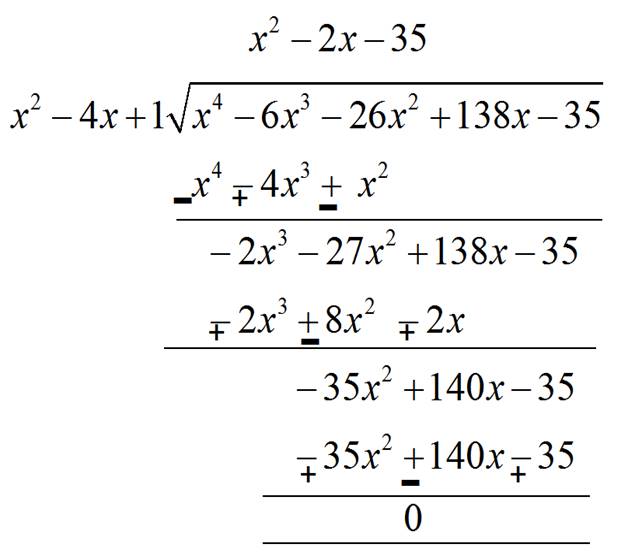
Sum of Zeroes {tex}2 + \sqrt { 3 } + 2 - \sqrt { 3 } = 4{/tex}
and product of zeroes = {tex}( 2 + \sqrt { 3 } ) ( 2 - \sqrt { 3 } ) = 4 - 3 = 1{/tex}
Hence quadratic polynomial formed out of this will be a factor of given polynomial,
So, x2 - (sum of zeroes)x + product of zeroes
= x2 - 4x + 1 will be a factor of given polynomial,
Divide given polynomial with x2 - 4x + 1 to get other zeroes.
Now,
x2 -2x - 35
= x2 - 7x + 5x - 35
= x(x - 7) + 5(x - 7)
= (x - 5) (x - 7)
{tex}\therefore {/tex} Zeros are
x = 7 and x = -5
{tex}\therefore {/tex} Other two zeros are 7 and -5
2Thank You