
A long charged cylinder of linear …

CBSE, JEE, NEET, CUET
Question Bank, Mock Tests, Exam Papers
NCERT Solutions, Sample Papers, Notes, Videos
 Test
Test
Related Questions
Posted by Khushbu Otti 1 year, 8 months ago
- 0 answers
Posted by Aniket Mahajan 1 year, 1 month ago
- 0 answers
Posted by Anterpreet Kaur 1 year, 9 months ago
- 0 answers
myCBSEguide
Trusted by 1 Crore+ Students

Test Generator
Create papers online. It's FREE.

CUET Mock Tests
75,000+ questions to practice only on myCBSEguide app

Sia ? 6 years, 7 months ago
Two co-axial cylindrical shells A and B of radii a and b are possessed by a cylindrical capacitor. Assume l be length of the cylindrical shell. Due to the introduction of +q charge on the inner cylindrical shell A, equal but opposite charge -q is induced on the inner surface of the outer cylindrical shell B. The induced charge +q on its outer surface will flow to earth if the shell B is earthed.
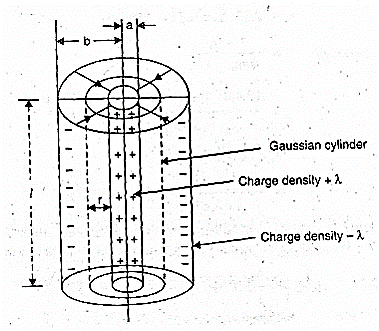
The capacitance of the cylindrical capacitor is given as follows if V is potential difference between the cylindrical shell A and B.
{tex}C = \frac{q}{V}{/tex}
By applying the Gaussian a theorem, we first need to find electric field E in the space between two shells to find out potential difference between the cylindrical shells A and B . Let a cylinder of radius r (such that b > r > a) and length l as the Gauss surface. Charge enclosed by the Gaussian surface is {tex}\lambda{/tex}1 and if {tex}\lambda{/tex} is charge per unit length on the shell A.
The electric flux will cross through only curved surface of the cylinder (Gauss surface). As the area of curved surface of cylinder is {tex}2\pi rl{/tex}, we have by Gaussian theorem.
{tex}\oint E \cdot ds = \frac{q}{{{\varepsilon _0}}}{/tex}
{tex}E \cdot 2\pi rl = \frac{{\lambda l}}{{{\varepsilon _0}}}{/tex}
{tex}E = \frac{\lambda }{{2\pi {\varepsilon _0}r}}{/tex}
The field lines are radial and normal to the axis of charged cylinder.
0Thank You