
Obtain all zeroes of 3x⁴-15x³+13x²+25x-30 if …

CBSE, JEE, NEET, CUET
Question Bank, Mock Tests, Exam Papers
NCERT Solutions, Sample Papers, Notes, Videos
Posted by Rani Patil 6 years, 4 months ago
- 1 answers
 Test
Test
Related Questions
Posted by Vanshika Bhatnagar 1 year, 4 months ago
- 2 answers
Posted by Kanika . 1 month ago
- 1 answers
Posted by Lakshay Kumar 1 year, 1 month ago
- 0 answers
Posted by Sahil Sahil 1 year, 4 months ago
- 2 answers
Posted by Parinith Gowda Ms 3 months, 2 weeks ago
- 1 answers
Posted by Hari Anand 6 months, 1 week ago
- 0 answers
Posted by Parinith Gowda Ms 3 months, 2 weeks ago
- 0 answers
myCBSEguide
Trusted by 1 Crore+ Students

Test Generator
Create papers online. It's FREE.

CUET Mock Tests
75,000+ questions to practice only on myCBSEguide app

Sia ? 6 years, 4 months ago
We have the polynomial f(x) = (3x4 - 15x3 + 13x2 + 25x - 30).
Since {tex}\sqrt { \frac { 5 } { 3 } } \text { and } - \sqrt { \frac { 5 } { 3 } }{/tex} are the zeros of f(x),
i.e., {tex}x=-\sqrt{\frac53}{/tex} and {tex}x=\sqrt{\frac53}{/tex}
i.e., {tex}x+\sqrt{\frac53}=0\;and\;x-\sqrt{\frac53}=0{/tex} so it follows that each
one of {tex}\left( x - \sqrt { \frac { 5 } { 3 } } \right) \operatorname { and } \left( x + \sqrt { \frac { 5 } { 3 } } \right){/tex} is a factor of f(x).so using {tex}\left(a+b\right)\left(a-b\right)=a^2-b^2{/tex}, we get
{tex}\therefore \quad \left( x - \frac { \sqrt { 5 } } { \sqrt { 3 } } \right) \left( x + \frac { \sqrt { 5 } } { \sqrt { 3 } } \right) = 0 \Rightarrow \left( x ^ { 2 } - \frac { 5 } { 3 } \right)= 0 \Rightarrow \frac { \left( 3 x ^ { 2 } - 5 \right) } { 3 }= 0{/tex} is also a factor of f(x).
Consequently, (3x2 - 5) is a factor of f{x).
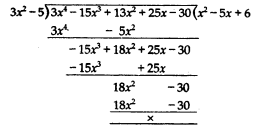
On dividing the polynomial by (3x2 - 5), we get
{tex}\therefore{/tex} f(x) = 3x4 - 15x3 + 13x2 + 25x - 30
= (3x2 - 5 )(x2 - 5x + 6).
By middle term factorisation. We get,
={tex}\left(3x^2-5\right)\left(x^2-2x-3x+6\right){/tex}
=({tex}\lbrack(\sqrt{3x})^2-\left(\sqrt5\right)^2\rbrack{/tex}{tex}\left[x\left(x-2\right)-3\left(x-2\right)\right]{/tex}
By using {tex}a^2-b^2=\left(a+b\right)\left(a-b\right){/tex}we get,
{tex}= ( \sqrt { 3 } x + \sqrt { 5 } ) ( \sqrt { 3 } x - \sqrt { 5 } ) ( x - 2 ) ( x - 3 ){/tex}
{tex}\therefore{/tex} f(x) = 0 , so either factors can equated to zero to get the roots {tex}\Rightarrow ( \sqrt { 3 } x + \sqrt { 5 } ) = 0 \text { or } ( \sqrt { 3 } x - \sqrt { 5 } ) = 0{/tex}
{tex}\Rightarrow{/tex}(x - 2) = 0 or (x - 3) = 0
{tex}\Rightarrow x = - \sqrt { \frac { 5 } { 3 } } \text { or } x = \sqrt { \frac { 5 } { 3 } }{/tex} or x = 2 or x = 3
Hence, we get all zeros of f(x) are {tex}\sqrt { \frac { 5 } { 3 } } , - \sqrt { \frac { 5 } { 3 } }{/tex}, 2 and 3.
1Thank You