
Which of the following pairs of …

CBSE, JEE, NEET, CUET
Question Bank, Mock Tests, Exam Papers
NCERT Solutions, Sample Papers, Notes, Videos
 Test
Test
Related Questions
Posted by Parinith Gowda Ms 3 months, 2 weeks ago
- 0 answers
Posted by Vanshika Bhatnagar 1 year, 4 months ago
- 2 answers
Posted by Kanika . 1 month ago
- 1 answers
Posted by Sahil Sahil 1 year, 4 months ago
- 2 answers
Posted by Parinith Gowda Ms 3 months, 2 weeks ago
- 1 answers
Posted by Hari Anand 6 months, 1 week ago
- 0 answers
myCBSEguide
Trusted by 1 Crore+ Students

Test Generator
Create papers online. It's FREE.

CUET Mock Tests
75,000+ questions to practice only on myCBSEguide app

Sia ? 6 years, 4 months ago
x + y = 5 ...(1)
2x + 2y = 10 ...(2)
Here, a1 = 1, b1 = 1, c1 = -5
a2 = 2, b2 = 2, c2 = -10
We see that {tex}\frac{{{a_1}}}{{{a_2}}} = \frac{{{b_1}}}{{{b_2}}} = \frac{{{c_1}}}{{{c_2}}}{/tex}
Hence, the lines represented by the equations (1) and (2) are coincident.
Therefore, equations (1) and (2) have infinitely many common solutions, i.e., the given pair of linear equations is consistent.
Graphical Representation, we draw the graphs of the equations (1) and (2) by finding two solutions for each if the equations. These two solutions of the equations (1) and (2) are given below in table 1 and table 2 respectively.
For equation (1) x + y = 5 {tex}\Rightarrow{/tex} y = 5 - x
Table 1 of solutions
For equations (2) x + 2y = 10
{tex}\Rightarrow{/tex} 2y = 10 - 2x
{tex}\Rightarrow y = \frac{{10 - 2x}}{2} \Rightarrow{/tex} y = 5 - x
Table 2 of solutions
We plot the points A(0, 5) and B(5, 0) on a graph paper and join these points to form the line AB representing the equation (1) as shown in the figure, Also, we plot the points C(1, 4) and D (2, 3) on the same graph paper and join these points to form the line CD representing the equation (2) as shown in the same figure.
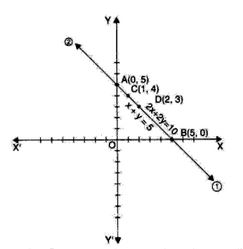
In the figure we observe that the two lines AB and CD coincide.
2Thank You