Given system of equations are:
{tex}2x + y = 6{/tex} ...(i)
{tex}2x - y + 2 = 0{/tex} ...(ii)
Graph of the equation {tex}2x + y = 6:{/tex}
We have,
{tex}2x + y = 6{/tex} {tex} \Rightarrow {/tex} {tex}y = 6 - 2x{/tex}
When x = 0, we have y = 6 - 2(0) = 6
When x =3, we have y = 6 - 2(3) = 6 - 6 = 0
Thus, we have the following table giving two points on the line represented by the equation {tex}2x + y = 6{/tex}
Graph of the equation {tex}2x - y + 2 = 0{/tex}:
We have,
{tex}2 x - y + 2 = 0 {/tex}{tex} \Rightarrow {/tex} y = 2x + 2
When x = 0, we have y = 2(0) + 2 = 2
When x = -1, we have y = 2(-1) + 2 = 2 - 2 = 0
Thus, we have the following table giving two points on the line representing the given equation
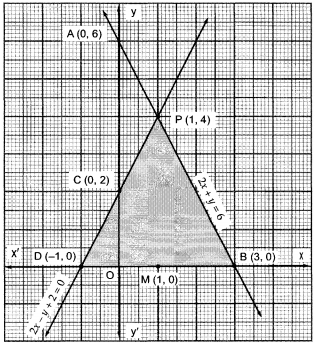
Thus, x = 1, y = 4 is the solution of the given system of equations. Draw PM perpendicular from P on x-axis
Clearly, we have
PM = y-coordinate of point P(1, 4)
{tex} \Rightarrow{/tex} PM=4
and, DB = 4
{tex} \therefore{/tex} Area of the shaded region =Area of {tex} \triangle{/tex}PBD
{tex}\Rightarrow{/tex} Area of the shaded region {tex}= \frac { 1 } { 2 } ( \text { Base } \times \text { Height } ){/tex}
{tex}\Rightarrow{/tex} Area of the shaded region {tex}= \frac { 1 } { 2 } ( D B \times P M ){/tex}
{tex}\Rightarrow{/tex} Area of the shaded region {tex}= \left( \frac { 1 } { 2 } \times 4 \times 4 \right) \text { sq. units } = 8 s q. units.{/tex}


 Test
Test



Sia ? 6 years, 5 months ago
Given system of equations are:
{tex}2x + y = 6{/tex} ...(i)
{tex}2x - y + 2 = 0{/tex} ...(ii)
Graph of the equation {tex}2x + y = 6:{/tex}
We have,
{tex}2x + y = 6{/tex} {tex} \Rightarrow {/tex} {tex}y = 6 - 2x{/tex}
When x = 0, we have y = 6 - 2(0) = 6
When x =3, we have y = 6 - 2(3) = 6 - 6 = 0
Thus, we have the following table giving two points on the line represented by the equation {tex}2x + y = 6{/tex}
Graph of the equation {tex}2x - y + 2 = 0{/tex}:

We have,
{tex}2 x - y + 2 = 0 {/tex}{tex} \Rightarrow {/tex} y = 2x + 2
When x = 0, we have y = 2(0) + 2 = 2
When x = -1, we have y = 2(-1) + 2 = 2 - 2 = 0
Thus, we have the following table giving two points on the line representing the given equation
Thus, x = 1, y = 4 is the solution of the given system of equations. Draw PM perpendicular from P on x-axis
Clearly, we have
PM = y-coordinate of point P(1, 4)
{tex} \Rightarrow{/tex} PM=4
and, DB = 4
{tex} \therefore{/tex} Area of the shaded region =Area of {tex} \triangle{/tex}PBD
{tex}\Rightarrow{/tex} Area of the shaded region {tex}= \frac { 1 } { 2 } ( \text { Base } \times \text { Height } ){/tex}
{tex}\Rightarrow{/tex} Area of the shaded region {tex}= \frac { 1 } { 2 } ( D B \times P M ){/tex}
{tex}\Rightarrow{/tex} Area of the shaded region {tex}= \left( \frac { 1 } { 2 } \times 4 \times 4 \right) \text { sq. units } = 8 s q. units.{/tex}
0Thank You