
What is geometrical and optical isomerism …

CBSE, JEE, NEET, CUET
Question Bank, Mock Tests, Exam Papers
NCERT Solutions, Sample Papers, Notes, Videos
Posted by Im Rohit 45 6 years, 10 months ago
- 1 answers
 Test
Test
Related Questions
Posted by Account Deleted 1 year, 9 months ago
- 0 answers
Posted by Roshni Gupta 1 year, 9 months ago
- 0 answers
Posted by Mahi Sharma 1 year, 9 months ago
- 0 answers
Posted by Priya Dharshini B 1 year, 8 months ago
- 4 answers
Posted by Kashish Baisla 1 year ago
- 1 answers
Posted by Karan Kumar Mohanta 1 year, 8 months ago
- 1 answers
Posted by Prity Rani Mishra 1 year, 9 months ago
- 0 answers
Posted by Shikhar Manav 1 year, 9 months ago
- 0 answers
myCBSEguide
Trusted by 1 Crore+ Students

Test Generator
Create papers online. It's FREE.

CUET Mock Tests
75,000+ questions to practice only on myCBSEguide app

Gaurav Seth 6 years, 10 months ago
1) Optical Isomerism
Optical isomers are those two compounds with the same chemical formula such that their mirror images are not superimposable on each other. Depending on the direction they rotate the plane of polarised light in a polarimeter, we have two forms of optical isomers. They are:
2) Geometric Isomerism
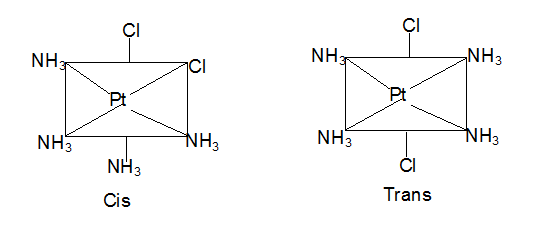
In case of disubstituted complexes, the substituted groups could either be adjacent or opposite to each other. This leads to geometric isomerism. Thus, we can prepare square planar complexes such as [Pt(NH3)4Cl2] in two forms, cis and trans. When the chlorine atoms are adjacent to each other, we get the cis form. While when two chlorine atoms are opposite, we get the trans-form.
2Thank You