
Draw the graph of 2x-y-2=0,4x+3y-24=0 and …

CBSE, JEE, NEET, CUET
Question Bank, Mock Tests, Exam Papers
NCERT Solutions, Sample Papers, Notes, Videos
Posted by Viney Yadav 6 years, 4 months ago
- 1 answers
 Test
Test
Related Questions
Posted by Sahil Sahil 1 year, 5 months ago
- 2 answers
Posted by Parinith Gowda Ms 4 months, 1 week ago
- 0 answers
Posted by Parinith Gowda Ms 4 months, 1 week ago
- 1 answers
Posted by Kanika . 1 month, 3 weeks ago
- 1 answers
Posted by Lakshay Kumar 1 year, 1 month ago
- 0 answers
Posted by Hari Anand 7 months ago
- 0 answers
Posted by Vanshika Bhatnagar 1 year, 5 months ago
- 2 answers
myCBSEguide
Trusted by 1 Crore+ Students

Test Generator
Create papers online. It's FREE.

CUET Mock Tests
75,000+ questions to practice only on myCBSEguide app

Sia ? 6 years, 4 months ago
Given equations,
{tex}2 x - y - 2 = 0{/tex}
{tex}4x + 3y - 24 = 0{/tex}
{tex}y + 4 = 0{/tex}
We have, {tex}2x - y - 2 = 0{/tex} or {tex}x = {{y+2}\over2} {/tex}
When y = 0, we have {tex}x = {{0+2}\over2} = 1{/tex}
When x = 0, we have y = -2.
Thus, we obtain the following table giving coordinates of two point on the line represented by the equation {tex}2x - y - 2 = 0{/tex} and its graph is shown below.
Now we have, {tex}\begin{array}{l}4x+3y-24=0\Rightarrow y=\frac{24-4x}3\\\end{array}{/tex}
When y = 0, we have x = 6
When x = 0, we have y = 8
Thus, we obtain the following table giving coordinates of two points on the line represented by the equation {tex}4x + 3y - 24 = 0{/tex} and its graph is shown below.
Also we have {tex}y + 4 = 0{/tex}
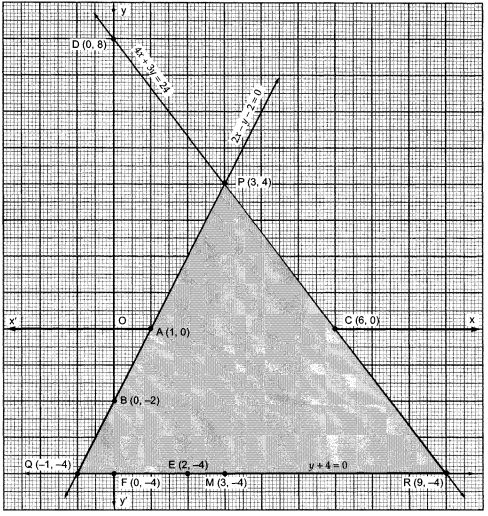
Clearly, y = - 4 for every value of x.
So, let E(2, -4) and F(0, -4) be two points on the line represented by y + 4 = 0. Plotting these points on the same graph and drawing a line passing through them, we obtain the graph of the line represented by the equation y + 4 = 0 as shown in Figure.
From Fig. we have {tex}\begin{array}{l}\bigtriangleup PQR\\\end{array}{/tex} having vertices P(3,4), Q(-1,-4) and R(9, -4).
Also, PM = 8 and QR = 10.
{tex}\therefore \quad \text { Area of } \triangle P Q R = \frac { 1 } { 2 } ( \text { Base } \times \text { Height } ){/tex}
{tex}\Rightarrow \quad \text { Area of } \triangle P Q R = \frac { 1 } { 2 } ( Q R \times P M ) = \frac { 1 } { 2 } ( 10 \times 8 )sq.\ units{/tex}
{tex}\Rightarrow \quad \text { Area of } \triangle P Q R = 40 \mathrm { sq } .units.{/tex}
0Thank You