
ABC is a triangle in which …

CBSE, JEE, NEET, CUET
Question Bank, Mock Tests, Exam Papers
NCERT Solutions, Sample Papers, Notes, Videos
 Test
Test
Related Questions
Posted by Kanika . 1 month, 1 week ago
- 1 answers
Posted by Sahil Sahil 1 year, 5 months ago
- 2 answers
Posted by Vanshika Bhatnagar 1 year, 5 months ago
- 2 answers
Posted by Hari Anand 6 months, 2 weeks ago
- 0 answers
Posted by Parinith Gowda Ms 3 months, 3 weeks ago
- 1 answers
Posted by Lakshay Kumar 1 year, 1 month ago
- 0 answers
Posted by Parinith Gowda Ms 3 months, 3 weeks ago
- 0 answers
myCBSEguide
Trusted by 1 Crore+ Students

Test Generator
Create papers online. It's FREE.

CUET Mock Tests
75,000+ questions to practice only on myCBSEguide app

Sia ? 6 years, 6 months ago
Given: ΔABC in which ∠B = 90°
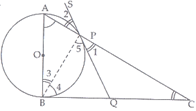
Circle with diameter AB intersect the hypotenuse AC at P.
A tangent SPQ at P is drawn to meet BC at Q.
To prove: Q is mid point of BC.
Construction: Join PB.
Proof: SPQ is tangent and AP is chord at contact point P.
Therefore,∠2 = ∠3 [ since Angles in alternate segment of circle are equal]
∠2 = ∠1 [Vertically opposite angles]
∠3 = ∠1 …(i) [From above two relations]
∠ABC = 90° [Given]
OB is radius , therefore BC will be tangent at B.
Therefore,∠3 = 90° - ∠4 …(ii)
∠APB = 90° [∠ in a semi circle]
⇒ ∠C = 90° - ∠4....(iii)
From (ii) and (iii), ∠C = ∠3
Using (i), ∠C = ∠1
⇒ CQ = QP …(iv) [Sides opp. to = ∠s in ΔQPC]
∠4 = 90° - ∠3 [From fig.]
∠5 = 90° - ∠1
∠3 = ∠1
Therefore,∠4 = ∠5
⇒ PQ = BQ …(v) [Sides opp. to equal angles in ΔQPB]
From (iv) and (v),
BQ = CQ
Therefore, Q is mid-point of BC. Hence, proved.
0Thank You