
If the angle of elevation of …

CBSE, JEE, NEET, CUET
Question Bank, Mock Tests, Exam Papers
NCERT Solutions, Sample Papers, Notes, Videos
 Test
Test
Related Questions
Posted by Vanshika Bhatnagar 1 year, 4 months ago
- 2 answers
Posted by Kanika . 1 month, 1 week ago
- 1 answers
Posted by Hari Anand 6 months, 2 weeks ago
- 0 answers
Posted by Sahil Sahil 1 year, 4 months ago
- 2 answers
Posted by Parinith Gowda Ms 3 months, 3 weeks ago
- 0 answers
Posted by Parinith Gowda Ms 3 months, 3 weeks ago
- 1 answers
Posted by Lakshay Kumar 1 year, 1 month ago
- 0 answers
myCBSEguide
Trusted by 1 Crore+ Students

Test Generator
Create papers online. It's FREE.

CUET Mock Tests
75,000+ questions to practice only on myCBSEguide app

Sia ? 6 years, 4 months ago
Let AB be the surface of the lake and let P be a point of observation such that AP = h metres. Let C be the position of the cloud and C be its reflection in the lake. Then, CB = C' B. Let PM be perpendicular from P on CB. Then,
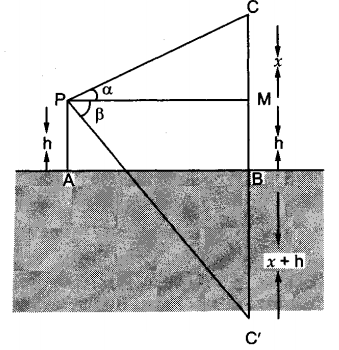
{tex}\angle C P M = \alpha{/tex} and {tex}\angle M P C ^ { \prime } = \beta.{/tex}
Let CM = x.
Then, CB = CM + MB = CM + PA = x + h.
In {tex}\triangle \mathrm { CPM },{/tex} we have
{tex}\tan \alpha = \frac { C M } { P M }{/tex}
{tex}\Rightarrow \quad \tan \alpha = \frac { x } { A B }{/tex}
{tex}\Rightarrow \quad A B = x \cot \alpha{/tex}.....(i)
In {tex}\triangle{/tex}PMC', we have
{tex}\tan \beta = \frac { C ^ { \prime } M } { P M }{/tex}
{tex}\Rightarrow \quad \tan \beta = \frac { x + 2 h } { A B }{/tex} [{tex}\because{/tex}CM = C'B + BM = x + h + h]
{tex}\Rightarrow \quad A B = ( x + 2 h ) \cot \beta{/tex}......(ii)
From (i) and (ii), we have
{tex}x \cot \alpha = ( x + 2 h ) \cot \beta{/tex}
[On equating the values of AB]
{tex}\Rightarrow \quad x ( \cot \alpha - \cot \beta ) = 2 h \cot \beta{/tex}
{tex}\Rightarrow \quad x \left( \frac { 1 } { \tan \alpha } - \frac { 1 } { \tan \beta } \right) = \frac { 2 h } { \tan \beta }{/tex}
{tex}\Rightarrow \quad x \left( \frac { \tan \beta - \tan \alpha } { \tan \alpha \tan \beta } \right) = \frac { 2 h } { \tan \beta }{/tex}
{tex}\Rightarrow \quad x = \frac { 2 h \tan \alpha } { \tan \beta - \tan \alpha }{/tex}
Hence, the height CB of the cloud is given by
CB = x + h
{tex}\Rightarrow \quad C B = \frac { 2 h \tan \alpha } { \tan \beta - \tan \alpha } + h{/tex}
{tex}\Rightarrow \quad C B = \frac { 2 h \tan \alpha + h \tan \beta - h \tan \alpha } { \tan \beta - \tan \alpha } = \frac { h ( \tan \alpha + \tan \beta ) } { \tan \beta - \tan \alpha }{/tex}
0Thank You