
Explain the cleansing action of soap

CBSE, JEE, NEET, CUET
Question Bank, Mock Tests, Exam Papers
NCERT Solutions, Sample Papers, Notes, Videos
Posted by Lavish Yadav 6 years, 3 months ago
- 1 answers
 Test
Test
Related Questions
Posted by Pandey Ji 5 months, 3 weeks ago
- 0 answers
Posted by Tushar Sharma 1 year, 4 months ago
- 2 answers
Posted by Harshal Patil 10 months, 1 week ago
- 0 answers
Posted by Aadarsh Tripathi 1 year, 4 months ago
- 2 answers
Posted by Surya Kumar 1 year, 4 months ago
- 1 answers
Posted by Ansh Preet 10 months, 1 week ago
- 1 answers
Posted by Rani Alan 1 year, 4 months ago
- 1 answers
Posted by Harshita Tondey 1 year, 4 months ago
- 3 answers
myCBSEguide
Trusted by 1 Crore+ Students

Test Generator
Create papers online. It's FREE.

CUET Mock Tests
75,000+ questions to practice only on myCBSEguide app

Sia ? 6 years, 3 months ago
A soap molecule is made up of two parts: one part is a long hydrocarbon chain which is non-ionic, and the other part is a short ionic group called carboxylate group (–COO-Na+). The non-ionic, hydrocarbon part of soap molecule is water repelling (hydrophobic) but it dissolves dirt and grease particles. So, the dirt and grease present on a piece of dirty cloth attach themselves to the hydrocarbon part of the soap molecule. The ionic part of soap molecule, however, attaches to the polar water molecules and thus pulls the dirt and grease particles away from the surface of dirty cloth thereby making the cloth clean.
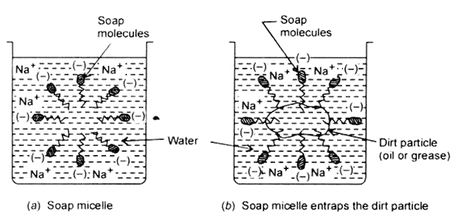
When soap is dissolved in water, it forms a micelle [Fig.(a)]. In a micelle, the soap molecules are arranged radially, with the hydrocarbon and directed towards the centre and the water attracting carboxylate part directed outwards [Fig.(b)]. The dirt and grease particles lying on the surface of clothe wetted by soap are thus entrapped by these micelles and removed.
0Thank You