
if a line is drawn parallel …

CBSE, JEE, NEET, CUET
Question Bank, Mock Tests, Exam Papers
NCERT Solutions, Sample Papers, Notes, Videos
 Test
Test
Related Questions
Posted by Lakshay Kumar 1 year, 1 month ago
- 0 answers
Posted by Parinith Gowda Ms 3 months, 2 weeks ago
- 0 answers
Posted by Sahil Sahil 1 year, 4 months ago
- 2 answers
Posted by Hari Anand 6 months, 1 week ago
- 0 answers
Posted by Vanshika Bhatnagar 1 year, 4 months ago
- 2 answers
Posted by Kanika . 1 month ago
- 1 answers
Posted by Parinith Gowda Ms 3 months, 2 weeks ago
- 1 answers
myCBSEguide
Trusted by 1 Crore+ Students

Test Generator
Create papers online. It's FREE.

CUET Mock Tests
75,000+ questions to practice only on myCBSEguide app

Sia ? 6 years, 6 months ago
Given: ABC is a triangle in which DE {tex}\parallel{/tex} BC.
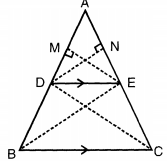
To prove: {tex}\frac { A D } { B D } = \frac { A E } { C E }{/tex}
Construction: Draw {tex}D N \perp A E{/tex} and {tex}E M \perp A D{/tex}., Join BE and CD.
Proof :
In {tex}\triangle ADE,{/tex}
Area of {tex} \Delta A D E = \frac { 1 } { 2 } \times A E \times D N{/tex} ...(i)
In {tex}\Delta D E C{/tex},
Area of {tex}\operatorname \Delta D C E = \frac { 1 } { 2 } \times C E \times D N{/tex} ...(ii)
Dividing equation (l) by equation (ii),
{tex}\Rightarrow\frac { \text { area } ( \Delta A D E ) } { \text { area } ( \Delta D E C ) } = \frac { \frac { 1 } { 2 } \times A E \times D N } { \frac { 1 } { 2 } \times C E \times D N }{/tex}
{tex}\Rightarrow{/tex} {tex}\frac { \text { area } ( \Delta A D E ) } { \text { area } ( \Delta D E C ) } = \frac { A E } { C E }{/tex} ...(iii)
Similarly, In {tex}\Delta A D E{/tex},
Area of {tex}\operatorname \Delta A D E = \frac { 1 } { 2 } \times A D \times E M{/tex} ...(iv)
In {tex}\Delta D E B,{/tex}
Area of {tex}\operatorname \Delta D E B = \frac { 1 } { 2 } \times E M \times B D{/tex} ...(v)
Dividing equation (iv) by equation (v),
{tex}\Rightarrow{/tex}{tex}\frac { \text { area } ( \Delta A D E ) } { \text { area } ( \Delta D E B ) }{/tex} {tex}= \frac { \frac { 1 } { 2 } \times A D \times E M } { \frac { 1 } { 2 } \times B D \times E M }{/tex}
{tex}\Rightarrow{/tex} {tex}\frac { \text { area } ( \Delta A D E ) } { \text { area } ( \Delta D E B ) } = \frac { A D } { B D }{/tex} ...(vi)
{tex}\Delta D E B \text { and } \Delta D E C{/tex} lie on the same base DE and between two parallel lines DE and BC.
{tex}\therefore{/tex} Area ({tex} \Delta D E B {/tex}) = Area ( {tex} \Delta D E C {/tex})
From equation (iii),
{tex}\Rightarrow\frac { \text { area } ( \Delta A D E ) } { \text { area } ( \Delta D E B ) } = \frac { A E } { C E }.{/tex}......(vii)
From equation (vi) and equation (vii),
{tex}\frac { A E } { C E } = \frac { A D } { B D }{/tex}
{tex}\therefore{/tex} If a line is drawn parallel to one side of a triangle to intersect the other two sides in two points, then the other two sides are divided in the same ratio.
0Thank You