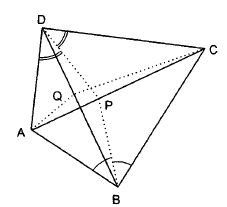
According to question it is given that ABCD is a quadrilateral in which the bisectors of {tex}\angle{/tex}ABC and {tex}\angle{/tex}ADC meet on the diagonal AC at P.
TO PROVE: Bisectors of {tex}\angle{/tex}BAD and {tex}\angle{/tex}BCD meet on the diagonal BD
CONSTRUCTION: Join BP and DP. Let us suppose that the bisector of {tex}\angle{/tex}BAD meet BD at Q. Now, Join AQ and CQ.
PROOF: In order to prove that the bisectors of {tex}\angle{/tex}BAD and {tex}\angle{/tex}BCD meet on the diagonal BD, we have to prove that CQ is a bisector of∠BCD for which we will prove that Q divides BD in the ratio BC: DC.
In {tex}\Delta{/tex}ABC, BP is the bisector of {tex}\angle{/tex}ABC.( According to question)
{tex}\therefore \quad \frac { A B } { B C } = \frac { A P } { P C }{/tex} .......................(i)
In {tex}\Delta{/tex}ACD, DP is the bisector of {tex}\angle{/tex}ADC.(as per fig)
{tex}\therefore \quad \frac { A D } { D C } = \frac { A P } { P C }{/tex} .....................(ii)
Therefore, from (i) and (ii), we get
{tex}\frac { A B } { B C } = \frac { A D } { D C }{/tex}
{tex}\Rightarrow \quad \frac { A B } { A D } = \frac { B C } { D C }{/tex}.................... ...(iii)
Again, In {tex}\Delta{/tex} ABD, AQ is the bisector of {tex}\angle{/tex}BAD. [By construction]
{tex}\therefore \quad \frac { A B } { A D } = \frac { B Q } { D Q }{/tex} .............(iv)
From (iii) and (iv), we get
{tex}\frac { B C } { D C } = \frac { B Q } { D Q }.{/tex}
Hence, in {tex}\Delta{/tex}CBD, Q divides BD in the ratio of CB: CD.
Thus, CQ is the bisector of {tex}\angle{/tex}BCD.
Therefore, the bisectors of {tex}\angle{/tex}BAD and {tex}\angle{/tex}BCD meet on the diagonal BD.( Hence proved)


 Test
Test



Sia ? 6 years, 4 months ago
According to question it is given that ABCD is a quadrilateral in which the bisectors of {tex}\angle{/tex}ABC and {tex}\angle{/tex}ADC meet on the diagonal AC at P.
TO PROVE: Bisectors of {tex}\angle{/tex}BAD and {tex}\angle{/tex}BCD meet on the diagonal BD
CONSTRUCTION: Join BP and DP. Let us suppose that the bisector of {tex}\angle{/tex}BAD meet BD at Q. Now, Join AQ and CQ.
PROOF: In order to prove that the bisectors of {tex}\angle{/tex}BAD and {tex}\angle{/tex}BCD meet on the diagonal BD, we have to prove that CQ is a bisector of∠BCD for which we will prove that Q divides BD in the ratio BC: DC.
In {tex}\Delta{/tex}ABC, BP is the bisector of {tex}\angle{/tex}ABC.( According to question)

{tex}\therefore \quad \frac { A B } { B C } = \frac { A P } { P C }{/tex} .......................(i)
In {tex}\Delta{/tex}ACD, DP is the bisector of {tex}\angle{/tex}ADC.(as per fig)
{tex}\therefore \quad \frac { A D } { D C } = \frac { A P } { P C }{/tex} .....................(ii)
Therefore, from (i) and (ii), we get
{tex}\frac { A B } { B C } = \frac { A D } { D C }{/tex}
{tex}\Rightarrow \quad \frac { A B } { A D } = \frac { B C } { D C }{/tex}.................... ...(iii)
Again, In {tex}\Delta{/tex} ABD, AQ is the bisector of {tex}\angle{/tex}BAD. [By construction]
{tex}\therefore \quad \frac { A B } { A D } = \frac { B Q } { D Q }{/tex} .............(iv)
From (iii) and (iv), we get
{tex}\frac { B C } { D C } = \frac { B Q } { D Q }.{/tex}
Hence, in {tex}\Delta{/tex}CBD, Q divides BD in the ratio of CB: CD.
Thus, CQ is the bisector of {tex}\angle{/tex}BCD.
Therefore, the bisectors of {tex}\angle{/tex}BAD and {tex}\angle{/tex}BCD meet on the diagonal BD.( Hence proved)
0Thank You