
If the area of two similar …

CBSE, JEE, NEET, CUET
Question Bank, Mock Tests, Exam Papers
NCERT Solutions, Sample Papers, Notes, Videos
Posted by Dev R 6 years, 5 months ago
- 1 answers
 Test
Test
Related Questions
Posted by Lakshay Kumar 1 year, 1 month ago
- 0 answers
Posted by Sahil Sahil 1 year, 4 months ago
- 2 answers
Posted by Kanika . 1 month ago
- 1 answers
Posted by Vanshika Bhatnagar 1 year, 4 months ago
- 2 answers
Posted by Parinith Gowda Ms 3 months, 2 weeks ago
- 0 answers
Posted by Parinith Gowda Ms 3 months, 2 weeks ago
- 1 answers
Posted by Hari Anand 6 months, 1 week ago
- 0 answers
myCBSEguide
Trusted by 1 Crore+ Students

Test Generator
Create papers online. It's FREE.

CUET Mock Tests
75,000+ questions to practice only on myCBSEguide app

Sia ? 6 years, 5 months ago
Given:
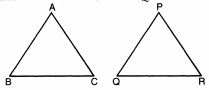
{tex}∆ABC\sim∆PQR{/tex}
and {tex}ar∆ABC=ar∆PQR{/tex}
To prove: {tex}∆ABC\cong∆PQR{/tex}
Proof: {tex}∆ABC\sim∆PQR{/tex}
Also {tex}\operatorname { ar } ( \Delta A B C ) = \operatorname { ar } ( \Delta P Q R ){/tex} (given)
or, {tex}\frac { \operatorname { ar } ( \Delta A B C ) } { \operatorname { ar } ( \Delta P Q R ) } = 1{/tex}
Or {tex}\frac{AB^2}{PQ^2}=\frac{BC^2}{QR^2}=\frac{CA^2}{RP^2}=1{/tex}
Or {tex}\frac{AB}{PQ}=\frac{BC}{QR}=\frac{CA}{RP}=1{/tex}
Hence we get that
AB=PQ,BC=QR and CA=RP
Hence {tex}∆ABC\cong ∆PQR{/tex}
0Thank You