Let A (x1, y1), B (x2, y2) and C (x3, y3) be the vertices of {tex}\triangle{/tex}ABC.
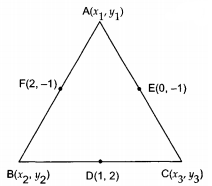
Let D (1, 2), E (0, -1), and F (2, -1) be the mid-points of sides BC, CA and AB respectively.
Since D is the mid-point of BC
{tex}\therefore \quad \frac { x _ { 2 } + x _ { 3 } } { 2 } = 1 \text { and } \frac { y _ { 2 } + y _ { 3 } } { 2 } = 2{/tex}
{tex}\Rightarrow{/tex}x2 + x3 = 2 and y2 + y3 = 4.............(i)
Similarly, E and F are the mid-points of CA and AB respectively.
{tex}\therefore \quad \frac { x _ { 1 } + x _ { 3 } } {2 } = 0 \text { and } \frac { y _ { 1 } + y _ { 3 } } { 2 } = - 1{/tex}
{tex}\Rightarrow{/tex}x1 + x3 = 0 and y1 + y3 = -2...........(ii)
and, {tex}\frac { x _ { 1 } + x _ { 2 } } { 2 } = 2 \text { and } \frac { y _ { 1 } + y _ { 2 } } { 2 } = - 1{/tex}
{tex}\Rightarrow{/tex}x1 + x2 = 4 and y1 + y2 = -2........(iii)
From (i), (ii) and (iii), we get
(x2 + x3) + (x1 + x3) + (x1 + x2)= 2 + 0 + 4:
and, (y2 + y3) + (y1 + y3) + (y1 + y2) =4 - 2 -2
{tex}\Rightarrow{/tex} 2(x1 + x2 + x3) = 6 and 2 (y1 + y2 + y3) = 0........(iv)
{tex}\Rightarrow{/tex}x1 + x2 + x3 = 3 and y1 + y2 + y3 = 0
From (i) and (iv), we get
x1 +2 = 3 and y1 + 4 = 0
{tex}\Rightarrow{/tex} x1 = 1 and y1 = -4
So, the coordinates of A are (1,-4)
From (ii) and (iv), we get
x2 + 0 = 3 and y2 - 2 = 0
{tex}\Rightarrow{/tex}x2 = 3 and y2 = 2
So, coordinates of B are (3, 2)
From (iii) and (iv), we get
x3 + 4 = 3 and y3 - 2 = 0
{tex}\Rightarrow{/tex}x3 = -1 and y3=2
So, coordinates of C are (-1, 2)
Hence, the vertices of the triangle ABC are A (1, -4), B (3, 2) and C (-1,2).


 Test
Test



Sia ? 6 years, 6 months ago
Let A (x1, y1), B (x2, y2) and C (x3, y3) be the vertices of {tex}\triangle{/tex}ABC.

Let D (1, 2), E (0, -1), and F (2, -1) be the mid-points of sides BC, CA and AB respectively.
Since D is the mid-point of BC
{tex}\therefore \quad \frac { x _ { 2 } + x _ { 3 } } { 2 } = 1 \text { and } \frac { y _ { 2 } + y _ { 3 } } { 2 } = 2{/tex}
{tex}\Rightarrow{/tex}x2 + x3 = 2 and y2 + y3 = 4.............(i)
Similarly, E and F are the mid-points of CA and AB respectively.
{tex}\therefore \quad \frac { x _ { 1 } + x _ { 3 } } {2 } = 0 \text { and } \frac { y _ { 1 } + y _ { 3 } } { 2 } = - 1{/tex}
{tex}\Rightarrow{/tex}x1 + x3 = 0 and y1 + y3 = -2...........(ii)
and, {tex}\frac { x _ { 1 } + x _ { 2 } } { 2 } = 2 \text { and } \frac { y _ { 1 } + y _ { 2 } } { 2 } = - 1{/tex}
{tex}\Rightarrow{/tex}x1 + x2 = 4 and y1 + y2 = -2........(iii)
From (i), (ii) and (iii), we get
(x2 + x3) + (x1 + x3) + (x1 + x2)= 2 + 0 + 4:
and, (y2 + y3) + (y1 + y3) + (y1 + y2) =4 - 2 -2
{tex}\Rightarrow{/tex} 2(x1 + x2 + x3) = 6 and 2 (y1 + y2 + y3) = 0........(iv)
{tex}\Rightarrow{/tex}x1 + x2 + x3 = 3 and y1 + y2 + y3 = 0
From (i) and (iv), we get
x1 +2 = 3 and y1 + 4 = 0
{tex}\Rightarrow{/tex} x1 = 1 and y1 = -4
So, the coordinates of A are (1,-4)
From (ii) and (iv), we get
x2 + 0 = 3 and y2 - 2 = 0
{tex}\Rightarrow{/tex}x2 = 3 and y2 = 2
So, coordinates of B are (3, 2)
From (iii) and (iv), we get
x3 + 4 = 3 and y3 - 2 = 0
{tex}\Rightarrow{/tex}x3 = -1 and y3=2
So, coordinates of C are (-1, 2)
Hence, the vertices of the triangle ABC are A (1, -4), B (3, 2) and C (-1,2).
0Thank You