
In an equilateral triangle with side …

CBSE, JEE, NEET, CUET
Question Bank, Mock Tests, Exam Papers
NCERT Solutions, Sample Papers, Notes, Videos
Posted by Tushar Yadav 6 years, 5 months ago
- 1 answers
 Test
Test
Related Questions
Posted by Vanshika Bhatnagar 1 year, 4 months ago
- 2 answers
Posted by Kanika . 1 month ago
- 1 answers
Posted by Sahil Sahil 1 year, 4 months ago
- 2 answers
Posted by Hari Anand 6 months, 1 week ago
- 0 answers
Posted by Parinith Gowda Ms 3 months, 2 weeks ago
- 1 answers
Posted by Parinith Gowda Ms 3 months, 2 weeks ago
- 0 answers
myCBSEguide
Trusted by 1 Crore+ Students

Test Generator
Create papers online. It's FREE.

CUET Mock Tests
75,000+ questions to practice only on myCBSEguide app

Sia ? 6 years, 5 months ago
According to the question, we have to prove that in an equilateral triangle with side a, area = {tex}\frac { \sqrt { 3 } } { 4 } a ^ { 2 }{/tex}
Let {tex}\triangle{/tex}ABC be an equilateral triangle with side a.
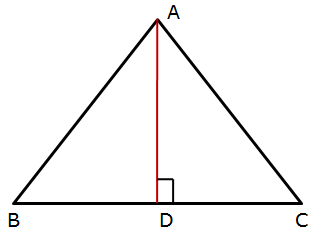
Then, AB = AC = BC = a.
Draw AD{tex}\perp{/tex}BC.
In {tex}\triangle{/tex}ADB and {tex}\triangle{/tex}ADC, we have
AB = AC ({tex}\Delta ABC{/tex} equilateral triangle)
{tex}\angle{/tex}ADB= {tex}\angle{/tex}ADC = 90° (AD is altitude)
AD = AD (Common)
{tex}\therefore \Delta A D B \cong \triangle A D C{/tex} [ RHS Congurency rule]
{tex}\therefore{/tex} BD = DC = {tex}\frac { a } { 2 }{/tex}
From right {tex}\triangle{/tex}ADB, we have
AB2 = AD2 + BD2 (By Pythagoras theorem)
{tex}\Rightarrow{/tex} AD = {tex}\sqrt { A B ^ { 2 } - BD ^ { 2 } }{/tex}
{tex}\Rightarrow A D = \sqrt { a ^ { 2 } - \left( \frac { a } { 2 } \right) ^ { 2 } }{/tex}
{tex}\Rightarrow A D = \sqrt { a ^ { 2 } - \frac { a ^ { 2 } } { 4 } }{/tex}
{tex}\Rightarrow A D = \sqrt { \frac { 3 a ^ { 2 } } { 4 } }{/tex}
So, the altitude is, AD = {tex}\frac { \sqrt { 3 } a } { 2 }{/tex}
Area of {tex}\triangle{/tex}ABC = {tex}\frac { 1 } { 2 } \times B C \times A D{/tex}
{tex}= \frac { 1 } { 2 } \times a \times \frac { \sqrt { 3 } a } { 2 }{/tex}
{tex}= \frac { \sqrt { 3 } a ^ { 2 } } { 4 }{/tex}
Hence proved.
0Thank You