
Ask questions which are clear, concise and easy to understand.
Ask QuestionPosted by Triloki Shrivastav 6 years, 10 months ago
- 2 answers
Posted by Rupesh Sharma 6 years, 10 months ago
- 3 answers
Yogita Ingle 6 years, 10 months ago
CaC2 is a chemical compound with chemical name Calcium Carbide. It is also called calcium acetylide or phenylglyceryl ether diacetate or glycerol phenyl ether diacetate. Calcium Carbide in its pure form appears as a colorless crystalline solid and is a rock-like structure at room temperature.
Posted by Prashant Bisht 6 years, 10 months ago
- 0 answers
Posted by Mursaleen Ansari 6 years, 10 months ago
- 0 answers
Posted by Ronak Abhi 6 years, 11 months ago
- 0 answers
Posted by Kunal Gupta 6 years, 11 months ago
- 0 answers
Posted by Pravesh Singh Negi 6 years, 11 months ago
- 1 answers
Posted by Anjali Thapa 6 years, 11 months ago
- 0 answers
Posted by Ajay Kandi 6 years, 11 months ago
- 1 answers
Yogita Ingle 6 years, 11 months ago
- Exchange of gases takes place between the alveoli of lungs and the surrounding blood capillaries. The two main gases exchanged are oxygen and carbon-dioxide. Oxygen is absorbed by the blood capillaries from the lungs alveoli by diffusion while carbon-dioxide is absorbed by the lungs alveoli from blood capillaries by diffusion.
- Transport of oxygen and carbon-dioxide occurs with the help of respiratory pigment called hemoglobin.
- Hemoglobin, the iron containing respiratory pigment is a red colored pigment of blood, which has a very high affinity for oxygen. Hemoglobin though is purple colored but oxy-hemoglobin is of bright red color. Oxygen is transported from lungs to the body cells in the form of oxy-hemoglobin.
- Carbon-dioxide is transported from the body cell to the lungs in the forms of carboxy-hemoglobin, carbonic acid, bicarbonates of sodium and potassium.
Posted by Ajeet Singh 6 years, 11 months ago
- 2 answers
Palak Tyagi 6 years, 6 months ago
Yogita Ingle 6 years, 11 months ago
- Forests are large regions of land covered with tree, shrubs, herbs. It sustains a variety of life forms.
- Naturally occurring plants and animals are the flora and fauna of the forests.
- Forests are biodiversity hotspots.
- The loss of forests and wild life leads to the ecological imbalance.
- Hence, it is important to conserve forests and wild life.
Posted by Alfiya Kids Footwear 6 years, 11 months ago
- 1 answers
Posted by Abhinav Abhi 6 years, 11 months ago
- 0 answers
Posted by Paras Kandpal 6 years, 11 months ago
- 0 answers
Posted by Rakesh Verma 6 years, 11 months ago
- 0 answers
Posted by Tenzin Kunsang 6 years, 11 months ago
- 1 answers
Posted by Saurabh S.L.K 6 years, 11 months ago
- 2 answers
Saniya Rawat 4 years ago
Tanuja Patwal 5 years, 6 months ago
Posted by Saurabh S.L.K 6 years, 11 months ago
- 1 answers
Tanuja Patwal 5 years, 6 months ago
Posted by Ghazanfar Ali 6 years, 11 months ago
- 2 answers
Gaurav Seth 6 years, 11 months ago
ओम का नियम
परिभाषा : नियत ताप पर ओम के नियम के अनुसार, एक चालक से गुजरने वाली धारा चालक पर विभवांतर के सीधे समानुपाती होती है।
इस तरह से, यदि एक चालक से प्रवाहित धारा I है और V तार पर विभवांतर (या वोल्टता) है, तब ओम के नियम के अनुसार,
I ∝ V (जब T नियत हो)
या, I = V/R ...(i)
जहाँ R एक नियतांक है, जिसे चालक का प्रतिरोध कहा जाता है।
समीकरण (i) को लिखा जा सकता है -
V = I x R ...(ii)
प्रतिरोध की इकार्इ :
प्रतिरोध (R) की SI इकार्इ ओम है। ओम को ग्रीक अक्षर ओमेगा (Ω) से प्रदर्शित किया जाता है।
ओम के नियम से, R = V/I
अब, यदि, V = 1 वोल्ट और I = 1 एम्पियर
तब, 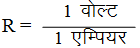
इस प्रकार, 1 ओम चालक का वह प्रतिरोध है जो इसमें से 1 एम्पियर धारा को प्रवाहित होने देता है जब इसके सिरो पर 1 वोल्ट विभवान्तर लगाए रखा जाता है।
ओम के नियम के परिणाम
एक चालक से प्रवाहित धारा चालक के सिरों पर लगाए गये विभवान्तर के सीधे समानुपाती होती है।

जब एक परिपथ में विभवान्तर नियत रखा जाता है, तो धारा चालक के प्रतिरोध के व्युत्क्रमानुपाती होती है।
I ∝ 1/R
विभवान्तर एवं धारा के मध्य अनुपात नियत रहता है। नियतांक का मान चालक (या प्रतिरोध) के प्रतिरोध पर निर्भर करता है।
V/I = R
Posted by Naijo Longjam 7 years ago
- 0 answers
Posted by Naijo Longjam 7 years ago
- 1 answers
Yugal Pathak 2 years, 5 months ago
Posted by Anmol Singh 7 years ago
- 0 answers
Posted by Reetu Reetu 7 years ago
- 1 answers
Posted by Manoj Kumar Sheth 7 years ago
- 1 answers
Yogita Ingle 7 years ago
- Monocots show fibrous root system whereas dicots show tap root system.
- Monocot leaves have parallel venation whereas dicot leaves have reticulate venation.
- Monocots have a single cotyledon in their seeds whereas dicots show 2 cotyledons in their seeds.
- The flowers of monocots are trimerous which means they have three or multiple of three petals. The flowers of dicots are pentamerous which means they possess five or multiple of five petals.
Posted by Manoj Kumar Sheth 7 years ago
- 0 answers
Posted by Muskan Shakil 7 years ago
- 1 answers
Posted by Geetanand Yadav 7 years ago
- 0 answers
Posted by 3 Idiots 7 years ago
- 1 answers
Rahul Rangher 6 years, 11 months ago
Posted by Gaurav Pal 7 years ago
- 1 answers
Posted by Aman Roy 7 years ago
- 0 answers
Posted by Suman Kumar 7 years ago
- 1 answers

myCBSEguide
Trusted by 1 Crore+ Students

Test Generator
Create papers online. It's FREE.

CUET Mock Tests
75,000+ questions to practice only on myCBSEguide app

Mr. Paras 6 years, 8 months ago
2Thank You