
Ask questions which are clear, concise and easy to understand.
Ask QuestionPosted by Nikhil Kumar 7 years ago
- 1 answers
Sonal Sonal 7 years ago
Posted by Sunita Tiwari 7 years ago
- 3 answers
Riddhi Dey 7 years ago
Aakriti Choudhary 7 years ago
Posted by Amardeep Prasad 7 years ago
- 0 answers
Posted by Prateek Madhav 7 years ago
- 1 answers
Posted by Akash Deep Singh 7 years ago
- 1 answers
Posted by Jaydeep Mathrani 7 years ago
- 1 answers
Gaurav Seth 7 years ago
Faraday’s laws of Induction
First law: -
- According to the first law an emf is induced in the circuit whenever the amount of magnetic flux linked with a circuit changes.
- Current was induced because of magnetic flux, as there is some current in the circuit therefore there will be some emf flowing in the circuit.
- Whenever the amount of magnetic flux linked with the circuit changes only at that time emf is induced.
- The induced emf will be there till there is change in the flux.
- When the magnet was moved then only there was change in the flux.
- As the magnet is moving the number of magnetic lines crossing the area is also changing.
- There is a change in the flux therefore there is induced emf.
- If the magnet is not moving, there will be no change in the amount of magnetic flux so there is no induced current.


Second law: -
- According to the second law the magnitude of the induced emf in a circuit is equal to the time rate of change of magnetic flux through the circuit.
- Emf which is induced will depend upon rate at which the magnetic flux is changing.
- Mathematically:-
- Let Φ1 = flux at initial time t=0.
- Φ2 = flux after time t.
- Rate of change of flux=(Φ2 – Φ1)/t =dΦ/dt
- According to Faraday’s law:-
- Induced emf e ∝ (dΦ/dt)
- Experimentally the constant of proportionality was found to be 1 in all cases.
- Therefore e=(dΦ/dt)
- Consider a coil which has N number of turns;Therefore
- e = N(dΦ/dt)
Posted by Ronald Hunter 7 years ago
- 1 answers
Posted by Vaibhav Singh Negi 7 years ago
- 2 answers
Vaibhav Singh Negi 7 years ago
Posted by Pragnya Mohalik 7 years ago
- 4 answers
Sonal Sonal 7 years ago
Ashok Kumar 7 years ago
Rahul Choudhary 7 years ago
Posted by Abc Kamboz 7 years ago
- 1 answers
Posted by Deepshikha Yadav 7 years ago
- 2 answers
Sonal Sonal 7 years ago
Vishali Raina 7 years ago
Posted by Mahi Yadav 7 years ago
- 4 answers
Chandan Kumar Soni 7 years ago
Posted by Kartheek Chowdary Vattkuti 7 years ago
- 1 answers
Sonal Sonal 7 years ago
Posted by Rahul Chaudhary 7 years ago
- 4 answers
Sonal Sonal 7 years ago
N Aaditya 7 years ago
Kartheek Chowdary Vattkuti 7 years ago
Posted by Lal Chand Bairwa 7 years ago
- 0 answers
Posted by Rahul Chaudhary 7 years ago
- 3 answers
Sonal Sonal 7 years ago
Kartheek Chowdary Vattkuti 7 years ago
Posted by Ayush Rawat 7 years ago
- 1 answers
Nitika Neb 7 years ago
Posted by Seetaram Patel Patel 7 years ago
- 0 answers
Posted by Yashwanth Venkat 7 years ago
- 1 answers
Yashwanth Venkat 7 years ago
Posted by Sanya Bhatia 7 years ago
- 1 answers
Posted by Suhani Rana? 7 years ago
- 1 answers
Anuj Sharma 7 years ago
Posted by Suhani Rana? 7 years ago
- 1 answers
Gaurav Seth 7 years ago
Principle of a capacitor : A capacitor works on the principle that the capacitance of a conductor increase appreciably when an earthed conductor is brought near it. Thus a capacitor has two plates separated by a distance having equal and opposite charges.
Parallel Plate capacitor : Consider a parallel plate capacitor having two plane metallic plates A and B, placed parallel to each other (fig) The plates carry equal and opposite charges +Q and -Q respectively.
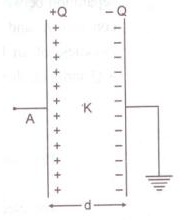
In general, the electric field between the plates due to charges +Q and -Q remains uniform, but at the edges, the electric lines of force deviate outward. If the separation between the plates is much smaller than the size of plates, the electric field strength between the plates may be assumed uniform.
Suppose A be the area of each plate, ‘d" the separation between the plates, K the dielectric constant of medium between the plates. If is the magnitude of charge density of plates, then
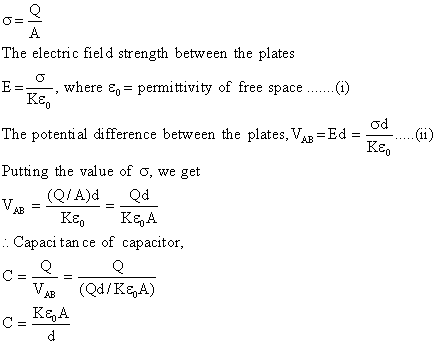
This is a general expression for capacitance of parallel plate capacitor. Obviously, the capacitance is directly proportional to the dielectric constant of medium between the plates.

Plate air capacitor. Obviously, the capacitance of parallel plate (air) capacitor is :
(a) directly proportional to the area of each plate.
(b) inversely proportional to the distance between the plates.
(c) independent of metal of plates
Posted by Ankit Sharma 5 years, 10 months ago
- 0 answers

myCBSEguide
Trusted by 1 Crore+ Students

Test Generator
Create papers online. It's FREE.

CUET Mock Tests
75,000+ questions to practice only on myCBSEguide app
