
Ask questions which are clear, concise and easy to understand.
Ask QuestionPosted by Naaz Khan 6 years, 4 months ago
- 0 answers
Posted by Naaz Khan 6 years, 4 months ago
- 1 answers
Posted by Naaz Khan 6 years, 4 months ago
- 2 answers
Raghav Patidar 6 years, 4 months ago
Raman Brar 6 years, 4 months ago
Posted by Naaz Khan 6 years, 4 months ago
- 1 answers
Sia ? 6 years, 4 months ago
A metallic object is charged by bringing a charged object near it.
Posted by Naaz Khan 6 years, 4 months ago
- 1 answers
Najma Shaheen 6 years, 4 months ago
Posted by Subham Yadav 6 years, 4 months ago
- 0 answers
Posted by Mayank Nigam 6 years, 4 months ago
- 2 answers
Saurabh Singh 6 years, 4 months ago
Posted by Zubair Khan 6 years, 4 months ago
- 1 answers
Posted by Siddhartha Singh 6 years, 4 months ago
- 5 answers
Řøhăň Řąjpůť ✌️✊ 6 years, 4 months ago
Posted by Vipin Choudhary 6 years, 4 months ago
- 5 answers
Posted by Arun Gamit 6 years, 4 months ago
- 1 answers
Pankaj Kumar 6 years, 4 months ago
Posted by Palak Upadhyay 6 years, 4 months ago
- 1 answers
Posted by Aradhya Trivedi 6 years, 4 months ago
- 1 answers
Řøhăň Řąjpůť ✌️✊ 6 years, 4 months ago
Posted by Sagar Gujjar 6 years, 4 months ago
- 1 answers
Manasi Jain 6 years, 4 months ago
Posted by Aakash Verma 6 years, 4 months ago
- 5 answers
Řøhăň Řąjpůť ✌️✊ 6 years, 4 months ago
Nishu Godara 6 years, 4 months ago
Posted by Aakash Verma 6 years, 4 months ago
- 1 answers
Gaurav Seth 6 years, 4 months ago
A wavefront is an imaginary surface over which an optical wave has a constant phase. The shape of a wavefront is usually determined by the geometry of the source.
Huygen's principle:
(i) Every point on a given wavefront acts as a fresh source of secondary wavelets which travel in all directions with the speed of light.
(ii) The forward envelope of these secondary wavelets gives the new wavefront at any instant.
Laws of reflection by Huygen's principle:
Let, PQ be reflecting surface and a plane wavefront AB is moving through the medium (air) towards the surface PQ to meet at the point B.
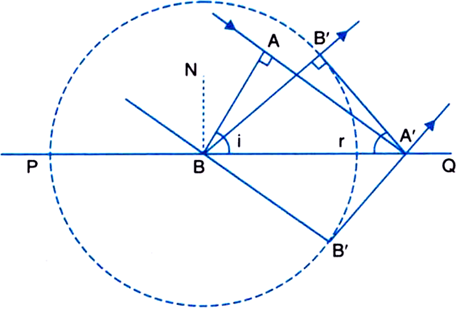
Let, c be the velocity of light and t be the time taken by the wave to reach A' from A.
Then, AA' = ct.
Using Huygen's principle, secondary wavelets starts from B and cover a distance ct in time t and reaches B'.
To obtain new wavefront, draw a circle with point B as centre and ct (AA' = BB') as radius. Draw a tangent A'B' from the point A'.
Then, A'B' represents the reflected wavelets travelling at right angle. Therefore, incident wavefront AB, reflected wavefront A'B' and normal lies in the same plane.
Consider ∆ABA' and B'BA'
AA' = BB' = ct [∵ AA' = BB' = BD = radii of same circle]
BA' = BA' [common]
∠BAA' = ∆BB'A' [each 90°]
∴ ∆ABA' ≅ ∠DBA' [by R.H.S]
∠ABA' = ∠B'A'B [corresponding parts of congruent triangles]
∴ incident angle i = reflected angle r
i.e., ∠i = ∠r
Posted by Sagar Baghel 6 years, 4 months ago
- 1 answers
Posted by Faraz Shahjahan 6 years, 4 months ago
- 1 answers
Sia ? 6 years, 4 months ago
A capacitor blocks DC as once it gets charged up to the input voltage with the same polarity then no further transfer of electrons can happen accept to replenish the slow discharge due to leakage if any. hence the flow of electrons which represents electric current is stopped.
Posted by Sunmeet Kaur Sachdeva 6 years, 4 months ago
- 2 answers
Gaurav Seth 6 years, 4 months ago
During sunrise, when the sun is just below the horizon, our atmosphere causes the light rays to bend and we see the sun early. Similarly, at sunset, the apparent position of the sun is visible to us and not the actual position due to the same bending of light rays effect.
To sum up, due to refraction we see the sun rise about two minutes before it’s actually there and during sunset we see it for around two minutes more, even though it has already moved from that position
Posted by Sundar Yadav 6 years, 4 months ago
- 1 answers
Gaurav Seth 6 years, 4 months ago
The object distance (u), image distance (v) and focal length (f).

The following sign convention is used for measuring various distances in the ray diagrams of spherical mirrors:
- All distances are measured from the pole of the mirror.
- Distances measured in the direction of the incident ray are positive and the distances measured in the direction opposite to that of the incident rays are negative.
- Distances measured above the principal axis are positive and that measured below the principal axis are negative.
- ?

The figure shows an object AB at a distance u from the pole of a concave mirror. The image A1B1 is formed at a distance v from the mirror. The position of the image is obtained by drawing a ray diagram.
Consider the D A1CB1 and D ACB

[when two angles of D A1CB1 and D ACB are equal then the third angle 


But ED = AB

From equations (1) and (2)

If D is very close to P then EF = PF


But PC = R, PB = u, PB1 = v, PF = f
By sign convention
PC = -R, PB = -u, PF = -f and PB1 = -v
 Equation (3) can be written as


Dividing equation (4) throughout by uvf we get


Posted by Ankit Kashyap 6 years, 4 months ago
- 2 answers
Vivekanand Yadav 6 years, 4 months ago
Nitish Mahto 6 years, 4 months ago
Posted by Abhilasha Kumari 6 years, 4 months ago
- 0 answers
Posted by Vivek Yadav Abd Yadav 6 years, 4 months ago
- 2 answers
Gursharn Kaur 6 years, 4 months ago
Posted by Param Sidhu 6 years, 4 months ago
- 2 answers
Posted by Prabhu Rathod 6 years, 4 months ago
- 4 answers
Posted by Prabhu Rathod 6 years, 4 months ago
- 2 answers

myCBSEguide
Trusted by 1 Crore+ Students

Test Generator
Create papers online. It's FREE.

CUET Mock Tests
75,000+ questions to practice only on myCBSEguide app
