
Ask questions which are clear, concise and easy to understand.
Ask QuestionPosted by Harish Sekar 5 years, 4 months ago
- 1 answers
Posted by Anand Jha 5 years, 4 months ago
- 0 answers
Posted by Arpit Pandey 5 years, 4 months ago
- 1 answers
Ovais Dar 5 years, 4 months ago
Posted by Maahi Anand 5 years, 4 months ago
- 0 answers
Posted by Gungun Bansal 5 years, 4 months ago
- 1 answers
Devil ? 5 years, 4 months ago
Posted by Harshita Garg 5 years, 4 months ago
- 2 answers
Harshita Garg 5 years, 4 months ago
Posted by Aryan Choudhary ?? 5 years, 4 months ago
- 2 answers
Meghna Thapar 5 years, 4 months ago
p H = 10
Using formula [H+] = 10-pH
So [H+] = 10-10 M
Electrode reaction will be
H+ + e- → ½ H2
Use the formula
Value of E0 = 0
Ecell = E0 - 0.0591 log[H2]
1 [H+]
Ecell = - 0.0591 log( 1/10-10)
1
Ecell = - 0.0591 ( 10) = -0.591 V
Posted by Nisha Yadav 5 years, 4 months ago
- 2 answers
Yogita Ingle 5 years, 4 months ago
Dow’s process is a method to prepare phenol. The reactant chlorobenzene is heated with aqueous sodium hydroxide at temperature 623K and 300atm to get sodium phenoxide ion. Then in the next step sodium phenoxide ion is treated with Dilute HCl which gives the final product as phenol.
Prince Maurya 5 years, 4 months ago
Posted by Anirudh Shukla 5 years, 4 months ago
- 2 answers
Gaurav Srivastav Gs 5 years, 4 months ago
Yogita Ingle 5 years, 4 months ago
Kolbe reaction, also known as Kolbe Schmitt Reaction is a type of addition reaction named after Hermann Kolbe and Rudolf Schmitt. When phenol is treated with sodium hydroxide, phenoxide ion is generated. The phenoxide ion generated is more reactive than phenol towards electrophilic aromatic substitution reaction. Hence, it undergoes electrophilic substitution reaction with carbon dioxide, which is a weak electrophile. Ortho-hydroxybenzoic acid (salicylic acid) is formed as the primary product. This reaction is popularly known as Kolbe’s reaction.
An example of the Kolbe reaction (Kolbe Schmitt Reaction) is given below:
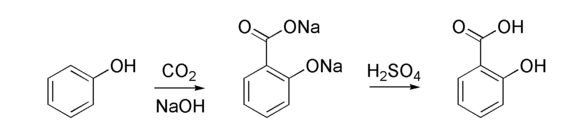
Kolbe’s Reaction – Treating phenol with sodium hydroxide generates phenoxide ion
Posted by Sandeep Ojha 5 years, 4 months ago
- 1 answers
Posted by Anisha Kabsuri 5 years, 4 months ago
- 1 answers
Sandeep Ojha 5 years, 4 months ago
Posted by Riya Babu 5 years, 4 months ago
- 1 answers
Yogita Ingle 5 years, 4 months ago
Bond angles in ammonia and ammonium ion.
The bond angles in ammonium ion, NH4+ are the theoretical tetrahedral bond angles of approximately 109.5 degrees. The ammonium ion is completely symmetrical.
The bond angles in the asymmetrical ammonia molecule are less than 109.5 degrees, they are about 107 degrees. This is due to the repulsion of the bonding pairs and the lone pair.
Posted by Aryan Verma 5 years, 4 months ago
- 0 answers
Posted by Riya Babu 5 years, 4 months ago
- 1 answers
Posted by Shailendra Singh 5 years, 4 months ago
- 1 answers
Vansh Prajapati 5 years, 4 months ago
Posted by Gaurav Srivastav Gs 5 years, 4 months ago
- 2 answers
Devil ? 5 years, 4 months ago
Posted by Lachhmi Pandey 5 years, 4 months ago
- 1 answers
Yogita Ingle 5 years, 4 months ago
Bond angles in ammonia and ammonium ion.
The bond angles in ammonium ion, NH4+ are the theoretical tetrahedral bond angles of approximately 109.5 degrees. The ammonium ion is completely symmetrical.
The bond angles in the asymmetrical ammonia molecule are less than 109.5 degrees, they are about 107 degrees. This is due to the repulsion of the bonding pairs and the lone pair.
Posted by Swetha.G Gajendran 5 years, 4 months ago
- 1 answers
Akanksha Kumari 5 years, 3 months ago
Posted by Ashish Yadav 5 years, 4 months ago
- 2 answers
Posted by Navneet Kaur 5 years, 4 months ago
- 4 answers
Mohit Thakur 5 years, 4 months ago
Vansh Prajapati 5 years, 4 months ago
Anuj Giri 5 years, 4 months ago
Posted by Aakash Pandey 5 years, 4 months ago
- 0 answers
Posted by Sandhya Bhandari 5 years, 4 months ago
- 3 answers
Posted by Abhishek Sharma 5 years, 4 months ago
- 3 answers
Posted by Naval Kushwah 5 years, 4 months ago
- 5 answers
Nitin Sharma 5 years, 4 months ago
Naval Kushwah 5 years, 4 months ago
Posted by Nikhil Negi 5 years, 4 months ago
- 4 answers
Nitin Sharma 5 years, 4 months ago
Posted by Nimisha N 5 years, 4 months ago
- 4 answers
Mahendra Rathor 5 years, 4 months ago
Bhawna Sangwan 5 years, 4 months ago
Posted by Manish Kumar 5 years, 4 months ago
- 2 answers
? Yang ? 5 years, 4 months ago
Yogita Ingle 5 years, 4 months ago
Primitive Unit Cells
If the constituent particles of a crystal lattice are present only on the corner positions of a unit cell, it is known as primitive unit cell.
Posted by Nancy Hooda 5 years, 4 months ago
- 0 answers

myCBSEguide
Trusted by 1 Crore+ Students

Test Generator
Create papers online. It's FREE.

CUET Mock Tests
75,000+ questions to practice only on myCBSEguide app

Sushmita Yadav 5 years, 4 months ago
0Thank You