
Ask questions which are clear, concise and easy to understand.
Ask QuestionPosted by Bablu Jyani Jyani 6 years, 10 months ago
- 3 answers
Sheeja Menon 6 years, 10 months ago
Posted by Mayank Pratap Singh 6 years, 10 months ago
- 3 answers
Posted by Sanjay Roy 6 years, 10 months ago
- 2 answers
Posted by Bablu Jyani Jyani 6 years, 10 months ago
- 2 answers
Posted by Bablu Jyani Jyani 6 years, 10 months ago
- 4 answers
Sudarshan Sharma 6 years, 10 months ago
Sudarshan Sharma 6 years, 10 months ago
Dindayal Rqthur 6 years, 10 months ago
Posted by Bablu Jyani Jyani 6 years, 10 months ago
- 1 answers
Bhavya Tiwari 6 years, 10 months ago
Posted by Bablu Jyani Jyani 6 years, 10 months ago
- 2 answers
Posted by Anindita Sahoo 6 years, 10 months ago
- 0 answers
Posted by Saurav Yadav 6 years, 10 months ago
- 0 answers
Posted by Avneesh Tripathi 6 years, 10 months ago
- 1 answers
Sia ? 6 years, 10 months ago
N1V1 = N2V2 (N = Normality, V = Volume)
n1M1V1 = n2M2V2 (n = valence factory, M = Molarity)
For H2SO4, n1=2, M1=0.1
For NaOH, n2=1, M2=0.2,V2=0.03
2 x 0.1 x V1= 1 x 0.2 x 0.03
V1 = (1 x 0.2 x 0.03) / (2 x 0.1)
= 0.006 / 0.2
= 0.03
So, volume of HsSO4 is 0.03 L or 30mL
Posted by Anshu Yadav 6 years, 10 months ago
- 1 answers
Posted by Bharat Prajapati 6 years, 10 months ago
- 0 answers
Posted by Charita Pandey 6 years, 10 months ago
- 0 answers
Posted by Shivam Sharma 6 years, 10 months ago
- 2 answers
Posted by Khan Shab 6 years, 10 months ago
- 1 answers
Posted by Siddartha Laishram 6 years, 10 months ago
- 1 answers
Deepak Jindal 6 years, 10 months ago
Posted by Golden Hayong 6 years, 10 months ago
- 1 answers
Gaurav Seth 6 years, 10 months ago
Nucleophilic Substitution Reaction : A chemical reaction in which a stronger nucleophilic (electron rich group which loves +ve centre) substitutes a weaker nucleophile is called the nucleophilic substitution reaction. For example, CH3Br + OH→ CH3OH + Br is a nucleophilic substitution reaction.
In haloalkanes (R—X) the halogen is more electronegative than carbon. Thus, C—X bond is polarized as C +—X
+—X -. Therefore, a strong nucleophile (electron rich species) such as Z attacks the positively charged carbon atom and replaces weak nucleophile halogen from C—Z. Thus a new product is formed.

Posted by Aditya Mishra 6 years, 10 months ago
- 0 answers
Posted by ???. Pragati 6 years, 10 months ago
- 0 answers
Posted by Suraj Kulkarni 6 years, 10 months ago
- 1 answers
Posted by Shriya Sharma 6 years, 10 months ago
- 2 answers
Dindayal Rqthur 6 years, 10 months ago
Posted by Gautam Singh 6 years, 10 months ago
- 2 answers
Sinchana Malagond 6 years, 10 months ago
Posted by Salim Kushwaha 6 years, 10 months ago
- 0 answers
Posted by Om Kanr 6 years, 10 months ago
- 1 answers
Posted by Im Rohit 45 6 years, 10 months ago
- 1 answers
Gaurav Seth 6 years, 10 months ago
1) Optical Isomerism
Optical isomers are those two compounds with the same chemical formula such that their mirror images are not superimposable on each other. Depending on the direction they rotate the plane of polarised light in a polarimeter, we have two forms of optical isomers. They are:
- Dextro Isomer: This rotates to right.
- Laevo Isomer: This rotates to left.
2) Geometric Isomerism
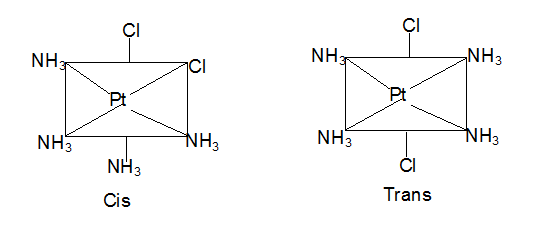
In case of disubstituted complexes, the substituted groups could either be adjacent or opposite to each other. This leads to geometric isomerism. Thus, we can prepare square planar complexes such as [Pt(NH3)4Cl2] in two forms, cis and trans. When the chlorine atoms are adjacent to each other, we get the cis form. While when two chlorine atoms are opposite, we get the trans-form.

myCBSEguide
Trusted by 1 Crore+ Students

Test Generator
Create papers online. It's FREE.

CUET Mock Tests
75,000+ questions to practice only on myCBSEguide app

Deepak Jindal 6 years, 10 months ago
0Thank You