
Ask questions which are clear, concise and easy to understand.
Ask QuestionPosted by Drishti Nahata 6 years, 7 months ago
- 7 answers
Ankana Saha 6 years, 7 months ago
Mehak Brar 6 years, 7 months ago
Posted by Satyaveer Singh 6 years, 7 months ago
- 1 answers
Yash Goswami????? 6 years, 7 months ago
Posted by Jk Verma 6 years, 7 months ago
- 2 answers
Khuskaran Sidhu 6 years, 7 months ago
Řøhăň Řąjpůť ✌️✊ 6 years, 7 months ago
Posted by Amol Gùpta 6 years, 7 months ago
- 0 answers
Posted by Vanshika Tripathi 6 years, 7 months ago
- 1 answers
Posted by Nikhil Chauhan 6 years, 7 months ago
- 1 answers
Yogita Ingle 6 years, 7 months ago
- Considering the Graph (1) the Cu2O line is at the top.
- So to reduce oxide ores of copper directly to the metal by heating with coke (both the lines of C, CO and C, CO2 are at much lower positions in the graph particularly after 500 – 600K).
- Most of the ores are sulphide and some may also contain iron. The sulphide ores
- are roasted/smelted to give oxides:
- 2Cu2S + 3O2 → 2Cu2O + 2SO2
- The oxide can then be easily reduced to metallic copper using coke:
- Cu2O + C → 2 Cu + CO
- In actual process, the ore is heated in a reverberatory furnace after mixing with silica. In the furnace, iron oxide ‘slags of’ as iron silicate and copper is produced in the form of copper matte. This contains Cu2S and FeS.
- FeO + SiO2 → FeSiO3 (Slag)
- Copper matte is then charged into silica lined convertor.
- Some silica is also added and hot air blast is blown to convert the remaining
- FeS2, FeO and Cu2S/Cu2O to the metallic copper.
- Following reactions take place:
- 2FeS + 3O2 → 2FeO + 2SO2
- FeO + SiO2 → FeSiO3 (6.38)
- 2Cu2S + 3O2 → 2Cu2O + 2SO2
- 2Cu2O + Cu2S → 6Cu + SO2
- The solidified copper obtained has blistered appearance due to the evolution of SO2 and so it is called blister copper.
- Following reactions take place:
- FeS2, FeO and Cu2S/Cu2O to the metallic copper.
Posted by Jk Verma 6 years, 7 months ago
- 3 answers
Bipen Singh 6 years, 7 months ago
Khuskaran Sidhu 6 years, 7 months ago
Gursharn Kaur 6 years, 7 months ago
Posted by Khushi Sinha 6 years, 7 months ago
- 3 answers
Posted by Kiran??? Gautam 6 years, 7 months ago
- 2 answers
K@Łp@N@ $Øđh!?? 6 years, 7 months ago
K@Łp@N@ $Øđh!?? 6 years, 7 months ago
Posted by Kiran??? Gautam 6 years, 7 months ago
- 8 answers
Khuskaran Sidhu 6 years, 7 months ago
Řøhăň Řąjpůť ✌️✊ 6 years, 7 months ago
Posted by K@Łp@N@ $Øđh!?? 6 years, 7 months ago
- 1 answers
Posted by K@Łp@N@ $Øđh!?? 6 years, 7 months ago
- 3 answers
Khuskaran Sidhu 6 years, 7 months ago
Řøhăň Řąjpůť ✌️✊ 6 years, 7 months ago
Posted by K@Łp@N@ $Øđh!?? 6 years, 7 months ago
- 3 answers
Řøhăň Řąjpůť ✌️✊ 6 years, 7 months ago
Posted by K@Łp@N@ $Øđh!?? 6 years, 7 months ago
- 2 answers
Řøhăň Řąjpůť ✌️✊ 6 years, 7 months ago
Posted by K@Łp@N@ $Øđh!?? 6 years, 7 months ago
- 0 answers
Posted by Jyoti Singh 6 years, 7 months ago
- 3 answers
Palak Tiwari 6 years, 7 months ago
K@Łp@N@ $Øđh!?? 6 years, 7 months ago
Posted by Parteek Kalia 6 years, 7 months ago
- 1 answers
K@Łp@N@ $Øđh!?? 6 years, 7 months ago
Posted by Shikhar Sinha 6 years, 7 months ago
- 3 answers
Shudhanshu Ranjan 6 years, 7 months ago
Khuskaran Sidhu 6 years, 7 months ago
Posted by Ankush Kumar 6 years, 7 months ago
- 1 answers
Posted by Pinki Kumari 6 years, 7 months ago
- 1 answers
Posted by Ravi Mishra 6 years, 7 months ago
- 2 answers
Sia ? 6 years, 7 months ago
To prepare phenol, cumene is first oxidized in the presence of air of cumene hydro-peroxide.

Then, cumene hydroxide is treated with dilute acid to prepare phenol and acetone as by-products.

Posted by Pooja Pandey 6 years, 7 months ago
- 2 answers
Gaurav Seth 6 years, 7 months ago
Oxygen is small in size and the lone pair of oxygen repel the bond pairs of O-O bond to larger extent than the lone pairs of sulphur in S-S bond. Sulphur naturally exists in nature as S8 molecules hence on heating this rings break and link jointly in to long chains making it have a greater tendency for catenation than oxygen.
Posted by Ravi Mishra 6 years, 7 months ago
- 9 answers
Posted by Hemant Maurya 6 years, 7 months ago
- 2 answers
Sia ? 6 years, 7 months ago
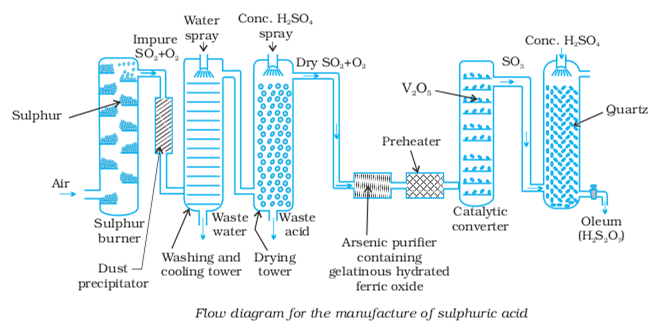
Contact process for sulphuric acid: The manufacturing process is completed in the following steps:
Step 1: Burning of either sulphur or iron pyrites in the air to give SO2
{tex}{S\; + {O_2} \to \;S{O_2}}{/tex}
{tex}{Fe{S_2}\; + 11{O_2}\; \to 2F{e_2}{O_3}\; + \;8S{O_2}}{/tex}
Step 2: Catalytic Conversion of SO2 to SO3 by reacting it with oxygen in presence of V2O5 as a catalyst.
{tex}2S{O_2} + {\text{ }}{O_2}\;\xrightarrow{{{V_2}{O_5}}}2S{O_3}{/tex} , {tex}\triangle H=\;-196.6\;KJ/mol{/tex}.
Step 3: Absorption of {tex}S{O_3}{/tex} in {tex}{H_2}S{O_4}{/tex} to give of oleum {tex}\left( {{H_2}{S_2}{O_7}} \right){/tex}
{tex}S{O_3} + {\text{ }}{H_2}S{O_4}\; \to {H_2}{S_2}{O_7}\left( {oleum} \right){/tex}
Step 4: Dilution of oleum with water to get off the H2SO4 desired concentration
{tex}{H_2}{S_2}{O_7} + {H_2}O \to 2{H_2}S{O_4}{/tex}
Nishu Goyal 6 years, 7 months ago
Posted by Utsav Anand 6 years, 7 months ago
- 7 answers
Sandeep Tyagi Sandeep Tyagi 6 years, 7 months ago
Shruti Kamal 6 years, 7 months ago
Posted by Utsav Anand 6 years, 7 months ago
- 1 answers
Posted by Barinder Singh 6 years, 7 months ago
- 1 answers
Shruti Kamal 6 years, 7 months ago

myCBSEguide
Trusted by 1 Crore+ Students

Test Generator
Create papers online. It's FREE.

CUET Mock Tests
75,000+ questions to practice only on myCBSEguide app

Bipen Singh 6 years, 7 months ago
0Thank You