
Ask questions which are clear, concise and easy to understand.
Ask QuestionPosted by Pinki Yadav 7 years, 1 month ago
- 1 answers
Posted by Fardeen Khan 7 years, 1 month ago
- 1 answers
Vansh Rastogi 7 years, 1 month ago
Posted by Fardeen Khan 7 years, 1 month ago
- 0 answers
Posted by Shail Gupta 7 years, 1 month ago
- 0 answers
Posted by Anju Sibal 7 years, 1 month ago
- 0 answers
Posted by Waquar Yunus 7 years, 1 month ago
- 0 answers
Posted by Mayank Mittal 7 years, 1 month ago
- 2 answers
Suryansh Sharma 7 years, 1 month ago
Honey 8 7 years, 1 month ago
Posted by Madan Batra 7 years, 1 month ago
- 1 answers
Gaurav Seth 7 years, 1 month ago
No, I do not agree with the given statement because supervision is an important function, which is to be performed for smooth functioning of an organisation. The importance of supervision can be understood by analyzing these points.
Importance of supervision :
- Maintains Contact
A supervisor maintains day-to-day contact and friendly relations with the workers. He guides and instructs them like a friend, philosopher and guide. - Acts as a Link
A supervisor acts as a link between workers and managers, as he conveys management ideas and instructions to the workers and workers’ grievances and suggestions to the managers. Thus, it helps to reduce conflicts and misunderstandings between the two groups. - Maintains Group Unity
A supervisor sorts out differences among workers in order to maintain group unity and harmony within the organisation. - Ensures Performance
A supervisor is responsible for the achievement of goals, for which he motivates his employees and ensures performance in the organisation. - Provides on-the-job Training
Through constant supervision and guidance, a supervisor provides on-the-job training to the workers. - Builds Morale
A supervisor helps to build high level of morale and motivates the employees through effective leadership and motivation. - Provides Feedback
A supervisor consistently analyses the work of subordinates and provides feedback by suggesting ways and means to develop new skills.
Posted by Kanishk Sharma 7 years, 1 month ago
- 0 answers
Posted by Harvinder Ahlawat 7 years, 1 month ago
- 1 answers
Posted by Gaganpreet Singh 7 years, 1 month ago
- 2 answers
Harvinder Ahlawat 7 years, 1 month ago
Gaurav Seth 7 years, 1 month ago
Meaning & Definition: Controlling involves comparison of actual performance with the planned performance. If there is any difference or deviation, then finding the reasons for such difference and taking corrective measures or action to stop those reasons so that they don‘t re-occur in future and that organizational objectives are fulfilled efficiently.
<hr />Controlling Process
1. Setting Performance Standards: Standards are the criteria against which actual performance would be measured. Thus standards become basis for comparison and the manager insists on following of standards.
2. Measurement of Actual Performance: Performance should be measured in an objective and reliable manner which includes personal observation, sample checking. Performance should be measured in same terms in which standards have been established, this will facilitate comparison.
3. Comparing Actual Performance with Standard: This step involves comparison of actual performance with the standard. Such comparison will reveal the deviation between actual and desired performance. If the performance matches the standards it may be assumed that everything is under control.
4. Analysing Deviations: The deviations from the standards are assessed and analysed to identify the causes of deviations.
5. Taking Corrective Action: The final step in the controlling process is taking corrective action. No corrective action is required when the deviation are within the acceptable limits. But where significant deviations occur corrective action is taken.
Posted by Namrata Deshpande 7 years, 1 month ago
- 2 answers
Honey 8 7 years, 1 month ago
Posted by Namrata Deshpande 7 years, 1 month ago
- 1 answers
Harvinder Ahlawat 7 years, 1 month ago
Posted by Amal Yas Krishna 7 years, 1 month ago
- 1 answers
Harvinder Ahlawat 7 years, 1 month ago
Posted by Niharika Sharma 7 years, 1 month ago
- 1 answers
Gaurav Seth 7 years, 1 month ago
Universal applicability of principles of management implies that these principles are equally applicable to all types of organisations irrespective of their size, ownership, functional area, etc. It is just that the extent of the applicability of these principles may vary from one organisation to another.
Posted by Adarsh Thakur 7 years, 1 month ago
- 0 answers
Posted by Harshu Rai 7 years, 1 month ago
- 1 answers
Vansh Rastogi 7 years, 1 month ago
Posted by Harshu Rai 7 years, 1 month ago
- 3 answers
Dheerendra Kalani 7 years, 1 month ago
Yogita Ingle 7 years, 1 month ago
- Quasi-Legislative Functions: These include drafting legislature with respect to the capital markets
- Quasi-Executive Functions: The implementation of the legislation also falls to SEBI. And when necessary they can conduct investigations as well about any wrongdoings.
- Quasi-Legal Functions: The SEBI also has the authority to conduct hearings and pass rulings and judgments.
Vansh Rastogi 7 years, 1 month ago
Posted by Vaidika Rawat 7 years, 1 month ago
- 1 answers
Shivam Gujjar 7 years, 1 month ago
Posted by Ishita Bhatt 7 years, 1 month ago
- 2 answers
Rahul Jain 7 years, 1 month ago
Waali Waseem 7 years, 1 month ago
Posted by Nancy Dhanda 7 years, 1 month ago
- 2 answers
Gaurav Seth 7 years, 1 month ago
1. Goal oriented Process It is a goal oriented process, which is to achieve already specified and desired objectives by proper utilization of available resources.
2. Pervasive: Management is universal in nature. It is used in all types of organizations whether economic, social or political irrespective of its size, nature and location and at each and every level.
3. Multidimensional: It is multidimensional as it involves management of work, people and operations.
4. Continuous: It consists of a series of function and its functions are being performed by all managers simultaneously. The process of management continues till an organization exists for attaining its objectives.
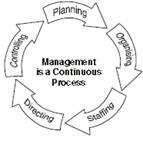
5. Group Activity: It is a group activity since it involves managing and coordinating activities of different people as a team to attain the desired objectives of the organization.
6. Dynamic function : It is a dynamic function since it has to adapt according to need, time and situation of the changing business environment. For example, McDonalds made major changes in its ‘Menu’ to survive in the Indian market.
7. Intangible Force: It is intangible force as it can’t be seen but its effects can be felt in the form of results like whether the objectives are met and whether people are motivated or not and there is orderliness and coordination in the work environment.
Rahul Jain 7 years, 1 month ago
Posted by Neha Jat 7 years, 1 month ago
- 2 answers
Shivam Gujjar 7 years, 1 month ago
Cbse Student 7 years, 1 month ago
Posted by Nifat Khan 7 years, 1 month ago
- 3 answers
Jnv Vines 7 years, 1 month ago
Vansh Rastogi 7 years, 1 month ago
Posted by Cbse Student 7 years, 1 month ago
- 7 answers
Vansh Rastogi 7 years, 1 month ago
Cbse Student 7 years, 1 month ago
Vansh Rastogi 7 years, 1 month ago
Posted by Ritik Gupta 7 years, 1 month ago
- 1 answers
Vansh Rastogi 7 years, 1 month ago
Posted by Raveena Purohit 7 years, 1 month ago
- 2 answers
Cbse Student 7 years, 1 month ago
Posted by Shashank Jaiswal 7 years, 1 month ago
- 1 answers

myCBSEguide
Trusted by 1 Crore+ Students

Test Generator
Create papers online. It's FREE.

CUET Mock Tests
75,000+ questions to practice only on myCBSEguide app

Lucifer Singh 7 years, 1 month ago
4Thank You