
Ask questions which are clear, concise and easy to understand.
Ask QuestionPosted by Akshay Engla 8 years, 8 months ago
- 1 answers
Sahdev Sharma 8 years, 8 months ago
Total distance S = 200+300= 500m
Initial velocity u = 3m/s
Final velocity v = 5 m/s
We know,
v2-u2 = 2as
=> 25-9= 1000a
=> a = {tex}{16\over 1000} m/s^2{/tex}
Again
v = u +at
=> 5 = 3+{tex}{16\over 1000}t{/tex}
=> t = {tex}{2\times 1000\over 16 }= 125s = 2 \ minutes \ 5 \ second{/tex}
Posted by Sumit Rana 8 years, 8 months ago
- 0 answers
Posted by Sanjana Mishra 8 years, 9 months ago
- 2 answers
Payal Singh 8 years, 8 months ago
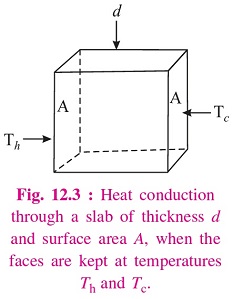
The quantity of heat Q transferred into the box from its one face
Q = {tex}KA(T_h–T_c)t\over d{/tex}
where K is thermal conductivity of thermocol.
= {tex}0.01×2500×10^{–4}×40º×5×60×60\over 4×10^{–2}{/tex} = 45000 J
As the box has six faces, total heat passing into the box Q = 45000 × 6 J = 270000 J
The mass m of ice melted= {tex} Q\over L {/tex} = {tex}270000\over 335{/tex} = 805.97 g
Sahdev Sharma 8 years, 8 months ago
The quantity of heat transferred into the box through its one face can be obtained by equation :
Q = {tex}KA (T_h –T_c ) t\over d {/tex} =
where K is thermal conductivity of thermocol.
A is area of one face of cube.
{tex}T_h \ is \ outside \ temperature{/tex}
{tex}T_c \ is \ inside \ temperature{/tex}
t is time and d is thickness.
So
= {tex} 0.01 × 2500 × 10^{–4} × 40º × 5 × 60 × 60 \over 4 × 10^{–2 }{/tex} = 45000 J
Since the box has six faces, total heat passing into the box Q = 45000 × 6 J
The mass of ice melted m, can be obtained by dividing Q by L :
m = Q/L ={tex}45000 × 6 \over 335{/tex} = 805.97 g
Posted by Sreedevi Ks 8 years, 9 months ago
- 1 answers
Aastha Pancholi 6 years, 5 months ago
Posted by Puneet Tyagi 8 years, 9 months ago
- 1 answers
Minakshi Kapoor 8 years, 9 months ago
At the highest point of a projectile, the vertical component of velocity is zero and the velocity is entirely horizontal. The direction of acceleration (due to gravity) is vertically downwards throughout the motion of the projectile. Therefore, the angle between the direction of acceleration and velocity at the highest point of a projectile is 90 °
Posted by Tanishka Jain 8 years, 9 months ago
- 2 answers
Sahdev Sharma 8 years, 9 months ago
Mass of car m = 2000 kg = 2{tex}\times 10^3 kg{/tex}
Initial velocity u = 40km/h = {tex}{40000\over 3600 }={100\over 9}m/s{/tex}
Distance to be covered before stopping s = 4m
Final velocity v = 0
We know
{tex}v^2-u^2= 2as{/tex}
=> {tex}{10^4\over 81}= 2a\times 4{/tex}
=> {tex}a = {1250\over 81}{/tex}m/s2
force applied = ma = {tex} {1250\over 81} \times 2000 = 30864.19\ N{/tex}
Payal Singh 8 years, 9 months ago
Initial velocity u = 40km/h = {tex}{40000\over 3600 }={100\over 9}m/s{/tex}
Distance to be covered before stopping s = 4m
Final velocity v = 0
We know
{tex}v^2-u^2= 2as{/tex}
=> {tex}{10^4\over 81}= 2a\times 4{/tex}
=> {tex}a = {1250\over 81}{/tex}m/s2
Mass of car m = 2000 kg
force applied = ma = {tex} {1250\over 81} \times 2000 = 30864.19\ N{/tex}
Posted by Pranshu Saini 8 years, 9 months ago
- 1 answers
Shweta Gulati 8 years, 9 months ago
m(A) = 12, m(B) = 5, m(C) = 13, where m(X) stands for magnitude of X.
A + B = C
squaring both sides,
A.A+ B.B + 2 A.B = C.C
note 'dot’ product i.e. A.A is equal to m(A)ˆ2.
=> m(A)ˆ2 + m(B)ˆ2 + 2 m(A)m(B)cos(ab) = m(C)ˆ2 , where ab is the angle between A and B.
Substituting the values in the above equation,
=> 144 + 25 + 60cos(ab) = 169
=> 169 + 60cos(ab) = 169
=> 60cos(ab) = 0
=> cos(ab) = 0
=> cos(ab) = cos(pi/2) or cos(90deg)
Posted by Umang Kumar 8 years, 9 months ago
- 1 answers
Arun Soni 8 years, 9 months ago
Here, {tex}V = 100 \pm 5V{/tex}and {tex}I = 10 \pm 0.2A{/tex}
Expressing limits of error as percentage error, we have
{tex}V = 100V \pm \frac{5}{{100}} \times 100 = 100V \pm 5\% {/tex}
{tex}I = 10A \pm \frac{{0.2}}{{100}} \times 100 = 10A \pm 2\% {/tex}
Now,{tex}R = \frac{V}{I}{/tex}
{tex}\therefore{/tex}% error in R=%error in V + % error in I
=5%+2%
=7%
{tex}\therefore{/tex}% error in R=7%
Posted by Umang Kumar 8 years, 9 months ago
- 0 answers
Posted by Saurav Kumar 8 years, 9 months ago
- 1 answers
Payal Singh 8 years, 9 months ago
Let’s first find the mean value of time:
{tex}t_{mean}={t_1+t_2+t_3+t_4\over 4}{/tex}
= {tex}{90+91+95+92\over 4}= 92 {/tex}
Then, we can find the absolute error for each measurement:
{tex}\Delta t_1=|t_{mean}-t_1|= |92-90|=2{/tex}
{tex}\Delta t_2=|t_{mean}-t_2|= |92-91|=1{/tex}
{tex}\Delta t_3=|t_{mean}-t_3|= |92-92|=0{/tex}
{tex}\Delta t_4=|t_{mean}-t_4|= |92-95|=3{/tex}
Let’s calculate the mean absolute error:
{tex}\Delta t_{mean}={ \Delta t_1+ \Delta t_2+ \Delta t_3+ \Delta t_4\over 4}{/tex}
= {tex}{2+1+0+3\over 4}= 1.5{/tex}{tex}\approx 2{/tex}
Therefore, the reported mean time should be 92 ± 2s
Posted by Harsh Vikram Singh 8 years, 9 months ago
- 1 answers
Saurav Kumar 8 years, 9 months ago
-
the tension of the surface film of a liquid caused by the attraction of the particles in the surface layer by the bulk of the liquid, which tends to minimize surface area.
Posted by Rohan P 8 years, 9 months ago
- 1 answers
Payal Singh 8 years, 9 months ago
In physics, a polar vector is a vector such as the radius vector r that reverses sign when the coordinate axes are reversed. Polar vectors are the type of vector usually simply known as "vectors." In contrast, pseudovectors (also called axial vectors) do not reverse sign when the coordinate axes are reversed. Examples of polar vectors include r, the velocity vector v, momentum p, and force F. The cross product of two polar vectors is a pseudovector
Posted by A P 8 years, 9 months ago
- 0 answers
Posted by Shaanthosh Shaanthosh 8 years, 9 months ago
- 1 answers
Payal Singh 8 years, 9 months ago
| Qualitative Analysis | Quantitative Analysis |
| Qualitative Analysis is used when the researcher wishes to analyze data that are subjective and not numerical. | In the quantitative analysis the data is analyzed through statistical means. |
| This focuses on descriptive data. | This focuses on numerical data. |
| This can be used to explore attitudes, behavior, nature of experience, etc. | This can be used for presenting percentages or any form of statistically significant data. |
Posted by Shaanthosh Shaanthosh 8 years, 9 months ago
- 1 answers
Payal Singh 8 years, 9 months ago
Two principles thrusts in the study of Physics are
- Unification which means explaining different physical phenomena by using few laws and concepts. Example: Electricity, magnetism and light are different phenomena and have different laws of physics for each of them. These are unified under theory of electromagnetism; all these three phenomena can be explained from this theory of electromagnetism.
- Reductionism which means explaining complex phenomena by breaking them into smaller constituents and studying simpler parts.
Example: A complex music can be broken down to simple sine waves so that we can make the music piece from the simple tones.
Posted by Uday Bhardwaj 8 years, 9 months ago
- 1 answers
Payal Singh 8 years, 9 months ago
let the initial velocity of football is u m/sec motion from ground to window
v=5m/sec
h=15m
v2 -u2 =2gh
=> 25 -u2 = 2*(-10)*15
=> u2=325
=u = {tex}\sqrt {325} = 5\sqrt{13}{/tex}m/s
A)motion from window to maximum height
v2-u2 = 2as
Here v is final velocity of ball = 0m/s
u is initial velocity of ball = 5m/s
a is acceleration due to gravity = -10 as it is going upward
s is distance traveled by it = ?
So,
=> 0 - 25 = 2*(-10)*h
=> -25 = -20h
=> h = {tex}{-25\over -20}= {5\over 4}{/tex}
Total height = 15 + {tex}{5\over 4} = {65\over 4}{/tex}m
B)motion from ground to max height
u= {tex}5\sqrt{13}{/tex}
v=0
v=u-gt
t={tex}{5\sqrt {13}\over 10}= {\sqrt {13}\over 2} sec{/tex}
Posted by Uday Bhardwaj 8 years, 9 months ago
- 1 answers
Arun Soni 8 years, 9 months ago
{tex}v = \frac{4}{a}{/tex}(Given)
{tex}\therefore a = \frac{{dv}}{{dt}} = \frac{4}{v}{/tex} -eqn (1)
{tex}\Rightarrow\int\limits_6^v {vdv} = \int\limits_2^t {4dt} {/tex}
{tex} \Rightarrow \frac{1}{2}{v^2} - 18 = 4t - 8{/tex}
{tex} \Rightarrow {v^2} = 18t + 20{/tex}
At t=3 sec,
v2=74
{tex}v = \pm \sqrt {74} {/tex}
Taking positive value of v
{tex}v = +6.63m/\sec {/tex}
Putting value of v in eq n (1)
{tex}a = \frac{4}{{6.63}} = 0.603m/{\sec ^2}{/tex}
Posted by Pfff Xy 8 years, 9 months ago
- 1 answers
Shweta Gulati 8 years, 9 months ago
A car in a steady turn has a centripetal acceleration. There is an inertial force associated with every acceleration acting in the opposite direction and in this case it is the centrifugal force. The friction at the tires arises as a centripetal force to match the centrifugal force.
Posted by Uday Bhardwaj 8 years, 9 months ago
- 1 answers
Payal Singh 8 years, 9 months ago
Let height of tower be 'h'
Time taken for 1st stone to reach ground = {tex}\sqrt{2h\over g}{/tex}
{tex}\left[ s = ut+ {1\over 2}at^2 ;h = {1\over 2}gt^2\right]{/tex}
Time taken for the first stone to be travel 5 m from top = {tex}\sqrt{2\times 5\over g}{/tex}
Time taken for 2nd stone to reach ground from a point (h−25)m above the ground = {tex}\sqrt{2(h-25)\over g}{/tex}
So,
{tex} \sqrt{2h\over g} -\sqrt{2\times 5\over g} = \sqrt{2(h-25)\over g}{/tex}
{tex}=> \sqrt{2h} -\sqrt{10} = \sqrt{2(h-25)}{/tex}
Squaring both sides
=> 2h + 10 - {tex}2\sqrt {20h}= {/tex}2h -50
=> {tex}\sqrt{20h} = 30{/tex}
Sqauring both sides
=> 20h = 900
=> h = 45
Posted by Gourav Pandey 8 years, 10 months ago
- 1 answers
Naveen Sharma 8 years, 10 months ago
Ans. The connection between physics, technology and society can be seen in many examples. The discipline of thermodynamics arose from the need to understand and improve the working of heat engines. The steam engine is inseparable from the Industrial Revolution in England in the eighteenth century, which had great impact on the course of human civilisation. Sometimes technology gives rise to new physics; at other times physics generates new technology
We can understand this by some examples :
- The wireless communication technology that followed the discovery of the basic laws of electricity and magnetism in the nineteenth century.
- Development of Alternative Energy Resources : A most significant area to which physics has and will contribute is the development of alternative energy resources. The fossil fuels of the earth are ending fast and there is an urgent need to discover new and affordable sources of energy. Considerable progress has already been made in this direction. For example : Conversion of solar energy, geothermal energy into electricity.
- Silicon Chip Technology : Yet another important example of physics giving rise to technology is the silicon chip, that triggered the computer revolution in the last three decades of the twentieth century.
Posted by Gourav Pandey 8 years, 10 months ago
- 0 answers
Posted by Gourav Pandey 8 years, 10 months ago
- 1 answers
Naveen Sharma 8 years, 10 months ago
Ans. The fact that we do not have a final theory in science is testament to our very limited understanding of the world around as well as within us. We do not have a complete sense of apprehension about most (if not all) of the various facets of science, like the following.
- what causes life?
- are we alone In space?
- what is the final number of elements in our universe ?
Many such questions plague the minds of scientists today and until all such queries are dealt with we will never have a full sense of everything. Now, even if we do happen to find the answers to everything then how do we now that there aren't any other questions left.
In other words do we even completely know what lies phenomena lies uncovered for us to decipher its mechanism. It seems almost impossible to demystify all of them, let alone the unknown stuff.
So, it might seem a bit pessimistic but it is almost certain that we will never have a final theory of science there are bound to be a few exceptions, but that is the fun of it all. The world would be a dull place without all its mysteries (for us to solve).
Posted by Gourav Pandey 8 years, 10 months ago
- 1 answers
Payal Singh 8 years, 10 months ago
Every experiment, calculation, result and prediction starts and ends with theory. Theory and experiment go hand in hand.
Theory makes predictions and motivate experiments. Experimental results are used to update, improve and validate the framework that scientists work within.
The models are reassessed under the light of the new data. The new information then comes full circle by helping to determine which experiments are conducted next. By knowing where the gaps in knowledge are – where theory needs more information – scientists can better decide which questions to ask and which experiments to run next.
Posted by Gourav Pandey 8 years, 10 months ago
- 0 answers
Posted by Gourav Pandey 8 years, 10 months ago
- 1 answers
Payal Singh 8 years, 10 months ago
- A hypothesis is a supposition without assuming that it is true. It would not fair to ask anybody to prove the universal law of gravitation, because it cannot be proved. It can be verified by experiments.
- An Axiom is self-evident truth
- A Model is a theory proposed to explain observed phenomena.
Posted by Gourav Pandey 8 years, 10 months ago
- 1 answers
Payal Singh 8 years, 10 months ago
Theory is a set of statements or principles devised to explain a group of facts or phenomena.
Most theories that are accepted by scientists have been repeatedly tested by experiments and can be used to make predictions about natural phenomena.

myCBSEguide
Trusted by 1 Crore+ Students

Test Generator
Create papers online. It's FREE.

CUET Mock Tests
75,000+ questions to practice only on myCBSEguide app
