
Ask questions which are clear, concise and easy to understand.
Ask QuestionPosted by Garima Pundir 5 years, 7 months ago
- 1 answers
Posted by Tanish Tomar 5 years, 7 months ago
- 2 answers
Posted by Nivaedithaa S 5 years, 7 months ago
- 2 answers
Posted by Athmapriya P 5 years, 7 months ago
- 1 answers
Gargi Aggarwal 5 years, 7 months ago
Posted by Athmapriya P 5 years, 7 months ago
- 1 answers
Gargi Aggarwal 5 years, 7 months ago
Posted by Unique #Seraj Ali ??? 5 years, 7 months ago
- 4 answers
Gaurav Seth 5 years, 7 months ago
Solution:
Let Ф = π/8
2Ф = π/4
tan 2Ф = 1 = 2 tan Ф / [ 1 - tan² Ф ]
1 - tan² Ф = 2 tan Ф
tan² Ф + 2 tan Ф - 1 = 0
tan Ф = 1/2 [ -2 +- √(4 +4) ] = -1 +- √2
tan π/8 is > 0
Therefore, tan π/8 = √2 - 1
Posted by Unique #Seraj Ali ??? 5 years, 7 months ago
- 4 answers
Vanshika Goyal 5 years, 7 months ago
Posted by Mansi Verma 5 years, 7 months ago
- 1 answers
Abhinandan Uday Mangla 5 years, 7 months ago
Posted by Aryan Kumar 5 years, 7 months ago
- 0 answers
Posted by Krish Joshi Joshi 5 years, 7 months ago
- 1 answers
Posted by Shakti Singh Rajput 5 years, 7 months ago
- 5 answers
Posted by Gauri Kumari 5 years, 7 months ago
- 0 answers
Posted by Vaishali ..... 5 years, 7 months ago
- 4 answers
Abhinandan Uday Mangla 5 years, 7 months ago
Jothi Prasath 5 years, 7 months ago
Yogita Ingle 5 years, 7 months ago
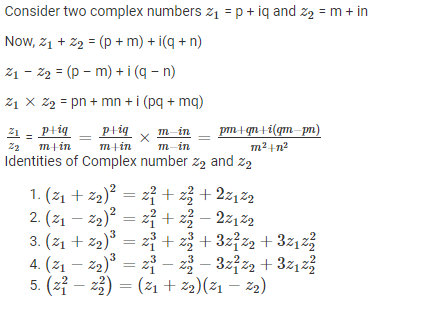
Complex Numbers Class 11 – A number that can be represented in form p + iq is defined as a complex number. [Where, p and q are real numbers and i=−1−−−√]. For a complex number z = p + iq, p is known as the real part, represented by Re z and q is known as the imaginary part represented by Im z of complex number z.
Posted by Debasis Panda 5 years, 7 months ago
- 3 answers
Dεερακ Ȿιηɠꜧ 5 years, 7 months ago
Abhinandan Uday Mangla 5 years, 7 months ago
Abhijeet Kharche 5 years, 7 months ago
Posted by Fardeen Malik 5 years, 7 months ago
- 1 answers
Posted by Puja Mohan 5 years, 7 months ago
- 3 answers
Posted by Vivek Mishra 5 years, 7 months ago
- 0 answers
Posted by Shreya Dubey 5 years, 7 months ago
- 0 answers
Posted by Mahima Choubey 5 years, 7 months ago
- 3 answers
Vivek Mishra 5 years, 7 months ago
Shreya Dubey 5 years, 7 months ago
Posted by Samarth Kapdi 5 years, 7 months ago
- 1 answers
Gaurav Seth 5 years, 7 months ago
</header>
Definition:
An equation involving one or more trigonometrical ratio of an unknown angle is called a trigonometrical equation

A trigonometric equation is different from a trigonometrical identities. An identity is satisfied for every value of the unknown angle e.g., cos2 x = 1 − sin2 x is true ∀ x ∈ R, while a trigonometric equation is satisfied for some particular values of the unknown angle.
(1) Roots of trigonometrical equation: The value of unknown angle (a variable quantity) which satisfies the given equation is called the root of an equation, e.g., cos θ = ½, the root is θ = 60° or θ = 300° because the equation is satisfied if we put θ = 60° or θ = 300°.
(2) Solution of trigonometrical equations: A value of the unknown angle which satisfies the trigonometrical equation is called its solution.
Since all trigonometrical ratios are periodic in nature, generally a trigonometrical equation has more than one solution or an infinite number of solutions. There are basically three types of solutions:
- Particular solution: A specific value of unknown angle satisfying the equation.
- Principal solution: Smallest numerical value of the unknown angle satisfying the equation (Numerically smallest particular solution).
- General solution: Complete set of values of the unknown angle satisfying the equation. It contains all particular solutions as well as principal solutions.
Trigonometrical equations with their general solution
| Trigonometrical equation | General solution |
| sin θ = 0 | θ = nπ |
| cos θ = 0 | θ = nπ + π/2 |
| tan θ = 0 | θ = nπ |
| sin θ = 1 | θ = 2nπ + π/2 |
| cos θ = 1 | θ = 2nπ |
| sin θ = sin α | θ = nπ + (−1)nα |
| cos θ = cos α | θ = 2nπ ± α |
| tan θ = tan α | θ = nπ ± α |
| sin2 θ = sin2 α | θ = nπ ± α |
| tan2 θ = tan2 α | θ = nπ ± α |
| cos2 θ = cos2 α | θ = nπ ± α |
| sin θ = sin α cos θ = cos α |
θ = nπ + α |
| sin θ = sin α tan θ = tan α |
θ = nπ + α |
| tan θ = tan α cos θ = cos α |
θ = nπ + α |
General solution of the form a cos θ + b sin θ = c

Posted by Arpit Yadav 5 years, 7 months ago
- 3 answers
Posted by Vaishu Sahu 5 years, 7 months ago
- 2 answers
Gaurav Seth 5 years, 7 months ago
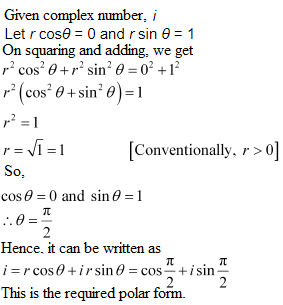
Given: 

 and
and 
Squaring both sides and adding both the equations, we get



 and
and 
 and
and 
[ lies in first quadrant]

Therefore, Polar form of  is
is 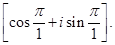
Posted by Aarohi Singh 5 years, 7 months ago
- 2 answers
Posted by Deepti Sahu Pcm 5 years, 7 months ago
- 2 answers
Posted by Siddharth Singhaniya 5 years, 7 months ago
- 3 answers
Aman Jha 5 years, 7 months ago
Sakshi Gupta Sakshi 5 years, 7 months ago
Posted by Nidhi Yadav 5 years, 7 months ago
- 0 answers
Posted by Karshan Kumar 5 years, 7 months ago
- 0 answers
Posted by Yash Chaudhary 5 years, 7 months ago
- 0 answers
Posted by Dhiraj G 5 years, 7 months ago
- 5 answers
Posted by Rahul Sheokand 5 years, 7 months ago
- 0 answers

myCBSEguide
Trusted by 1 Crore+ Students

Test Generator
Create papers online. It's FREE.

CUET Mock Tests
75,000+ questions to practice only on myCBSEguide app

Gargi Aggarwal 5 years, 7 months ago
1Thank You