
Ask questions which are clear, concise and easy to understand.
Ask QuestionPosted by Medhâvi Bhâtnâgar 8 years, 10 months ago
- 1 answers
Naveen Sharma 8 years, 10 months ago
Ans. yx = xy
Take log both side, we get
log yx = log xy
=> x log y = y log x
differentiate w.r.t x, we get
=> \(x {1\over y} {dy \over dx} + log y = y {1\over x} + log x {dy \over dx}\)
=> \( {x\over y} {dy \over dx} - log x {dy \over dx} = {y\over x} - log y\)
=> \(( {{x\over y} - log x} ) {dy \over dx} = {y\over x} - log y\)
=> \( {dy \over dx} = { ( { {y\over x} - log y } ) \over ( {{x\over y} - log x} )}\)
Posted by Tanay Joshi 8 years, 10 months ago
- 1 answers
Naveen Sharma 8 years, 10 months ago
Ans. Sn = 8( 1 + 11 + 111 + 1111 + ..... Upto n terms )
=> 8/9 (9 + 99 + 999 + 9999 + ……… upto n terms)
=> 8/9 [ (10-1) + (100-1) + (1000-1) + upto n terms]
=> 8/9 [ (10 + 100 + 1000 + ...... n terms ) -(1+ 1 + 1 + ………… n terms)]
=> 8/9 [ 10(10n -1)/ (10-1) - n ]
=> 8/9 [ 10(10n-1)/9 - n]
=> 80(10n -1) /81 - 8n/9
Posted by Sourav Keshri 8 years, 10 months ago
- 1 answers
Naveen Sharma 8 years, 10 months ago
Ans. f(x) = (x2+2x+1)/(x2-8x+12)
To find domain as the function is rational so its denominator must not be equal to zero(0).
x2-8x+12 = 0
=> x2-6x-2x+12=0
=> x(x-6)-2(x-6)=0
=> (x-6)(x-2)=0
=> x = 2,6
For these two values this function 'll become undefined. So domain = R - {2,6}
To Find Range:
Let f(x)=y
=> (x2+2x+1)/(x2-8x+12) = y
=> x2+2x+1 = yx2+
-8xy+12y
=> yx2-8xy +12y -x2-2x-1 =0
=> (y-1)x2 -(8y+2)x +(12y-1) = 0
Now D ≥ 0
=> b2 -4ac ≥ 0
=> (8y+2)2 - 4(y-1)(12y-1) ≥ 0
= (8y+2)2 ≥ 4(12y2 -13y +1)
=> 64y2 + 4 + 32y ≥ 48y2 -52y +4
=> 16y2 + 84y ≥ 0
divide by 4
=> 4y2 + 21y ≥ 0
=> y(4y+21) ≥ 0
=> y ≥ 0 and 4y +21 ≥ 0
y ≥ 0 and y ≥ -21/4
So domain = R - (-21/4, 0)
Posted by Sukriti Sharma 8 years, 10 months ago
- 1 answers
Rashmi Bajpayee 8 years, 10 months ago
2tan x - cot x + 1 = 0
2tan x - 1/tan x + 1 = 0
2tan2x - 1 + tan x = 0
2tan2x + tan x - 1 = 0
2tan2x + 2tan x - tan x - 1 = 0
2tan x(tan x + 1) - 1 (tan x + 1) = 0
(tan x + 1)(2tan x - 1) = 0
tan x + 1 = 0 or 2tan x - 1 = 0
tan x = -1 or tan x = 1/2
x = 3π/4, 7π/4 or x = 3.6052, 0.4636
Posted by Ritik Sharma 8 years, 10 months ago
- 2 answers
Rashmi Bajpayee 8 years, 10 months ago
Since the family of lines passing through the intersection of given lines is
(2x + 3y - 4) k(x - 5y + 7) = 0
This line meets x-axis i.e. y = 0, then
2x - 4 + k(x - 5y + 9) = 0
x = (4 - 7k)/(2 + k), which is the x-intercept.
Therefore, -4 = (4 - 7k)/(2 + k)
k = 4
Putting the value of k in the family equation
(2x + 3y - 4) + 4(x - 5y + 7) = 0
6x - 17y + 24 = 0, which is the required equation
Naveen Sharma 8 years, 10 months ago
Ans.
First we need to find intersection of the lines, For that solve these equation for x and y
multiply equation (2) by 2, We get
Subtract (1) from (3), we get
Put value of y in (1), we get
Let the Equation of line in intercept form is
as x intecept is -4 and point satisfies this equation.
putting all Values, we get
=>
=>
=>
So the Equation of line ll be
Posted by Arish Faraz 8 years, 10 months ago
- 1 answers
Shweta Gulati 8 years, 10 months ago
In that case, post the question along with your answer and we will give the correct explanation for your wrong answers.!
Posted by Divya Prakash 8 years, 10 months ago
- 1 answers
Naveen Sharma 8 years, 10 months ago
Ans. Infinity multiplied by zero is UNDEFINED. It is one of the 7 indeterminate forms in limits.
Posted by Jahanvi Malhotra 8 years, 10 months ago
- 1 answers
Rashmi Bajpayee 8 years, 10 months ago
Domain: If f : X Y is a function, then the set X is called the Domain and Y is called the co-domain of the function f.
Example: Find domain of the function
The given function is not defined at x = 5.
Therefore, Domain of the given function is R - {5}, where R is set of all real numbers.
Range: The set of second elements of the ordered pairs defining a function is called the Range of the function.
Example: Find the range of function
Now,
Clearly, x is not defined when y = 0.
Therefore, Range of given funciton is R - {0}.
Posted by Shivendu Shekhar 8 years, 11 months ago
- 1 answers
Posted by Sourav Kamboj 8 years, 11 months ago
- 1 answers
Posted by Manoj Mishra 8 years, 11 months ago
- 2 answers
Manish Gandhi 8 years, 11 months ago
Proper Subset is a subset of the set which is having the elemnts from the Main set but not all. It is 2n - 1 in numbers.
Non Empty Proper subsets are all the subsets excluding the "Empty Subset" i.e. { }. It is 2n - 2 in numbers.
For e.g. If A = {1,2} then the number of subsets it has is 2n where n represents the no. of elements in that set means A will have 22 = 4 subsets which are {1}, {2}, {1,2} & { } sets.
Now, here {1}, {2} & { } are the proper subsets & {1}, {2} are the non empty proper subsets.
Hope it clears better.
Naveen Sharma 8 years, 11 months ago
If A and B are two sets, then A is called the proper subset of B if A ⊆ B but B ⊇ A i.e., A ≠ B. The symbol ‘⊂’ is used to denote proper subset. Symbolically, we write A ⊂ B.
E.g
A = {1, 2, 3, 4}
Here n(A) = 4
B = {1, 2, 3, 4, 5}
Here n(B) = 5
We observe that, all the elements of A are present in B but the element ‘5’ of B is not present in A.
So, we say that A is a proper subset of B.
Symbolically, we write it as A ⊂ B
Posted by Divya Patel 8 years, 11 months ago
- 0 answers
Posted by Jayesh Aggarwal 8 years, 11 months ago
- 1 answers
Posted by Jayesh Aggarwal 8 years, 11 months ago
- 1 answers
Naveen Sharma 8 years, 11 months ago
The derivative of sin(x) from first principles.
Setting aside the limit for now, our first step is to evaluate the fraction with f(x) = sin x.
On the right hand side we have a difference of 2 sines, so we apply the formula in (A2) above:
Simplifying the right hand side gives:
Now to put it all together and consider the limit:
We make use of (3), fraction on a fraction, to bring that 2 out front down to the bottom:
Now, the limit of a product is the product of the limits, so we can write this as:
Now, the first limit is in the form of Limit of sin θ/θ that we met in (A1) above.
We know it has value 1.
For the right hand limit, we simply obtain cos x.
So we can conclude that
Posted by Amulya Chukka 9 years ago
- 1 answers
Shruti Dadhwal 9 years ago
The sum of cubes of even numbers is equal to 2 n^2 (n+1)^2
So 2^3+ 4^3+ 6^3 +........+2n^2 = 2n^2(n+1)^2
2 n^2 (n+1)^2 = k n^2 (n+1) ^2
Cancelling the common terms, we get
k=2
Posted by Mansi Goel 9 years ago
- 2 answers
Manish Gandhi 9 years ago
It is given that sum of n terms of an A.P. is 3n2 + 5n
=> S1 = 3(1)2 + 5(1) = 3 + 5 = 8 which will also be 1st term as "a1".
Further, S2 = 3 (2)2 + 5 (2) = 12 + 10 = 22
And, we know, a2 = S2 - S1 = 22 - 8 = 14.... So, d = a2 - a1 = 14 - 8 = 6
Now, it's given that am = 164 => a1 + (m - 1)d = 164
8 + (m - 1)6 = 164 => (m - 1)6 = 156 => (m - 1) = 26 => m = 27 (Answer)
Rashmi Bajpayee 9 years ago
According to question,
S1 = a = 3(1)2 + 5 x 1 = 8
S<font size="2">2</font> = 3(2)<font size="2">2</font> + 5 x 2 = 22 Then, a2 = S2 - S1 = 22 - 8 = 14
S<font size="2">3</font> = 3(3)<font size="2">2</font> + 5 x 3 = 42 Then, a<font size="2">3</font> = S<font size="2">3</font> - S<font size="2">2</font> = 42 - 22 = 22
Therefore, d = 14 - 8 = 6
Now, am = a + (m - 1)d = 164
=> 164 = 8 + (m - 1)6
=> 156 = (m - 1)6
=> 26 = m - 1
=> m = 27
Posted by Ishita Tomar 9 years, 1 month ago
- 1 answers
Naveen Sharma 9 years ago
In the expension of (1+X)n, T(r+1) = nCr Xr
Cofficient of (r+1)th term = nCr
So Cofficient of 5th, 6th and 7th term ll be nC4 nC5 nC6 respectivily
As it is given these terms are in AP
So, 2 * ( nC5 ) = nC4 + nC6
(2 * n! ) / { (n-5)! 5!} = (n! ) / { (n-4)! 4!} + (n! ) / { (n-6)! 6!}
i think you can proceed from here .
Posted by Ishita Tomar 9 years, 1 month ago
- 1 answers
Rashmi Bajpayee 9 years, 1 month ago
Given: b = (a + b)/2. ........(i)
And. c2 = bd ..........(ii)
And. d = 2ce/(c + e). ..........(iii)
Substituting values of b and d from eq.(i) and (iii), in eq.(ii),
c2 = {(a + c)/2} × {2ce/(c + e)}
c2 = (ace + c2e)/(c + e)
c3 = ace
c2 = ae
Posted by Ishita Tomar 9 years, 1 month ago
- 1 answers
Rashmi Bajpayee 9 years, 1 month ago
L.H.S. = [1/(ab)1/2+a] + [1/(ab)<font size="2">1/2</font>+b] = [1/a1/2(a1/2 + b1/2)] + [1/b<font size="2">1/2</font>(a<font size="2">1/2</font> + b<font size="2">1/2</font>)]
= (a1/2 + b1/2)/(ab)1/2(a<font size="2">1/2</font> + b<font size="2">1/2</font>)
= 1/(ab)1/2
= 1/g
= R.H.S.
Posted by Wasim Ansari 9 years, 1 month ago
- 1 answers
Rashmi Bajpayee 9 years, 1 month ago
L.H.S. = Cos(3π/4+x)-cos(3π/4-x)
= cos 3π/4 cos x - sin 3π/4 sin x - [cos 3π/4 cos x + sin 3π/4 sin x]
= cos 3π/4 cos x - sin 3π/4 sin x - cos 3π/4 cos x - sin 3π/4 sin x]
= -2sin 3π/4 sin x
= -2 x (1/√2) sin x
= -√2sin x
Posted by Kms Praveen 9 years, 1 month ago
- 1 answers
Manish Gandhi 9 years ago
Given: ( x + iy ) ( 3 – 4i ) = (5 + 12i )
Solution:
( x + iy ) = (5 + 12i ) ( 3 – 4i )
By Rationalization, ( x + iy ) = (5 + 12i ) ( 3 – 4i ) ( 3 + 4i ) ( 3 + 4i )
= (5 + 12i ) ( 3 + 4i ) ( 3 + 4i ) ( 3 - 4i )
= (15 + 36i + 20i + 48i2) 3^2 - (4i)2 {( 3 + 4i ) ( 3 - 4i ) = 32 - (4i)2 because (a+b)(a-b)=a2 - b2}
= (15 - 48 + 56i) 9 - 16i2 (48i^2 = -48 because i2 = -1)
= ( -33 + 56i) 9 +16
= ( -33 + 56i) 25
So, ( x + iy ) = -3325 + 56i25
And, ( x - iy ) = -3325 - 56i25
Now, ( x + iy )( x - iy ) = (-3325 + 56i25 ) (-3325 - 56i25 )
x2 + y2 = (-3325)2 - (56i25)2
= 1089625 - 3136 i2 625
= 1089625 + 3136 625
= 4225 625 = 6.76
Now Root of x2 + y2 means root of 6.76 = 2.6 (Answer)
Posted by Priyanshu Rawat 9 years, 2 months ago
- 1 answers
Naveen Sharma 9 years ago
The Binomial Theorem is a quick way (okay, it's a less slow way) of expanding (or multiplying out) a binomial expression that has been raised to some (generally inconveniently large) power.
Posted by Shalini Kumari 9 years, 2 months ago
- 1 answers
Naveen Sharma 9 years ago
total number of terms in expansion = (power of expression +1)
so in this expension total number of terms ll be 13 and middle term ll be 7th term
T7 = 12C6 ({x)2}6 (yx)6
Posted by Shalini Kumari 9 years, 2 months ago
- 1 answers
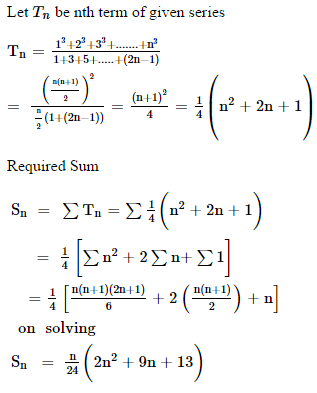
Posted by Madhu Mitha 9 years, 2 months ago
- 1 answers
Manish Gandhi 9 years ago
Given:
n (U) = 100, n (H - G - S) = 15, n (S - G - H) = 12, n (G - H - S) = 8, n (G H) = 40, n (G S) = 20, n (H S) = 10, n (G) = 65
Solution:
n(G) = n (G - H - S) + n (G H) + n (G S) - n (G S H)
65 = 8 + 40 + 20 - n (G S H)
n (G S H) = 68 - 65 = 3
Similarly, n (H) = n (H - G - S) + n (H S) + n (G H) - n (G S H)
n (H) = 15 + 10 + 40 - 3 = 65 - 3 = 62 (Answer to part a)
Similarly, n (S) = n (S - G - H) + n (H S) + n (G S) - n (G S H)
n (S) = 12 + 10 + 20 - 3 = 39 (Answer to part b)
Also, we know n (G S H) = n (G) + n (S) + n (H) - n (G S) - n (H S) - n (G H) + n (G S H)
n (G S H) = 65 + 39 + 62 - 20 - 10 - 40 + 3 = 169 - 70 = 99
Also, n (G S H) = n (U) - (G S H) = 100 - 99 = 1 (Answer to part c)
Posted by Mayank Shahabadee 9 years, 2 months ago
- 1 answers
Rashmi Bajpayee 9 years, 2 months ago
dx = sin x / 2cos2x = 1/2[sin x - sec2x] [By Product rule]
dx = 1/2[sin x.2sec x.sec x.tan x + sec2x.cos x]
dx = 1/2[sin x.2sec2x.tan x + sec x]
dx = (1/2) sec x[2sin2x.sec2x + 1] = (1/2) sec x[2tan2x + 1] = 1/(2cos x) [(2sin2x/cos2x) + 1]
dx = 1/(2cos3 x) [2sin2x + 1 - sin2x ] = 1/(2cos3 x) [sin2x + 1]

myCBSEguide
Trusted by 1 Crore+ Students

Test Generator
Create papers online. It's FREE.

CUET Mock Tests
75,000+ questions to practice only on myCBSEguide app
